
 Overnight on From the Bench with Margaret Callahan
Tucson Evangelist Takes City to Court for the Right to Share Christ at Christmas Festival
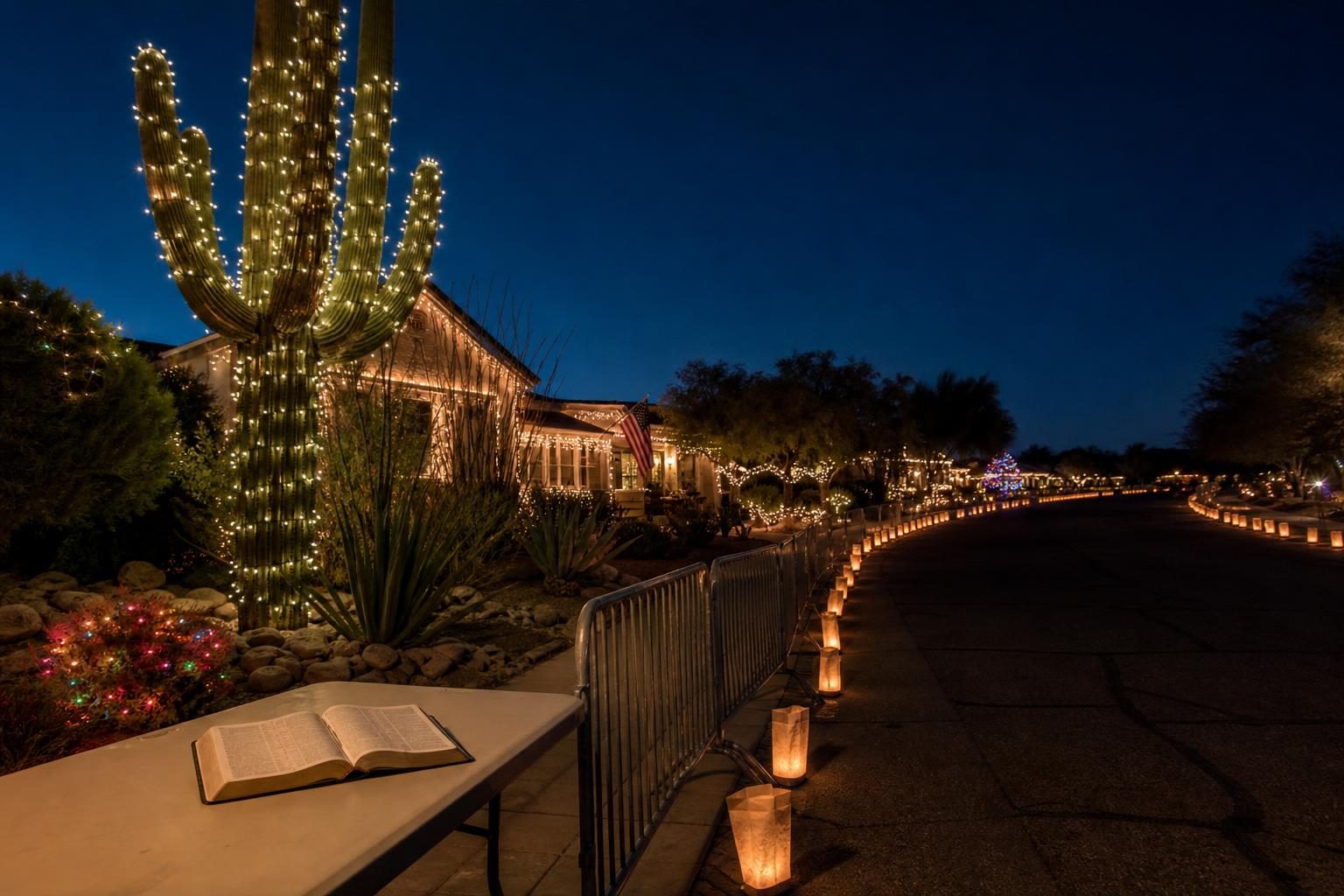
Street evangelist David Hoffman says police threatened to arrest him for talking about Jesus at Tucson's Winterhaven Festival of Lights, and First Liberty Institute is now asking a federal court to block the city's ban on religious messaging.
Filed November 14, 2026 · 📍 Tucson, AZ 85701
Were you there? Share your story
Key points
- Evangelist David Hoffman says Tucson police warned him he would be ticketed and arrested for preaching at the Winterhaven Festival of Lights in December 2025.
- A city event policy barred religious, political and issue-based leafleting, while vendors, performers and party bikes were allowed.
- First Liberty Institute and two law firms filed a federal lawsuit and injunction request in October 2026.
- Tucson says it cannot discuss pending litigation; no ruling has been reported.
A Tucson street evangelist says he was given a stark choice at his city's beloved Christmas lights festival last December: stop talking about Jesus or face arrest. David Hoffman told CBN News that officers approached his group at the Winterhaven Festival of Lights and warned that "if we continued within the event, we would be ticketed and arrested" [1]. Now, with the religious liberty law firm First Liberty Institute at his side, he is asking a federal court to make sure it does not happen again [1][4].
The city of Tucson has not addressed the merits of his complaint. A spokesperson for the City Manager's Office told the Arizona Daily Star that the city cannot discuss pending litigation [3], and the city gave Fox News a similar answer [2]. Hoffman told CBN that, so far, his side has received no answer or response from the city [1].
What happened at Winterhaven
According to First Liberty, Hoffman and friends were sharing their faith at the festival on Dec. 13, 2025, when police told them to stop, citing the event's solicitation policy [4]. The Arizona Daily Star reported that the city had adopted an event policy before the 2025 festival that barred religious, political and issue-based leafleting [3]. Fox News reported that, according to the lawsuit, officers described Hoffman's offer to discuss Jesus as "sermonizing" and warned he could face criminal trespass charges [2]. Four uniformed officers then escorted him away from the festival, the suit says [2][3].
Instead, officers pointed him to a designated "free expression zone" outside the festival perimeter [4]. First Liberty says the barricaded zone sat alongside a busy street, which made conversations with people walking by impractical [4]. Meanwhile, the group notes, commercial food vendors, live performers and 15-passenger pedal pub party bikes playing amplified music were permitted throughout the festival area [4].
First Liberty attorney Garrett Bell told CBN that 2025 was the first year the festival's city permit carried a free speech policy barring religious messaging or materials [1]. Bell added that Hoffman had attended the event many times before without incident [1].
The lawsuit and the law
Bell first sent the city a demand letter and then filed suit, according to CBN [1]. In October 2026, First Liberty and the law firms Gibson, Dunn & Crutcher and Holtzman Vogel filed a complaint and a motion for a preliminary injunction against the city [4]. The suit names Tucson and two police officers, the officers in their individual capacities [3][4]. It raises free speech and free exercise claims under the First Amendment, a due process claim under the Fourteenth Amendment, and claims under Arizona's constitution and state law [4]. Hoffman asks the court to let him share the gospel at this year's festival, to declare the policy unconstitutional, and to award nominal damages and attorneys' fees, the Star reported [3].
The legal backdrop gives speech on public streets strong protection. In McCullen v. Coakley, the 2014 case that struck down Massachusetts' 35-foot buffer zones around abortion clinics, the Supreme Court said public streets and sidewalks hold a "special position in terms of First Amendment protection" [5]. The justices said the government's power to restrict speech in such places is very limited, and even the content-neutral Massachusetts law failed because it was not narrowly tailored [5].
Closer to home, the Ninth Circuit, which covers Arizona, ruled in Gathright v. City of Portland (2006) against a Portland policy that let event permit holders remove people from public park events [6]. That case also involved an evangelical preacher ordered out and threatened with trespass arrest. The appeals court agreed the rule was not a valid time, place and manner restriction and stressed that letting permit holders exclude speakers simply because they dislike the message risks censorship [6].
To be fair to the city, governments may set reasonable, content-neutral rules for crowded public events, and those precedents recognize that [5][6]. The question for the court is whether a rule that singles out religious messaging, while welcoming vendors and party bikes, can fit that mold.
Why it matters and what comes next
There is a painful irony in a Christmas festival that has room for amplified party music but not for a quiet conversation about the One whose birth the season celebrates. Hoffman is not asking for special treatment. He is asking to stand on a public street and speak, the same freedom Americans have long exercised on sidewalks from courthouse steps to town squares.
The case remains at an early stage. Coverage so far reports no ruling on the injunction request, and the city has declined to discuss the case publicly [3]. Because Hoffman is seeking relief in time for this year's festival, the timing of the court's answer matters. For believers across the country who share their faith in public, how a federal judge in Arizona answers that question will be worth watching.
Sources
- [1]Opens in a new tab ↗
- [2]Opens in a new tab ↗
- [3]Arizona Daily StarTucson preacher sues over Winterhaven Festival limitsOpens in a new tab ↗
- [4]First Liberty InstituteDavid Hoffman - CasesOpens in a new tab ↗
- [5]Legal Information Institute (Cornell Law School)McCullen v. CoakleyOpens in a new tab ↗
- [6]Opens in a new tab ↗
Pope Leo XIV drew more than a million people in Argentina. Would you travel to see the pope?
- Absolutely
- Maybe, if he came to the U.S.
- No, but I'd watch on TV
- No
More in Faith & Religion
Maryland Synagogue Asks Appeals Court to Let Its Members Stay Protected on the Sabbath Walk to Prayer
Last night on Faith & Family with Ethan Calloway
U.S. Officials Tell Congress Nigeria Still Isn't Doing Enough to Protect Its Christians
Last night on From the Bench with Margaret Callahan
'Padre Roberto' Comes Home: Pope Leo XIV Returns to Chiclayo, the Peruvian Flock He Shepherded for Eight Years
Yesterday on From the Bench with Margaret Callahan
Were you there?
If you were at the scene, or this story touched your life, tell us what you saw and what it was like.
Discussion 0
Sign in or create a free account to join the discussion.
No comments yet. Start the discussion.