
 Tonight on The Hart of the Economy with Evelyn Hart
Diesel Squeeze Pushes Small Trucking Firms to the Brink as Holiday Costs Climb
Family-run trucking companies are slowing down, adding surcharges and selling rigs to survive diesel prices still far above prewar levels, and the costs are reaching Thanksgiving tables and holiday shopping lists.
Filed November 23, 2026 · 📍 St. Paul, MN 55102
Were you there? Share your story
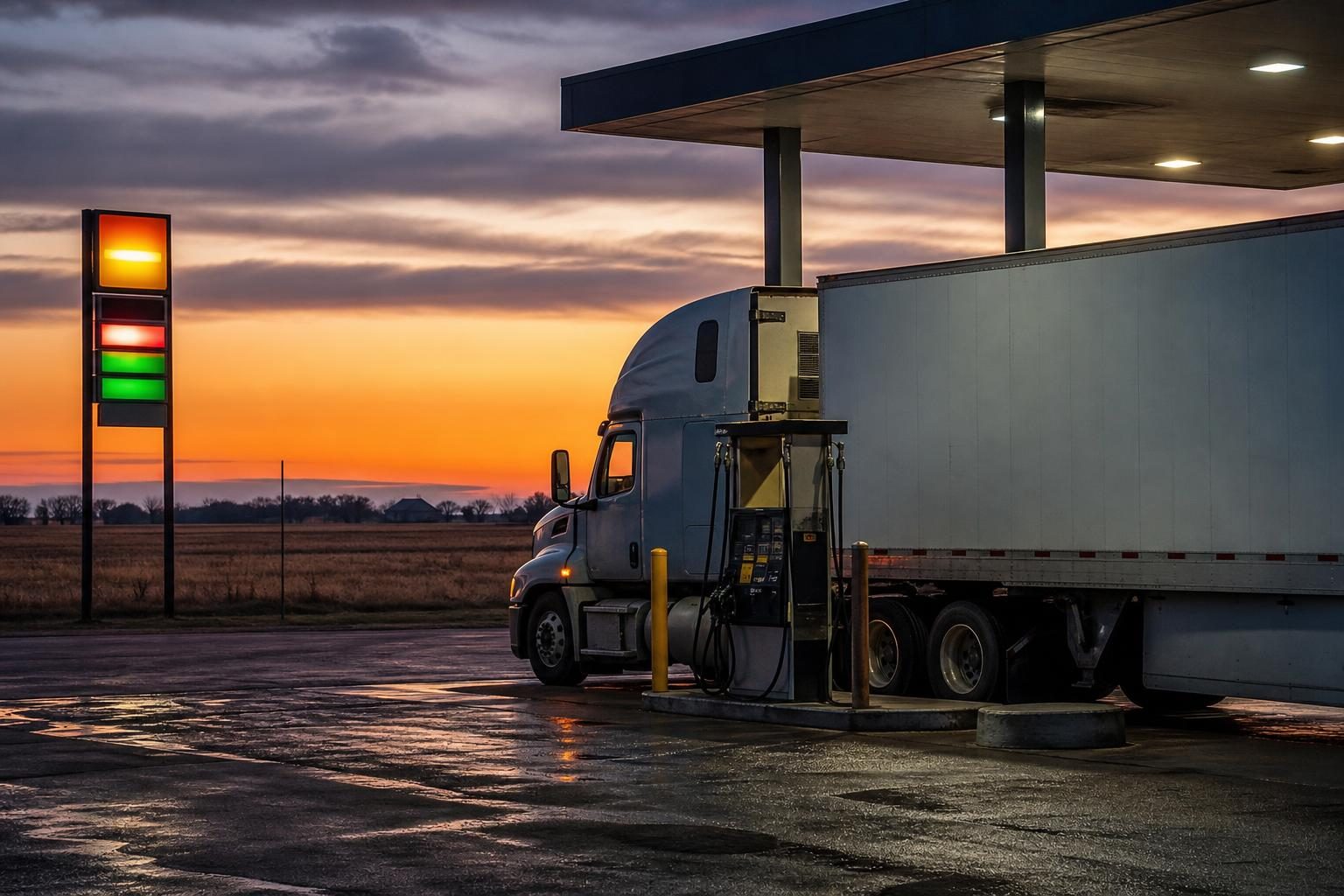
Key points
- Diesel averaged $5.94 a gallon for the week ending Nov. 16, still about 56% above prewar levels.
- Small carriers are slowing trucks, adding fuel surcharges and selling rigs to stay afloat.
- Trucking rates ran more than 47% above a year earlier in early November, per Evercore ISI data.
- Farm Bureau says diesel helped push the average Thanksgiving dinner for 10 up 6%, to $58.63.
When diesel first climbed past $4 a gallon early in the U.S.-Iran war, Minnesota trucker Kevin Otto figured he could ride it out by asking his 16 drivers to ease off the accelerator, the Associated Press reported in a story carried by the Washington Times [1]. Otto calculated that holding his flatbed fleet to 65 miles per hour would squeeze about two-tenths of a mile more out of every gallon and save roughly $7,000 per truck [1].
It was not enough. Once diesel pushed past $6, Otto Transfer, based in Delano, Minnesota, began adding a fuel surcharge to every job for the first time, tied to the government's weekly Midwest diesel average, starting at 5% and since rising to 12.5% [1]. Longtime customers have accepted it, but he is unsure he can pay his drivers their usual year-end bonus [1]. "It is unsustainable, and I fear that it will only get worse," Otto told the AP [1].
His story is playing out across the country, where the people who move America's food and Christmas gifts are being squeezed hardest.
The Energy Information Administration's weekly survey put the national average for diesel at $5.94 a gallon for the week ending Nov. 16, a 19-cent drop from the week before, the trade publication Overdrive reported [2]. That is still about 56% above where diesel stood before the war, and it follows a record national average of $6.53 in September, according to the AP's reading of federal data [1].
Relief at the pump has lagged the drop in crude oil. Brent crude has fallen more than 20% since the start of November to just over $90 a barrel as Middle East exports recover, Reuters columnist Ron Bousso wrote Monday [3]. But U.S. diesel refining margins remain roughly double their prewar level, because lost Middle East refining capacity and attacks on Russian energy facilities have kept fuel markets tight [3]. In November, the EIA raised its 2027 diesel forecast by 54 cents, to an average of $5.03 a gallon, citing constrained global supplies of refined fuel [1].
Why Small Carriers Feel It First
Small operators are the backbone of the industry. Lewie Pugh of the Owner-Operator Independent Drivers Association said in September that small-business truckers make up more than 90% of America's trucking companies, and "they are the first to feel it when prices jump," The Center Square reported [4]. Pugh noted that many of the group's members work load to load and cannot simply raise their rates when fuel spikes the way larger competitors can [4]. Even so, independent truckers kept hauling, and OOIDA dismissed social media rumors of a nationwide strike on Oct. 1 [4].
Big fleets often have cash reserves and negotiated fuel discounts, the AP noted, while small carriers can wait 30 to 90 days to be paid even when a rate includes a fuel charge [1]. Margins were already razor-thin. The American Transportation Research Institute found the average cost of running a truck hit a record $2.34 per mile in 2025, and truckload and refrigerated carriers averaged operating margins below 1%, while flatbed haulers ran at an average loss of 0.5% [1].
In Lexington, Alabama, David McKinney, who has spent 30 years in the business, sold two trucks in September to preserve cash and is running the 15 he has left [1]. His company, McKinney & Sons Transfer, has made it through the past four months but has not turned a profit, he told the AP [1]. He has little confidence in a temporary policy backed by President Trump and Alabama Gov. Kay Ivey that lets trucks run on red-dyed diesel, normally reserved for off-road use, and he worries that leftover dye in his tanks could bring fines once the program ends [1].
The Bill Comes Due at the Checkout Line
Those costs do not stay at the truck stop. General trucking rates ran more than 47% above a year earlier in the week of Nov. 2, and fuel surcharges were up 64%, according to Evercore ISI data cited by CNBC [5]. CNBC reported that retailers facing those freight bills and steep carrying costs are stocking fewer big-ticket holiday items such as large televisions, grills, washers and dryers [5].
The Thanksgiving table is feeling it, too. The American Farm Bureau Federation's annual survey puts the average feast for 10 at $58.63 this year, up 6% and the first increase since 2022, PBS News reported [6]. The Farm Bureau said high diesel prices have made it costlier to process and haul staples such as milk, dinner rolls, potatoes and cranberries, though turkey remained the biggest driver of the increase [6].
What Could Bring Relief
There are hopeful signs. U.S. distillate inventories have rebuilt by almost 6% since late October, when they fell below 100 million barrels for the first time since 2003, according to Reuters [3]. But the market remains exposed to the war itself: Bousso noted that Iran has stepped up attacks on tankers around the Strait of Hormuz [3].
For now, small carriers are doing what working families have always done in hard times: cutting where they can, selling what they must and praying prices keep falling. As Americans give thanks for full tables this week, the drivers who brought that food to market are still waiting for relief.
Sources
- [1]The Washington TimesSmall U.S. trucking firms scramble to survive mounting diesel costsOpens in a new tab ↗
- [2]Opens in a new tab ↗
- [3]Reuters (via BOE Report)Oil's Iran war recovery masks a stubborn diesel shortage: BoussoOpens in a new tab ↗
- [4]The Center SquareNo national truckers' strike ThursdayOpens in a new tab ↗
- [5]Opens in a new tab ↗
- [6]Opens in a new tab ↗
Should towns welcome AI data centers?
- Yes, they bring jobs and tax money
- Only if they pay their own power costs
- No, they strain water and the grid
More in Business & Economy
Trump Predicts China Will Order 250 More Boeing Jets
Today on Main Street Money with Marcus Hale
Staffing Gap Halts Flights Into O'Hare as Thanksgiving Week Opens, a Day After Delta's Atlanta Stop
Today on Open Road with Frank Kowalski

TREASURY HITS IRAN'S HIDDEN MONEY PIPELINE
Today on Main Street Money with Marcus Hale
Were you there?
If you were at the scene, or this story touched your life, tell us what you saw and what it was like.
Discussion 0
Sign in or create a free account to join the discussion.
No comments yet. Start the discussion.