
 Tonight on Command Post with Dan Whitaker
NATO Sends Radar Plane to Poland as Russian Pressure Builds Along the Eastern Flank
After Russian cruise missiles crashed in southeastern Poland, NATO is forward-deploying an AWACS aircraft, while a rebuilt base near Finland and an alleged assassination plot show how wide Moscow's pressure runs.
Filed November 23, 2026 · 📍 Washington, DC 20001
Were you there? Share your story
Part of our continuing coverage: NATO Pledges to Defend Poland After Russian Missiles Land Near the Ukraine Border, as Warsaw Offers to Pay for a Permanent U.S. Base
Key points
- NATO's top commander authorized forward-deploying an AWACS early-warning aircraft to Poland after Monday's Brussels talks.
- Polish prosecutors say all three objects that crashed Friday were Russian Kh-101 cruise missiles.
- Satellite images show Russia rebuilding a garrison about 37 miles from Finland for an 11,000-troop division.
- Poland and Denmark say Russian intelligence plotted twice to kill a Ukrainian American rapper.
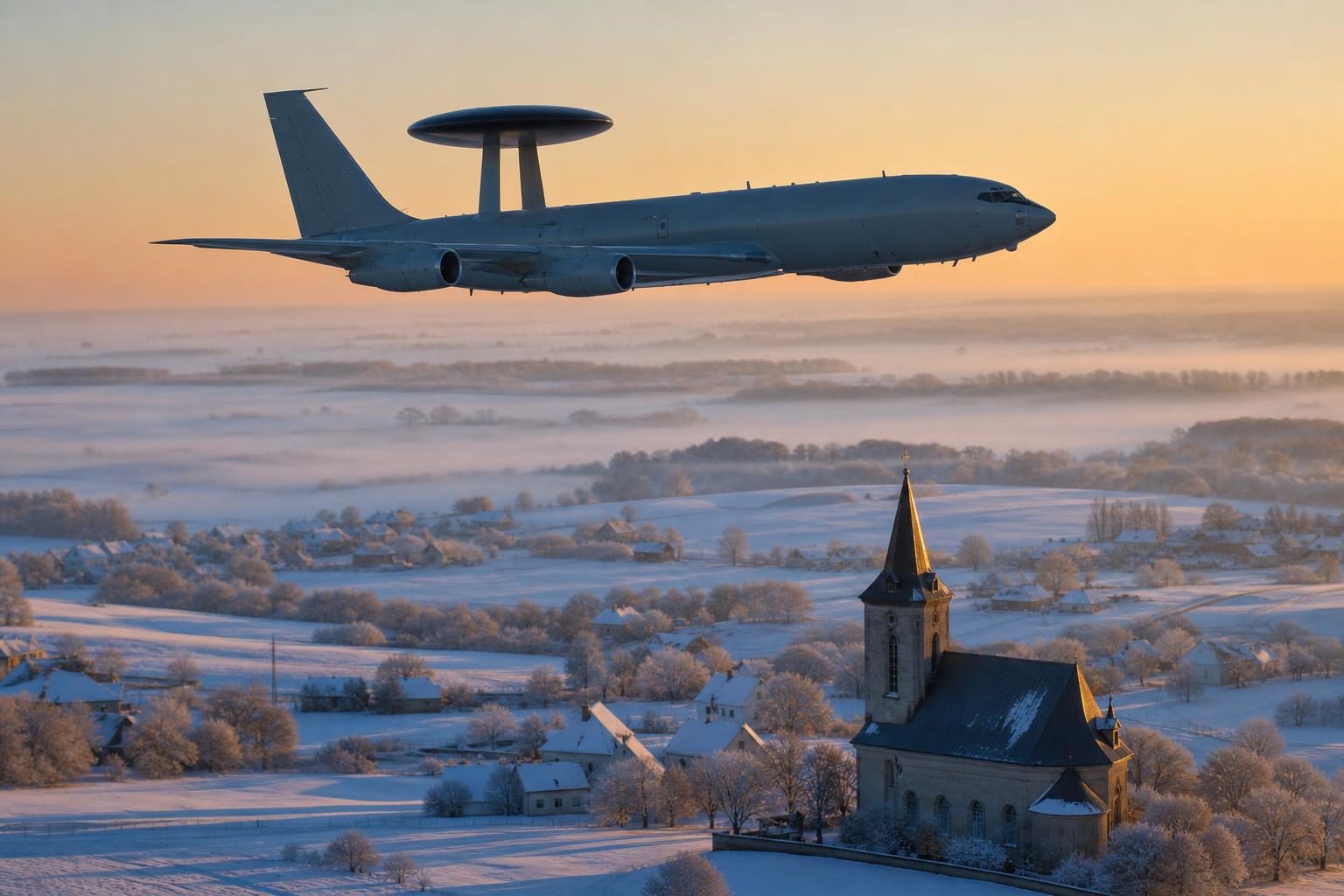
NATO is sending an airborne early-warning and control aircraft, known as an AWACS, to Poland, a concrete step after Russian cruise missiles came down in the country's southeast on Friday [1]. Poland's deputy defense minister, Paweł Zalewski, announced the move Monday after allies met in Brussels, and a NATO spokesperson said the alliance's top military commander in Europe, Gen. Alexus Grynkewich, had authorized sending the plane forward [1].
The radar plane was only one thread in a single day's news from NATO's eastern edge. Satellite pictures show Russia rebuilding a major army garrison roughly 37 miles from Finland [4]. Poland says Russian intelligence tried twice to kill a Ukrainian American rapper, once on Polish soil and once in Denmark [5]. And the U.S. Mission in Poland has told Americans in the area to stay alert [3]. Each story stands on its own. Taken together, they describe steady Russian pressure along the alliance's border, from the Finnish frontier to the edge of Ukraine.
What came down in southeastern Poland
The trouble began during a Russian strike on Ukraine on Friday, Nov. 20. Polish officials first said three airborne objects had crossed into the country and that they believed two were missiles and one was a drone, Just the News reported [2]. According to Stars and Stripes, the objects crashed in southeastern Poland during one of Moscow's largest recent attacks on its neighbor [6]. Polish prosecutors have since concluded that all three were Russian Kh-101 cruise missiles, NBC News reported, a finding that adds to fears the war could spill onto NATO territory [1].
Warsaw has not treated the timing as an accident. Poland was hosting military exercises with a coalition of Ukraine's supporters when the missiles fell, and Polish leaders believe that was no coincidence, according to Just the News [2].
In Warsaw on Saturday, NATO Secretary General Mark Rutte promised the alliance would defend "every inch" of Polish territory [2]. He also called the breach a "grave violation" of Polish airspace and described it as dangerous, Fox News reported [3]. That pledge came over the weekend. On Monday, the alliance began backing its words with hardware.
Eyes in the sky over the eastern flank
Zalewski said the AWACS would give Poland a deeper picture of its own skies, describing "operational awareness which allows us to respond better to this kind of threat" [1]. NATO's AWACS fleet is based at Geilenkirchen air base in Germany and has supported surveillance along the eastern flank since 2022, NBC News reported [1].
The NATO spokesperson added that Grynkewich is now examining whether to deploy additional assets [1]. Warsaw has a wish list ready. Polish officials have asked the alliance for more early-warning aircraft and for F-35 fighter jets, Stars and Stripes reported, though as of the weekend no new deployments had been announced [6].
Ambassadors on the North Atlantic Council, NATO's top decision-making body, gathered in Brussels on Monday to take up the incident [1][6]. Before that meeting, Rutte said Grynkewich would study potential threats and adjust the alliance's defenses as needed, according to Stars and Stripes, which cited the Polish Press Agency [6].
That detail should matter to Americans. Stars and Stripes described Grynkewich as the U.S. general in charge of allied forces in Europe, and he is the one now assessing whether Poland's defenses need strengthening [6]. When a frontline ally asks what more the alliance can do, the answer runs through an American commander. That is how NATO was built to work, and it is a reminder that steady U.S. leadership is not charity for Europe. It is the backbone of a deterrent that has kept a wider war off allied soil.
Washington's message to Americans in Poland
The U.S. Mission in Poland has urged Americans in the region to use caution after the suspected Russian missiles and drone came down near the Ukrainian border, Fox News reported [3]. American officials told U.S. citizens to follow the guidance of Polish authorities [3].
The advice is measured. It is not a call to flee, and it does not suggest Americans are being targeted. It is the kind of calm, practical notice a government owes its citizens abroad when the neighborhood gets more dangerous, and it fits the broader approach Washington and its allies are taking: watch closely, prepare carefully and avoid panic.
A garrison rising near Finland
Far to the north, Russia is rebuilding its Kamenka garrison about 37 miles from the Finnish border, the Washington Examiner reported [4]. Satellite images analyzed for Finland's public broadcaster, Yle, and taken a year apart in September 2025 and September 2026, show old mess halls, barracks and maintenance buildings demolished at three parts of the base, with new structures going up in their place [4].
Once the work is finished, the base is set to house the 69th Motor Rifle Division, an 11,000-strong unit that is the largest Russian force facing Finland [4]. That would be a sharp jump from the roughly 4,400 troops the garrison has held since the late 1990s [4]. The Examiner placed the project within a wider Russian push to revive its military infrastructure on its northern front since Finland joined NATO in 2023 [4].
Kamenka is not the only site. This spring Moscow began building an entirely new base at Novaya Vilga, near Petrozavodsk, where imagery in June showed a headquarters, a parade ground and about a dozen large barracks under construction [4]. A Finnish analyst said the base could soon hold 4,000 to 6,000 troops, the Examiner reported [4]. The same analyst cautioned that the buildup does not point to an immediate threat, while noting that Russia's strength near the border will rise substantially once the new forces are established, a process that will take time [4].
That is the right way to read it: not as an alarm bell, but as a long-term signal. Russia is investing in the very border that Finland's NATO membership was meant to secure. Helsinki was wise to join, and the alliance is wise to watch.
A murder plot against an American citizen
The darkest report of the day centers on a musician. Albert Vasiliev, a rapper who performs as Kyivstoner and holds Ukrainian and U.S. citizenship, was allegedly targeted twice by Russian intelligence, according to an Associated Press report carried by PBS NewsHour [5]. Denmark's security service, PET, said a plot to kill him at a Sept. 25 concert north of Copenhagen was "planned and initiated by Russian intelligence services," and Denmark expelled a Russian official over the case [5].
Poland then disclosed that the same man had been targeted on its soil. Prime Minister Donald Tusk announced on Aug. 13 that a plot to kill a Ukrainian American citizen in Warsaw had been thwarted, without naming the target, and a suspect allegedly recruited by Russia's secret services had been detained Aug. 7, the AP reported [5]. Polish Foreign Ministry spokesman Maciej Wewiór confirmed to the AP that Vasiliev was the man targeted in Poland [5].
Russia dismissed the allegations through its embassy in Copenhagen, calling them unsubstantiated [5]. Russia's FSB security service has accused Vasiliev of involvement in supplying drones for an alleged Ukrainian attack, a charge he denies [5]. If the Polish and Danish accounts hold up in court, an American citizen was hunted on the territory of two NATO allies by a hostile foreign service. That is not a gray zone. It is a line no free nation can allow to be crossed quietly.
Why a ready NATO keeps the peace
History teaches that aggressors move when they believe no one will answer. Cruise missiles drifting into a NATO country, a garrison swelling near Finland and alleged murder plots on allied soil are tests of resolve, whether or not each one was ordered as such. The response so far has been the right one: firm, proportionate and free of bluster. A radar plane over Poland, a review of defenses led by an American general and a calm advisory to U.S. citizens all say the same thing to Moscow. The alliance is watching, and it is ready.
Christians are called to seek peace and pursue it. In a fallen world, pursuing peace often means making sure that would-be aggressors never mistake restraint for weakness. A strong, prepared NATO, anchored by confident American leadership, is how free nations keep the guns quiet without surrendering an inch.
The next steps are already in view. Grynkewich is examining whether to send more aircraft and other assets to Poland [1], and Warsaw's requests for additional early-warning planes and F-35s remain on the table [6]. How quickly allies answer those requests will show Moscow, and the families living along this border, whether Rutte's promise to defend every inch is more than words [2].
Sources
- [1]Opens in a new tab ↗
- [2]Opens in a new tab ↗
- [3]Opens in a new tab ↗
- [4]Washington ExaminerRussia rebuilding key military base along border with FinlandOpens in a new tab ↗
- [5]Opens in a new tab ↗
- [6]Stars and StripesNATO emergency talks on tap as US commander assess defenses after Russian missiles hit PolandOpens in a new tab ↗
Should U.S. military aid to Israel end early?
- Yes, Israel can afford its own weapons
- Phase it out slowly
- No, keep it while Iran is a threat
More in Military & Defense

Flight Trackers Catch F-35 Squawking Emergency Over UAE
Today on Command Post with Dan Whitaker

Trump Says a Nuclear Deal Will Be 'Very Hard' as China's Buildup Runs 'Hot and Heavy'
Today on Command Post with Dan Whitaker
U.S. Troops Could Return to Syria to Clear Deadly Mines
Today on Command Post with Dan Whitaker
Were you there?
If you were at the scene, or this story touched your life, tell us what you saw and what it was like.
Discussion 0
Sign in or create a free account to join the discussion.
No comments yet. Start the discussion.