
 Today on Command Post with Dan Whitaker
U.S. Troops Could Return to Syria to Clear Deadly Mines
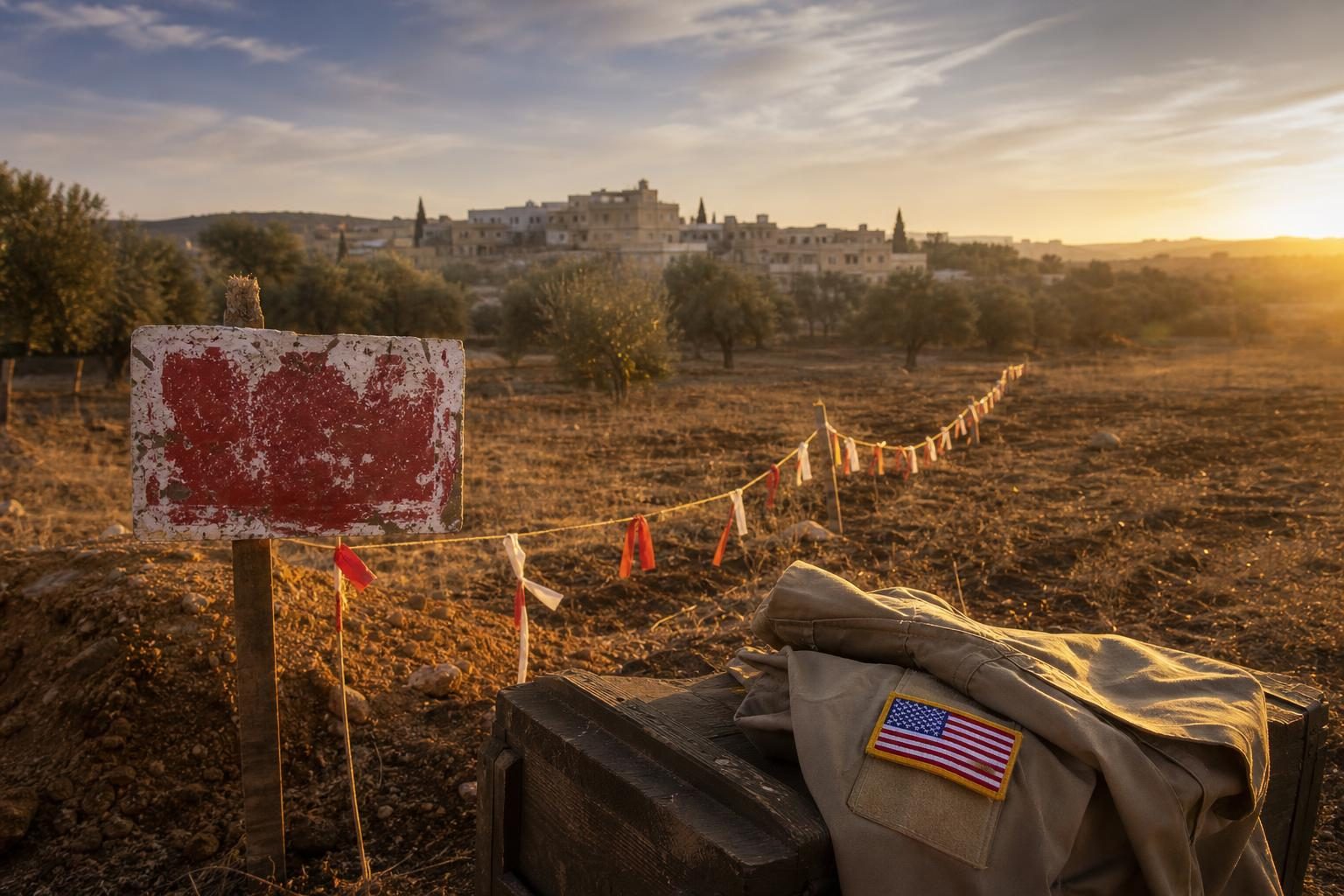
Washington is weighing a multinational program to train Syrian soldiers to find and destroy the mines and unexploded bombs that are still killing children, Reuters reports. Nothing is final.
Filed November 23, 2026 · 📍 Washington, DC 20001
Were you there? Share your story
Key points
- Reuters, citing five people familiar with the talks, says the U.S. is discussing training Syrian forces in demining and explosives disposal.
- A small number of American troops could be back in Syria as early as next year; one option starts training in Jordan and Syria in March.
- Leftover Operation Inherent Resolve money, about $200 million by one estimate, could pay for it.
- Leahy Law limits and wariness inside Syria's defense ministry stand in the way; CENTCOM says no final decisions have been made.
The United States is discussing a plan to train Syrian soldiers to clear land mines and dispose of unexploded ordnance, a step that could put a small number of American troops back on the ground in Syria as early as next year, Reuters reported Monday, citing five people familiar with the talks [1].
Nothing has been decided. A spokesperson for U.S. Central Command told Reuters that full decisions had not yet been made on the effort's future structure and mission focus [1].
What is on the table
According to the people who spoke to Reuters, the first phase would concentrate on mine clearance and the safe disposal of explosives, and it could later serve as a model for wider security cooperation with the new government in Damascus [1]. One option under review would begin training in Jordan and Syria as soon as March, with only limited participation by U.S. service members [1].
The New Arab, summarizing the plan, reported that it is designed as a multinational effort that could involve as many as 15 countries, including Britain, France and Saudi Arabia, and would build on an existing coordination center in Jordan [2]. The Jerusalem Post also carried the report [3].
Money is one reason the idea is moving. Officials are looking at whether funds left over from Operation Inherent Resolve, the campaign that broke the Islamic State's grip on eastern Syria, could cover the cost; one source put the remaining pot at roughly $200 million [1][2].
The hurdles
The proposal still faces legal limits at home. U.S. law, under what are known as the Leahy Laws, bars American aid to foreign military units where there is credible evidence of gross human rights violations, and vetting Syrian units will take time [1][2]. Reuters also reported skepticism inside Syria's defense ministry, where some officials have been reluctant to give American personnel access to their institutions and facilities [1].
Why it matters
For Syrian families, the danger is not abstract. Save the Children has reported that child casualties from explosives in Syria have climbed to a five-year high as families return to homes and fields that were front lines for more than a decade [4]. Earlier this month a mine exploded inside a school in northeastern Syria, killing a child and wounding at least 10 other people, most of them children [5].
A narrowly drawn, allied-led mission that teaches Syrians to make their own land safe, paid for with money Congress has already approved, is the kind of limited, practical commitment that can save young lives without opening a new war. The key test will be the one the law already demands: keeping American help away from any unit with blood on its hands. The talks are expected to continue in the coming weeks, and any deployment would come only after a final decision in Washington [1].
Sources
- [1]U.S. News & World Report (Reuters)Exclusive-US Discussing Military Training for Syrian ForcesOpens in a new tab ↗
- [2]Opens in a new tab ↗
- [3]The Jerusalem PostUS discussing military training for Syrian forcesOpens in a new tab ↗
- [4]Save the ChildrenSyria child casualties from explosives reach five-year high as families return homeOpens in a new tab ↗
- [5]Opens in a new tab ↗
Should U.S. military aid to Israel end early?
- Yes, Israel can afford its own weapons
- Phase it out slowly
- No, keep it while Iran is a threat
More in Military & Defense
Recruits, Allies and Results: Hegseth's Record Answers His Critics
This morning on Command Post with Dan Whitaker

Pentagon Stands by Hegseth as Ex-Aide Urges Him to Quit
This morning on Command Post with Dan Whitaker

REPORT: RUSSIA READYING A NUCLEAR SATELLITE, LAUNCH AS SOON AS DECEMBER
This morning on Command Post with Dan Whitaker
Were you there?
If you were at the scene, or this story touched your life, tell us what you saw and what it was like.
Discussion 0
Sign in or create a free account to join the discussion.
No comments yet. Start the discussion.