
 This morning on World Watch with Grace Whitfield
Iran Vows 'All Available Means' Against the U.S. Blockade as Houthis Claim a Strike on a Saudi Refinery
Tehran's foreign ministry calls the naval cordon an act of aggression, while Yemen's Iran-backed militia says it hit Rabigh and President Trump keeps the pressure on.
Filed November 23, 2026 · 📍 Washington, DC 20001
Were you there? Share your story
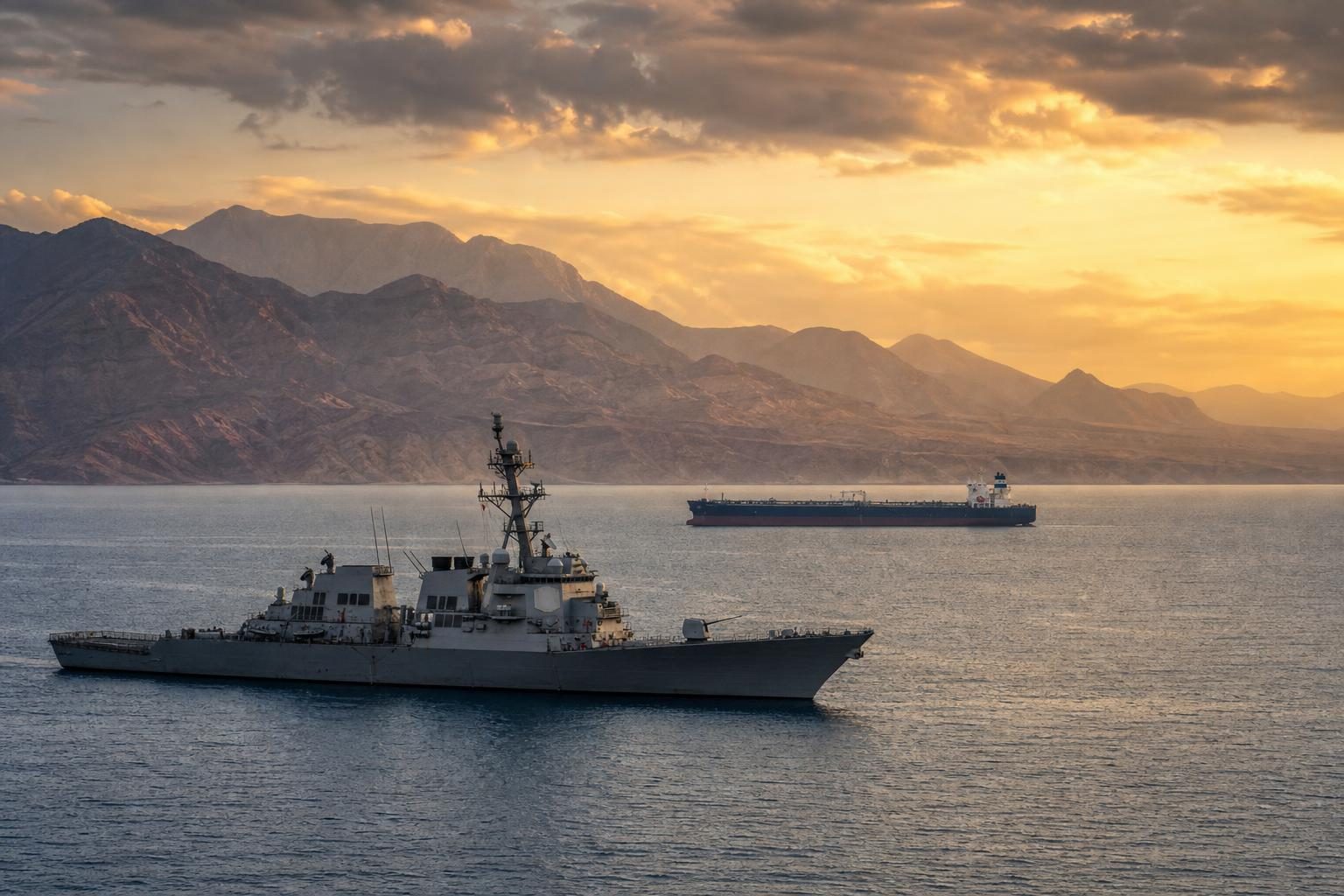
Part of our continuing coverage: Trump Dares Iran to Test Hormuz Blockade as Navy Stands Ready to Stop Tanker Convoy
Key points
- Iran's foreign ministry said Monday it will use all available means to counter the U.S. naval blockade.
- Yemen's Houthis claimed a Sunday strike on Saudi Arabia's Rabigh refinery; damage was not confirmed.
- President Trump says Iran's attacks have done no damage and has signaled strikes could return next year.
- A Kuwaiti report says Washington gave Tehran four days to answer a new offer; it has not been confirmed.
Iran's government said Monday it will use "all available means" to confront the American naval blockade of its ports, a sharp new warning that came as Yemen's Iran-backed Houthis claimed an attack on one of Saudi Arabia's largest refineries and as President Trump kept up the economic squeeze on Tehran [1][2].
Foreign Ministry spokesman Esmaeil Baqaei made the statement at his weekly press briefing in Tehran, according to Reuters reporting carried by Arab News. He described the blockade as military aggression and pointed to the self-defense provision in Article 51 of the United Nations Charter as Iran's legal footing, while saying the government was studying countermeasures he did not describe [1]. CBS News reported that Iran vowed to force the United States to lift the blockade, even as the President acknowledged the regime's stepped-up attacks and said they had "done no damage" [2].
A blockade that has come and gone, and come back
The American cordon has been the centerpiece of the President's strategy for months. Reuters-based accounts published Monday note that the blockade of Iran-linked oil exports first began on April 13, was lifted in June after Washington and Tehran reached a draft understanding, and was reimposed on July 14 when that understanding collapsed [1]. Iran's stated price for reopening the Strait of Hormuz has not changed: an end to hostilities, an end to the blockade and relief from oil sanctions [1].
Washington's position has been just as firm. This site reported over the weekend that the President has dared Iran to test the blockade with a tanker convoy, and that the Navy stands ready to stop it. CNBC reported Monday that the President has also warned he is inclined to order new military strikes against Iran next year if no acceptable deal emerges [3].
A Kuwaiti newspaper report, relayed by Times Kuwait, said the United States had given Iran four days to respond to a new proposal covering Hormuz, Iran's nuclear program and sanctions, after rejecting Tehran's latest counteroffer as unrealistic [4]. Under the reported American plan, Iran would restore shipping through the strait to conditions before February 28, and Washington would gradually ease the blockade and suspend some oil sanctions in return [4]. That account rests on a single outlet citing unnamed sources, and neither government has publicly confirmed a deadline.
The Houthis widen the fight
On Sunday, the Houthis said they had carried out an operation against Saudi Arabia's Rabigh refinery on the kingdom's Red Sea coast and claimed a direct hit, The New Arab reported. The group gave no details of damage, and videos said to show a fire at the site could not be independently verified [5]. The Saudi-led coalition said it intercepted and destroyed a Houthi drone launched toward the kingdom's western region, though no Saudi statement directly tied that interception to the refinery [5].
Rabigh, about 100 miles north of Jeddah, hosts the Petro Rabigh refining and petrochemical complex developed by Saudi Aramco and Japan's Sumitomo Chemical [5]. The Houthis made a similar claim against the same facility in late October, which Saudi Arabia never confirmed [5]. CNBC tied the latest claim to a broader pattern of Iranian pressure on the region as Tehran tries to force Washington to accept its terms [3].
Al Jazeera's live coverage reported that oil prices fell late Sunday despite fresh attacks on shipping in Hormuz, and that Israel's public broadcaster said Prime Minister Benjamin Netanyahu has urged the President to strike Iran soon [6].
Why it matters
For American families, the stakes are not abstract. Hormuz has long carried a large share of the world's seaborne oil, and every week the strait stays choked is a week of risk for fuel prices, shipping and the Gulf allies who host American troops. The administration's bet is that steady economic pressure, backed by credible force, will move Tehran further than another round of bombing would. Iran's bet, by its own account, is that it can outlast that pressure.
Critics of the President's approach argue the blockade has not yet produced a deal and has kept the region on edge. Supporters counter that Iran's leaders are the ones who closed an international waterway and fired on neighbors, and that lifting the pressure before Tehran changes course would reward exactly that behavior.
What comes next
The next markers are Iran's answer to any American offer, whether Qatari and other mediators can narrow the gap, and whether the Houthis' attacks on Saudi energy sites escalate. The administration has made clear that the blockade stays until Iran reopens the strait on terms Washington can accept.
Sources
Israel's new parliament is sworn in. Who would you rather see lead Israel?
- Benjamin Netanyahu
- Gadi Eisenkot
- Someone new
- That's for Israelis to decide
More in World News
A Handshake, No Thaw: Japan and China Leave the Shenzhen Summit as Far Apart as Ever Over Taiwan
This morning on Cross-Examination with Dominic Kane

Tajikistan Walks Out on the ICC, Fourth Since U.S. Push
This morning on World Watch with Grace Whitfield
Beijing Orders Death for Official Who Sold Secrets Abroad
This morning on World Watch with Grace Whitfield
Were you there?
If you were at the scene, or this story touched your life, tell us what you saw and what it was like.
Discussion 0
Sign in or create a free account to join the discussion.
No comments yet. Start the discussion.