
 This morning on Command Post with Dan Whitaker
Houthis Take the High Ground Over Bab el-Mandeb as Yemen's Southern Forces Pull Back and a Siege Pushes Taiz Toward Famine
Saudi-backed troops say they are leaving positions above one of the world's busiest sea lanes to defend Aden, handing Iran's Yemeni allies new leverage over global shipping while a city of about a million people goes hungry.
Filed November 15, 2026 · 📍 World desk · Washington, DC
Were you there? Share your story
Story tracker
Our anchors are following this story. New details will appear here as they come in.
Key points
- Yemen's Southern Armed Forces say they are redeploying from Dhubab and the Bab el-Mandeb area to defend Aden.
- Reuters says the move gives the Iran-aligned Houthis more leverage over a vital shipping chokepoint while Iran disrupts Hormuz.
- Taiz's governor says the besieged city of roughly 1 million has entered famine; rights investigators warn of starvation tactics.
- Health officials in Taiz report a surge in diarrhea and suspected cholera as patients struggle to reach hospitals.
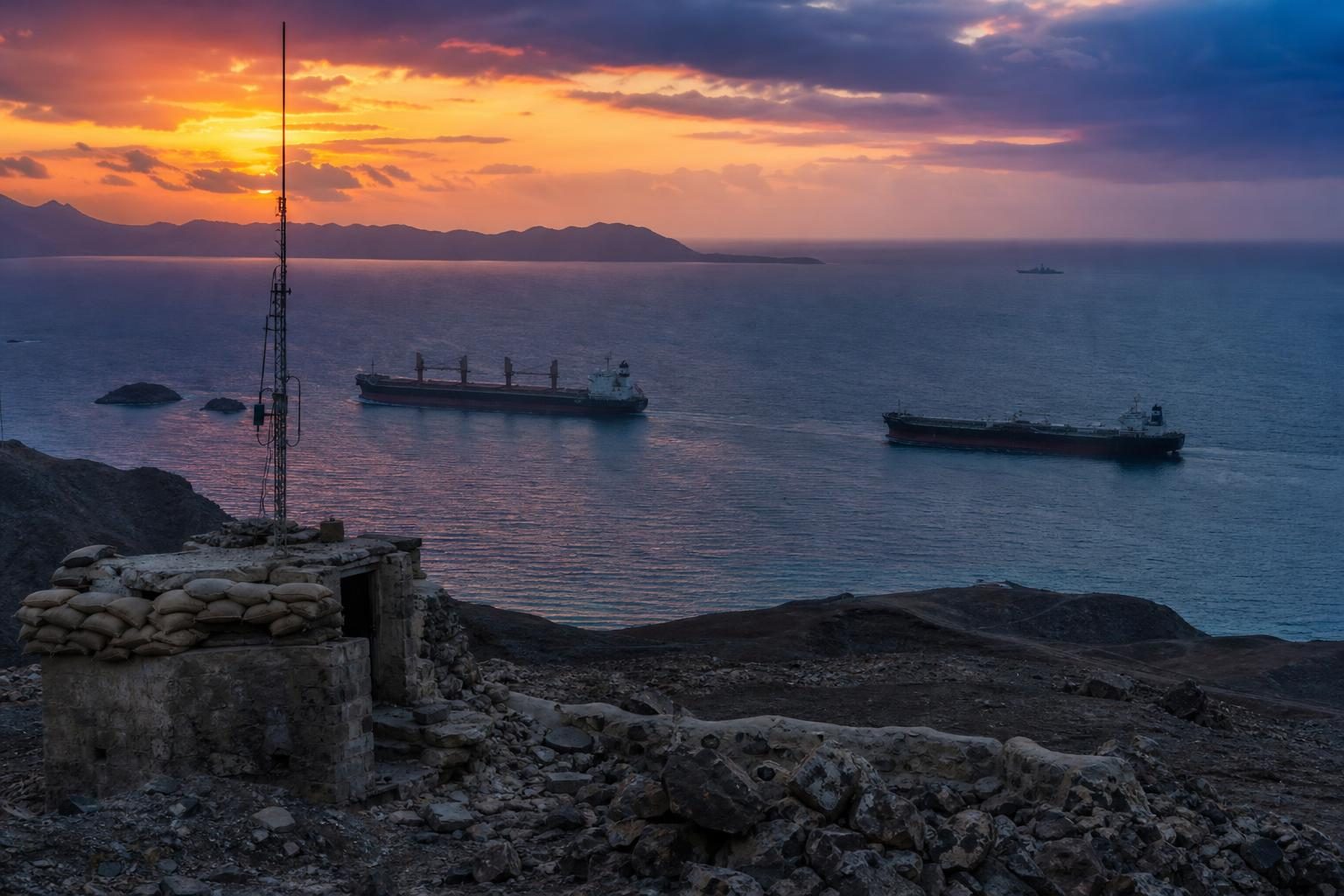
Yemeni forces fighting for the country's internationally recognized, Saudi-backed government said Sunday that they are pulling out of an area overlooking the Bab el-Mandeb Strait, leaving the Iran-aligned Houthis in control of the high ground above one of the most important sea lanes on earth, Reuters reported in a dispatch carried by Al-Monitor [1]. The announcement came from the Southern Armed Forces, which said they were redeploying from Dhubab airport and the surrounding Bab al-Mandab area to bolster the defense of Aden, the seat of the government in the south, the Saudi outlet Sabq reported [2].
For Americans, the news lands thousands of miles away but close to home in two ways: the price of the goods on our shelves and the safety of the sailors who keep the world's sea lanes open. The strait is one of the world's busiest routes for seaborne commodities and manufactured goods, Reuters noted, and the pullback hands the Houthis greater leverage over that chokepoint at the very moment Iran is still disrupting traffic through the Strait of Hormuz [1]. Put simply, both great doorways for Middle East shipping are now under pressure from Tehran and the militias it backs.
What the Southern Forces Said
The Southern Armed Forces presented the move as a repositioning, not a surrender. Their statement said the step was meant to secure Aden and the neighboring provinces, strengthen front lines elsewhere and deal with what they called existing threats, according to Reuters [1]. Sabq described the withdrawal from Dhubab as part of a plan to concentrate forces around Aden [2].
The National, the Abu Dhabi newspaper that follows Yemen closely, reported that the pullout effectively cedes the area above the strait to the Houthis [3]. It also pointed out that a Houthi offensive launched in September had already pushed the group within reach of Bab al-Mandab, which means Sunday's announcement formalizes a threat that has been building for weeks [3].
None of the first reports described new Houthi attacks on ships tied to the withdrawal [1][3]. For now, the danger is leverage: the ability to threaten traffic at will, from hills that look straight down on the shipping lane.
How Iran's Allies Got This Close
The Houthis are no ordinary rebel movement. They seized Yemen's capital, Sanaa, in 2014, have fought a Saudi-led coalition for more than a decade, and carry an official slogan that calls for death to America and Israel. The Trump administration designated the group a foreign terrorist organization in 2025, and Americans will remember the missile and drone attacks on merchant ships that began in late 2023 and forced many carriers to sail the long way around Africa.
This fall the group went back on offense on the ground. The September push that The National described carried Houthi fighters toward the strait itself [3]. At the same time, they tightened their grip on Taiz, Yemen's third-largest city, which sits inland from the coast and has been the front line of this war for years.
The timing matters. With Iran itself locked in a conflict with the United States and pressing on Hormuz [1], a stronger Houthi hand at Bab el-Mandeb gives Tehran a second pressure point without firing a shot from Iranian soil.
A City Under Siege
Inside Taiz, the human cost is mounting. The governor of Taiz province said the city of roughly 1 million people has entered famine after a weekslong Houthi siege, The Washington Post reported on Oct. 29 [4]. The same Post report said a Saudi airstrike had killed 13 people, a reminder that civilians in Yemen are suffering from more than one direction [4].
Human Rights Watch, which interviewed 15 people for its investigation, including five residents of the city, four doctors and six civil society workers, said the siege "may amount to the war crime of using starvation as a method of warfare" [5]. A Houthi spokesperson told the group on Oct. 21 that government forces, not Houthi fighters, were blocking the roads into Taiz, but residents, civil society workers and United Nations officials placed responsibility for the shortages on the Houthis, the group reported [5].
Disease is now following hunger. Health officials in Taiz told Al Jazeera that more than 1,400 cases of acute diarrhea and suspected cholera were reported in a single week [6]. One official estimated that patients' ability to reach hospitals had fallen by 60 to 70 percent by the end of the siege's second week, and officials warned that a drop in recorded infections may simply mean sick people cannot get to a clinic, not that they are getting better [6].
Why It Matters to Us
There are three reasons readers here should care.
First, freedom of the seas is an American interest, not a favor we do for others. When a terrorist-designated militia sits above a chokepoint that carries a large share of the world's trade, every container ship, tanker and grain carrier that passes is exposed to blackmail. Reuters' assessment that the withdrawal gives the Houthis more leverage over global shipping [1] should be read in Washington as a warning, not a footnote.
Second, this is Iran's strategy in action. Tehran has spent years building a ring of proxies so that it can strike at its enemies through others. Hormuz is the front door; Bab el-Mandeb is the back door [1]. A Houthi movement that besieges Taiz and holds the hills above the strait is a force multiplier for the regime the United States is now confronting.
Third, the suffering in Taiz is real, and it is being inflicted on purpose, according to the people who live there and the investigators who listened to them [5]. Christians who take seriously the command to care for the hungry and the stranger cannot look away from a city where, according to local health officials, families cannot even reach a doctor [6]. Standing up to the Houthis is not only a security policy. It is a moral one.
What Comes Next
The immediate question is whether the Southern Armed Forces can hold Aden and the south now that they have shortened their lines [1][2]. A second question is whether the Houthis will use their new position to threaten ships, or hold it in reserve as a bargaining chip while Iran negotiates. The National's reporting suggests the group has momentum on the ground after its September offensive [3].
Saudi Arabia, which backs the government side, has kept up its air campaign, as the Post's report of a deadly airstrike shows [4]. Whether Riyadh and its partners choose to reinforce the south, retake lost ground or press for a negotiated pause will shape the next phase of the war. Whatever they decide, the families of Aden, Taiz and the villages in between will live with the consequences.
For Taiz, the questions are more basic: whether roads will open, whether fuel and medicine will get through, and whether the world will pay attention before famine turns into mass death. The governor's famine warning [4] and the rights investigators' findings [5] have put the facts on the record.
For American policymakers, the lesson of the last three years is that the Houthis respond to strength, not to statements. Keeping U.S. and allied naval power in the Red Sea, enforcing the terrorist designation, cutting off the Iranian weapons pipeline and backing the Yemeni forces still willing to fight are the tools that matter. Sunday's withdrawal is a reminder that ground ceded to Iran's allies is rarely given back for free.
Sources
- [1]Opens in a new tab ↗
- [2]Opens in a new tab ↗
- [3]Opens in a new tab ↗
- [4]The Washington PostYemen's besieged Taiz is in famine, governor says, as 13 are killed by Saudi airstrikeOpens in a new tab ↗
- [5]Human Rights WatchYemen: Houthis Depriving Taizz Civilians of Food, MedicineOpens in a new tab ↗
- [6]Opens in a new tab ↗
Israel's new parliament is sworn in. Who would you rather see lead Israel?
- Benjamin Netanyahu
- Gadi Eisenkot
- Someone new
- That's for Israelis to decide
More in World News

Five Saturdays of Anger: Why France Keeps Marching Over Prices, Schools and Police, and What Americans Should Take From It
Overnight on Main Street Money with Marcus Hale
Follow the Oil: Iraq Fires Nine Officials Over Smuggling in a Militia Stronghold, but Baghdad Still Won't Name Kataib Hezbollah
Overnight on Deep Dive with Kevin Nakamura
Hamas Confirms Its Rafah Brigade Commander, Tied to October 7 Planning, Was Killed in an Israeli Strike
Overnight on Breaking Now with Nathan Brooks
Were you there?
If you were at the scene, or this story touched your life, tell us what you saw and what it was like.
Discussion 0
Sign in or create a free account to join the discussion.
No comments yet. Start the discussion.