
 Overnight on World Watch with Grace Whitfield
El Hierro's Emergency: A Tiny Canary Island Takes In Thousands in Days as Europe's Atlantic Route Roars Back
Thousands of migrants reached Spain's Canary Islands in the first 10 days of November, most landing on 12,000-person El Hierro, forcing an emergency declaration and renewing a hard debate over Europe's borders.
Filed November 14, 2026 · 📍 World desk · Washington, DC
Were you there? Share your story
Key points
- El Hierro declared an emergency after more than 3,300 people arrived in about 30 boats in the first week of November.
- Le Monde counted nearly 6,000 arrivals across the archipelago in the first 10 days of November, most of them on El Hierro.
- Regional president Fernando Clavijo called the surge unsustainable and sought an urgent meeting with Prime Minister Sánchez.
- The Atlantic route is among the world's deadliest; an advocacy group counted more than 10,000 dead or missing in 2024.
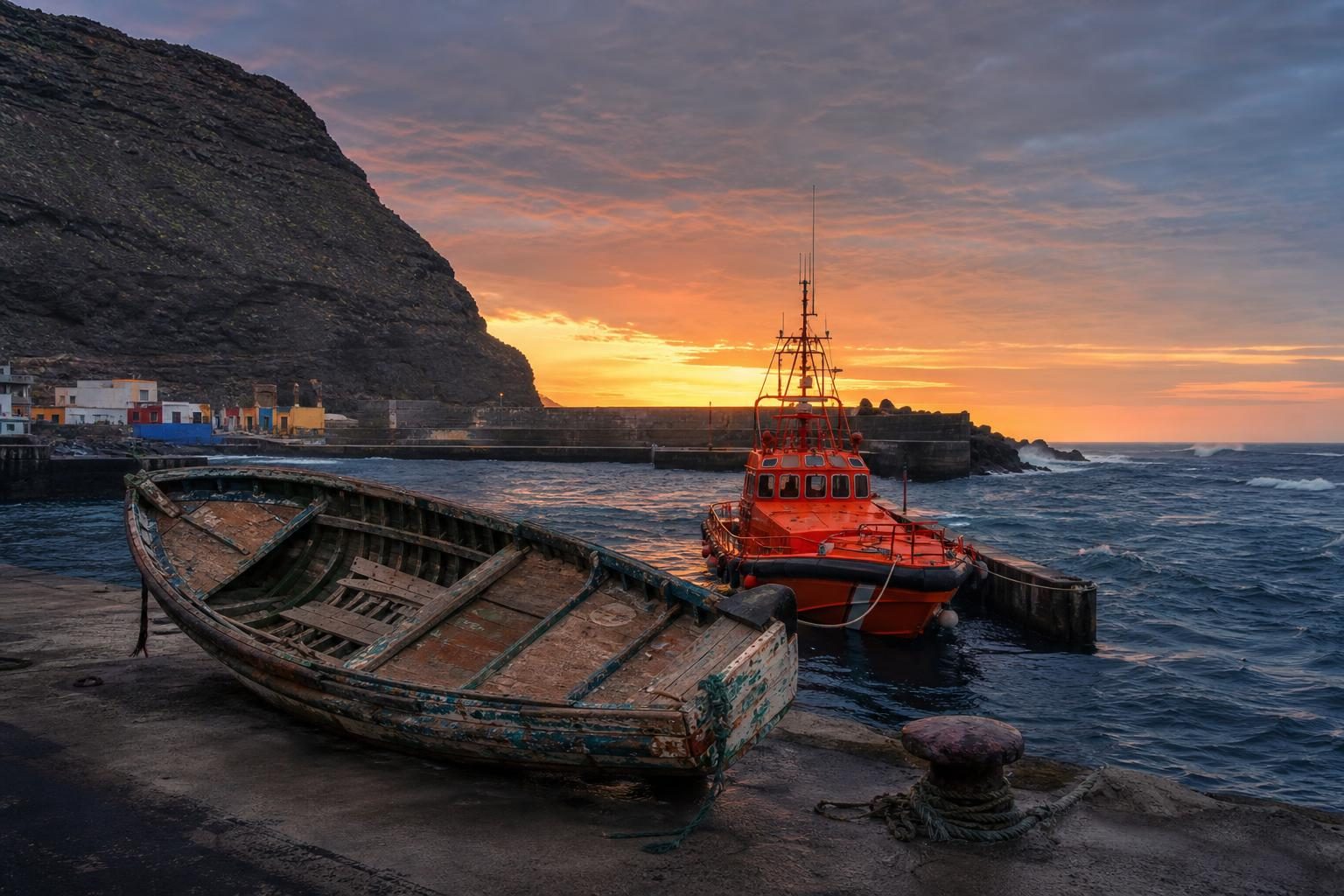
El Hierro is the smallest and most remote of Spain's Canary Islands, a volcanic outpost in the Atlantic with about 12,000 residents, Le Monde reported [2]. In the first days of November it became the front line of Europe's migration crisis. Island authorities declared an emergency and asked Madrid for help after more than 3,300 people arrived in about 30 boats in barely a week, according to local figures reported by Al Jazeera [1].
The numbers kept climbing. Le Monde reported that nearly 6,000 people reached the archipelago during the first 10 days of November, most of them on El Hierro [2]. Euro Weekly News, counting over a longer window, reported that more than 8,000 migrants had reached El Hierro by boat in five weeks [5]. Whichever count proves final, an island the size of a small American county seat has absorbed in a matter of weeks a number of newcomers approaching two-thirds of its own population.
A Small Island Overwhelmed
The pressure on El Hierro is easy to picture. Its port, its clinics and its emergency crews were built for a quiet island, not for wave after wave of open boats arriving after days at sea. The regional president of the Canary Islands, Fernando Clavijo, called the situation "absolutely unsustainable" and asked for an urgent meeting with Prime Minister Pedro Sánchez, according to an AFP report carried by Baird Maritime [3]. Clavijo said calm seas had helped drive the surge [3].
Among the arrivals are children. A tally by the Spanish news agency EFE counted 307 minors and 11 babies among those who reached El Hierro in the first five days of November, Baird Maritime reported [3]. Caring for unaccompanied minors has long been one of the most painful flashpoints between the islands and the national government, because the young arrivals cannot simply be moved on and the islands' shelters fill quickly.
The pressure is now on Madrid. The central government's job now is to relieve El Hierro quickly, by moving people to larger facilities and sending medical and emergency help, while the islands press for a lasting answer.
Why the Boats Are Coming Now
The Atlantic route runs from the coast of West Africa, from countries such as Senegal, The Gambia, Mauritania and Morocco, across hundreds of miles of open ocean to the Canaries [4]. The journeys are long and brutal. Passengers on one boat that reached El Hierro told emergency teams they had set out from Kafountine, in southern Senegal, seven days earlier, Euro Weekly News reported [5]. A week in an open wooden boat on the Atlantic, with little food, water or shelter from the sun, is an ordeal few Americans can imagine.
Le Monde reported that the November influx is partly the result of other migration routes being closed [2]. When one door shuts, smugglers steer their customers toward another, and the Canaries sit at the end of the longest and most dangerous of those doors.
The surge also comes against a backdrop of lower overall numbers this year. Arrivals of illegal migrants to the islands were down nearly 61 percent in the first 10 months of 2026 compared with the same period of 2024, Baird Maritime reported [3]. That is a reminder that this route is volatile. Smuggling networks respond quickly to weather, enforcement and politics, and a calm stretch of sea can turn a quiet year into a crisis in a matter of days [3].
The scale of the problem in recent years is sobering. Spain's Interior Ministry reported a record 46,843 migrants reaching the Canary Islands illegally in 2024, NPR reported, the second record year in a row [4]. Spain as a whole received 63,970 irregular migrants that year, the vast majority of them through the Atlantic archipelago [4]. Mali, Senegal and Morocco were among the most common countries of origin on the Atlantic route, according to the same report [4].
The Deadliest Crossing
Behind every boat that reaches El Hierro are boats that never arrive. The Spanish migrant-rights group Caminando Fronteras said at least 10,457 people died or disappeared trying to reach Spain by sea between Jan. 1 and Dec. 5, 2024, the highest toll since the group began counting in 2007, NPR reported [4]. Most of those deaths were on the Atlantic route [4]. The figure is an estimate from an advocacy group rather than an official count, but even a fraction of it would be a staggering loss of life.
Christians cannot look at those numbers and shrug. Every person in those boats bears the image of God, and many were sold a lie by smugglers who took their money and put them on an overcrowded boat headed into the open Atlantic. Compassion and border security are not opposites. The surest way to save lives at sea is to stop the smuggling trade that sends people out onto the ocean in the first place.
The Policy Debate in Spain
Sánchez's government has taken a markedly different path from the United States. Earlier this year, Spain approved a landmark decree to regularize the status of roughly 500,000 undocumented migrants already living in the country, Idealista reported [6]. Supporters in Madrid have argued that the move brings workers into the legal economy and the tax system. Critics across Europe have long warned that mass legalizations send a signal to smugglers and to would-be migrants that, once someone reaches European soil, the odds of being allowed to stay are good.
That debate is not settled, and both sides deserve a hearing. But the experience of El Hierro shows why ordinary citizens in Spain and elsewhere in Europe are asking hard questions. When an island of 12,000 people [2] must absorb thousands of new arrivals in a week, the cost of policy decisions made in capitals far away lands on fishermen, nurses, teachers and local officials who had no vote in those decisions.
Americans have watched a similar argument unfold at home. The lesson from both sides of the Atlantic is that a nation that cannot control who enters will eventually face a crisis of public trust, and that the most humane border is one that is clearly and consistently enforced, so that families are not tempted to gamble their lives on a smuggler's promise.
What Comes Next
In the short term, the test for Madrid is practical: whether it can relieve El Hierro before the island's services break down, and whether the larger Canary Islands and mainland Spain will take their share of the arrivals [1][3]. Clavijo has made clear that the islands cannot carry the load alone [3].
In the longer term, Spain and the European Union face the harder work of stopping departures at the source, through cooperation with the West African countries where the boats are launched, action against smuggling networks and a clear message that the Atlantic crossing is not a path to a new life but a deadly gamble. The weather will turn rougher as winter sets in, which may slow the boats for a time, but as this year has shown, the calm will return, and so will the smugglers [3].
For the people of El Hierro, the immediate need is help. For Europe, the need is a policy that protects both its borders and the lives of those tempted to risk the sea.
Sources
- [1]Opens in a new tab ↗
- [2]Opens in a new tab ↗
- [3]Baird Maritime (AFP)Canary Islands sound alarm over unsustainable illegal migrant influxOpens in a new tab ↗
- [4]Opens in a new tab ↗
- [5]Euro Weekly News8,000 arrivals push El Hierro in the Canary Islands into emergency as passengers report a week at seaOpens in a new tab ↗
- [6]Opens in a new tab ↗
Israel's new parliament is sworn in. Who would you rather see lead Israel?
- Benjamin Netanyahu
- Gadi Eisenkot
- Someone new
- That's for Israelis to decide
More in World News
Lebanese Army Raids Hidden Arms Depot in Hezbollah's Beirut Stronghold
Overnight on World Watch with Grace Whitfield
A NATO Ally Pledges to Defend Qatar: The Hard Questions America Should Ask About the Türkiye-Qatar Pact
Overnight on Cross-Examination with Dominic Kane

Israel's Coalition Standoff: Netanyahu Holds His Ground as Eisenkot Hunts for 61 Seats
Last night on World Watch with Grace Whitfield
Were you there?
If you were at the scene, or this story touched your life, tell us what you saw and what it was like.
Discussion 0
Sign in or create a free account to join the discussion.
No comments yet. Start the discussion.