
 This morning on Free Speech Frontline with Ryan Mercer
One Rulebook or Fifty? Governors Ask Washington for National AI Rules That Leave States Room to Protect Their People
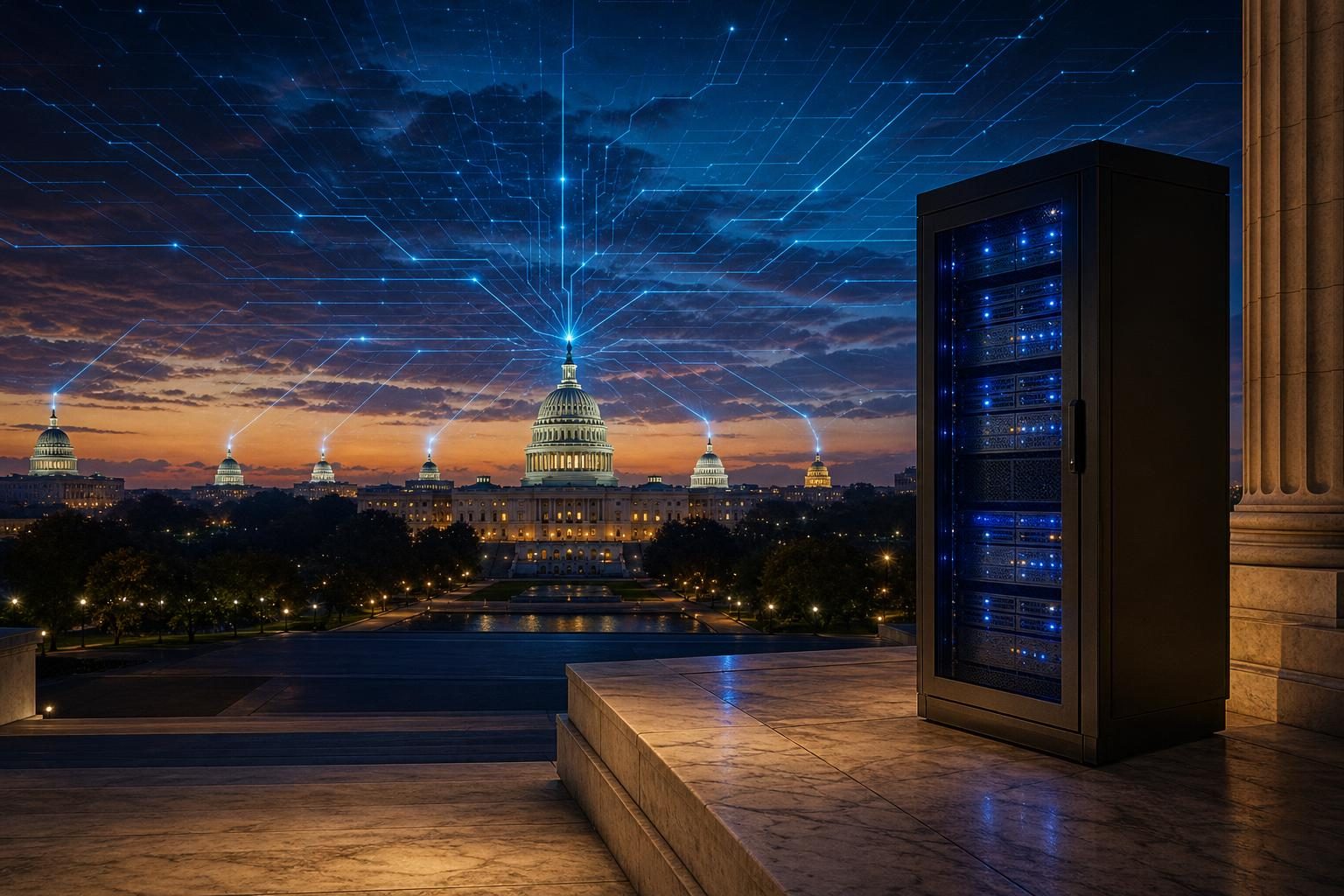
The nation's governors want Congress to oversee the most powerful AI systems while states keep their traditional role on consumer protection. It sets up the next round of a fight the White House started last December, just as a new Congress arrives.
Filed November 22, 2026 · 📍 White House, DC 20500
Were you there? Share your story
Key points
- Bloomberg reports governors are calling for federal AI rules on the most powerful systems while states keep consumer protection and discrimination enforcement.
- The push comes from a bipartisan governors' group formed this fall by NGA Chair Wes Moore and Vice Chair Mike Braun, citing federal inaction.
- President Trump's December 2025 executive order and the White House's 2026 framework ask Congress to preempt burdensome state AI laws.
- Illinois Gov. JB Pritzker wants federal rules to be a floor, not a ceiling, setting up a clash as Democrats take over Congress in January.
Who should write the rules for artificial intelligence: Washington, the 50 states, or both? The nation's governors have offered their answer. Bloomberg reported on Sunday that governors are calling on Congress to set federal rules for artificial intelligence, without pushing the states out of the job of protecting their own residents [1].
The proposal, as Bloomberg described it, would split the work. Washington would oversee the most powerful AI systems, including independent safety reviews of the most advanced models and mandatory reporting of serious security breaches and safety incidents. States would keep their traditional role over consumer protection, enforcement of anti-discrimination laws and the effects of AI on jobs and workers [1].
It is a significant marker in one of the biggest policy fights of the decade, and it arrives at a pivotal moment. A new Congress takes office in January, the White House has spent most of the past year pressing lawmakers to override what it calls burdensome state AI laws, and the technology itself is moving faster than any legislature.
Where the Governors' Plan Came From
The call grows out of a bipartisan effort launched this fall. In early October, Maryland Gov. Wes Moore, a Democrat who chairs the National Governors Association, announced a bipartisan group of governors to tackle the risks posed by artificial intelligence, citing a lack of action in Washington, the Associated Press reported [2]. His partner in the effort is Indiana Gov. Mike Braun, a Republican who serves as the association's vice chair [2].
Moore told the AP that he did not want to see 50 different sets of rules, but that states needed a seat at the table [2]. He also sharply criticized a White House meeting with technology executives, calling it a "billionaire boys club," and argued that the federal government, both the White House and Congress, has a unique leadership role to play [2]. A governors' group has no formal power to compel anyone to act. Its influence lies in shaping what Congress does next.
The White House's Push for One National Standard
The governors are answering a campaign that began in the Oval Office. On Dec. 11, 2025, President Trump signed an executive order titled Ensuring a National Policy Framework for Artificial Intelligence [3]. According to the White House fact sheet, the order created a Justice Department task force to challenge state AI laws that conflict with national policy, directed the Commerce Department to identify onerous state laws, tied certain federal broadband dollars to states' AI policies, and called on Congress to pass a national framework that would preempt conflicting state rules [3].
The administration followed up this year with a set of legislative recommendations to Congress. According to a summary by the National Governors Association, the White House framework covers seven areas, including child protection, the effects of AI on communities and infrastructure, intellectual property, free speech, innovation, workforce development and preemption of state AI laws that impose undue burdens [4]. Importantly, the NGA's summary notes that the White House plan would preserve state laws of general application that protect children and consumers [4].
In other words, the two sides are closer than the headlines suggest. Both the White House and the governors accept that some AI questions are national and some are local. The fight is over where to draw the line.
Congress Has Tried, and Stalled
Lawmakers have struggled to settle the question. In July 2025, the Senate voted 99 to 1 to strip a proposed 10-year moratorium on state AI laws from the budget reconciliation bill, a sign of how strongly many senators of both parties felt about states' rights on the issue [6]. This June, Reps. Jay Obernolte, a California Republican, and Lori Trahan, a Massachusetts Democrat, released a draft framework that would preempt state laws aimed at how AI models are developed for three years, while leaving alone state laws on how AI is used, Route Fifty reported [6]. That draft has not become law.
Meanwhile, the states have not waited. California, Texas, Colorado, Illinois and others have passed their own AI measures, covering everything from transparency for the largest AI developers to protections against discrimination. In Illinois, Gov. JB Pritzker has gone further than most, calling on the incoming Democratic Congress to pass federal AI rules that act as a floor, not a ceiling, so that states can always add protections on top, Capitol News Illinois reported [5]. He has also pushed for mandatory AI risk assessments and standards on the energy and water used by data centers [5].
What Is at Stake for American Families and Businesses
For a conservative, the argument cuts in two directions, and both deserve a hearing.
On one side is the Constitution's design. The Founders gave Congress power over commerce among the states precisely so that the country would not be carved into competing economic fiefdoms. AI models are built, trained and sold across the whole country and the whole world. A startup in Austin or Nashville should not need a team of lawyers to comply with 50 different and sometimes contradictory sets of rules on how it builds its product. Every dollar spent navigating a patchwork is a dollar not spent competing with China, which is racing to dominate the technology. That is the heart of the White House's case [3][4].
On the other side is federalism, which conservatives have defended for generations. The states are where Americans most directly hold their leaders accountable, and they have long carried the primary responsibility for protecting children, policing fraud and enforcing consumer protection laws. Parents worried about AI chatbots talking to their teenagers, or seniors targeted by AI voice-cloning scams, are far more likely to get a quick answer from a state attorney general than from a federal agency. Washington should be careful before it tells states they cannot act.
The governors' split, as Bloomberg described it, tries to honor both principles: national oversight of the most powerful frontier systems, and state authority over how the technology is used on the ground [1]. The White House framework, as the NGA summarized it, also keeps general state protections for children and consumers in place [4]. That overlap is the most promising sign in this debate.
The danger lies in the other direction. Pritzker's floor-not-ceiling approach would let the most aggressive states keep writing the rules for everyone, because companies tend to build to the strictest market they serve [5]. If a few large states impose sweeping mandates on how AI models are designed, the rest of the country effectively lives under those rules without ever voting for them. A national standard on model development, paired with real room for states to police fraud and protect kids, is the better answer.
What Comes Next
The decision now moves to the next Congress, which convenes in January with Democrats in control. Governors from both parties have put a concrete framework on the table, the White House has its own, and the Obernolte-Trahan draft offers a possible bridge [1][4][6]. Whether lawmakers can agree on a single, sensible rulebook, one that keeps America ahead of China while letting states keep watch over their own people, will be one of the defining technology questions of 2027.
Sources
- [1]Opens in a new tab ↗
- [2]Opens in a new tab ↗
- [3]The White HouseFact Sheet: President Donald J. Trump Ensures a National Policy Framework for Artificial IntelligenceOpens in a new tab ↗
- [4]National Governors AssociationIn Summary: The White House National Legislative Policy Framework for Artificial IntelligenceOpens in a new tab ↗
- [5]Capitol News IllinoisWith new Democratic Congress incoming, Pritzker calls for federal AI regulationsOpens in a new tab ↗
- [6]Opens in a new tab ↗
Do you trust AI chatbots to give straight answers on politics?
- Yes
- Sometimes
- No, they lean left
- I don't use them
More in Technology

Beijing's Spies Hunted America's AI Chips for Years: Report
This morning on Free Speech Frontline with Ryan Mercer

AI-Found Bugs Could Mean More Outages, Microsoft Chief Warns
Yesterday on Free Speech Frontline with Ryan Mercer

No Treaty, More Talks: Geneva's 'Killer Robot' Conference Ends With a Two-Year Plan as Washington's Caution Holds
Yesterday on Free Speech Frontline with Ryan Mercer
Were you there?
If you were at the scene, or this story touched your life, tell us what you saw and what it was like.
Discussion 0
Sign in or create a free account to join the discussion.
No comments yet. Start the discussion.