
 This morning on Launch Pad with Hannah Lindgren
The Ring Holds Up: An Independent Team Confirms the First-Ever Picture of a Black Hole, Using a Method That Never Knew What One Looks Like
Australian scientists trained an algorithm on everyday photos, then turned it loose on Event Horizon Telescope data from the galaxy M87. It found the same glowing ring astronomers unveiled in 2019, answering skeptics who called it an artifact.
Filed November 22, 2026 · 📍 Washington, DC 20001
Were you there? Share your story
Key points
- A four-person CSIRO team reported in Nature on Nov. 11 that an independent method reproduces the 2019 image of the black hole in galaxy M87.
- The technique uses closure invariants, combining signals from three telescopes at a time to cancel out atmospheric and calibration errors.
- The algorithm was trained only on ordinary pictures, not black holes, and still recovered a ring about 42 microarcseconds across.
- The result is consistent with Einstein's general relativity and answers critics who argued the ring was a product of the original processing.
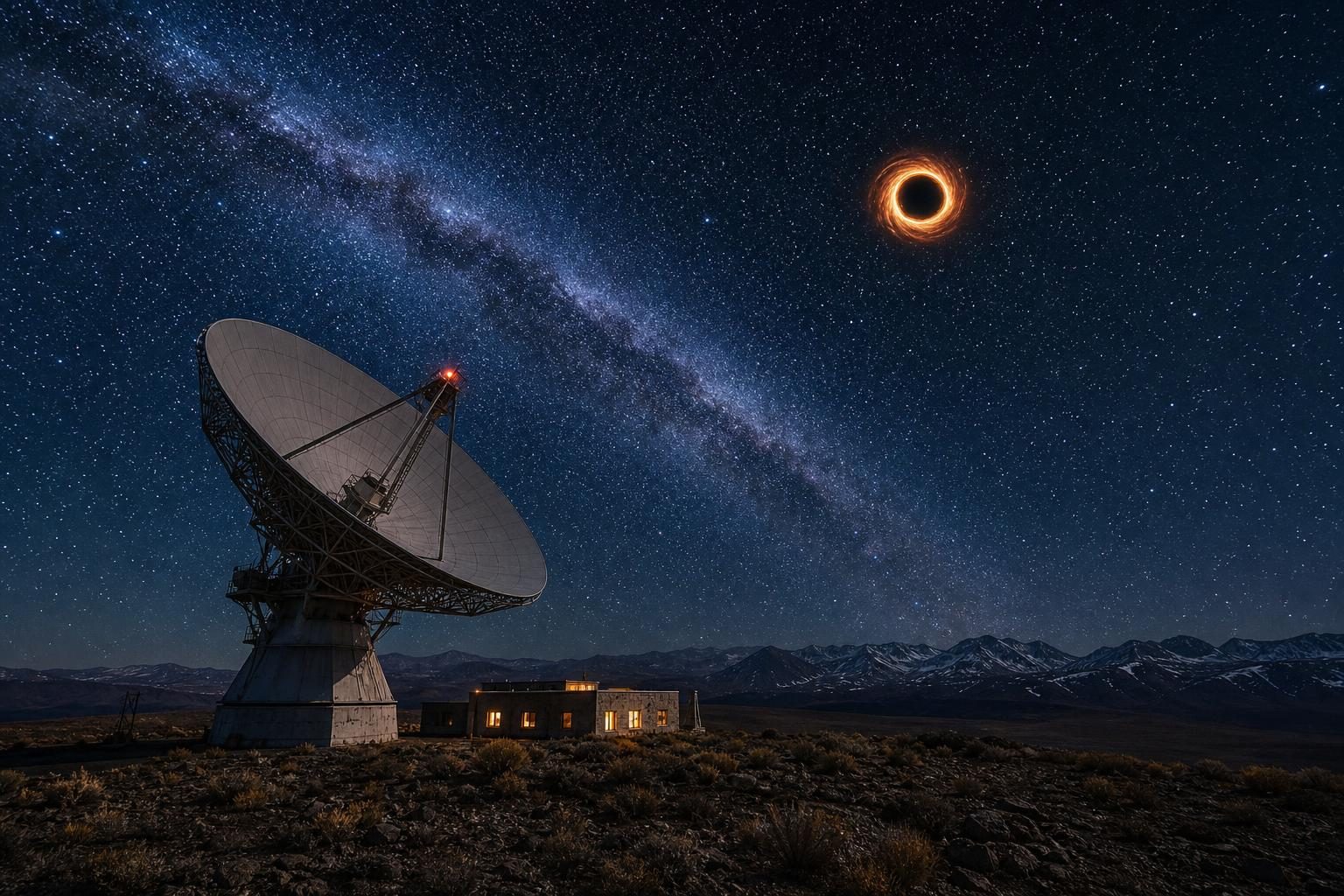
Seven years after astronomers showed the world its first picture of a black hole, a team of scientists who had no part in making it has checked the work, and the famous glowing ring has held up. Researchers at CSIRO, Australia's national science agency, reported in the journal Nature on Nov. 11 that an entirely independent analysis of Event Horizon Telescope data recovers the same ring around the supermassive black hole at the center of the galaxy M87 [1][2].
What the Team Did
The 2019 image, assembled by the international Event Horizon Telescope collaboration, came from linking radio observatories around the globe into a single Earth-sized telescope. Turning that patchwork of signals into a picture required heavy processing, and skeptics argued that some of what the world saw might be a product of the imaging methods rather than the black hole itself. Nature's news team noted that critics had suggested the ring could be an artifact, and that one alternative reconstruction showed more of a blob than a ring [3].
The CSIRO team, Samuel Lai, Nithyanandan Thyagarajan, O. Ivy Wong and Foivos Diakogiannis, took a different route [1][2]. Standard analysis combines measurements from pairs of telescopes. Their approach relies on what are called closure invariants, which combine measurements from three telescopes at a time in a way that cancels out errors caused by Earth's atmosphere and by the instruments themselves, according to CSIRO [2].
They also built in a safeguard against seeing what they expected to see. Their machine-learning algorithm, called GenDIReCT, was trained on ordinary, non-astronomical pictures, so it had no built-in notion of what a black hole should look like, CSIRO said [2]. The team reported that the training and testing setup was fixed before the algorithm ever touched the real telescope data [1].
What They Found
The algorithm found a ring. The team measured its diameter at about 42.2 microarcseconds, give or take 1.5, which agrees with the Event Horizon Telescope's original estimate of about 42 microarcseconds within the margins of error [1]. A microarcsecond is an almost unimaginably small slice of the sky, roughly the size a doughnut on the surface of the Moon would appear from Earth.
From the ring's size, the researchers estimated the black hole's mass at about 6.5 billion times that of our Sun, consistent with independent estimates based on the motions of stars in the galaxy [1]. The overall shape and orientation of the ring matched the 2019 picture, while some of the finer details differed [1][3].
Lai described the work as the first truly independent validation of the Event Horizon Telescope image, according to The Register [5]. The collaboration's director, Laurent Loinard, welcomed the study and praised the method as elegant and fully independent, the outlet reported [5]. Nature's news team summed it up by saying the new results largely corroborate the original [3].
Einstein, Again
Headlines about Einstein being right again reflect the fact that the size and shape of the ring are what Albert Einstein's general theory of relativity predicts for light bending around a black hole, Space.com reported [4]. Strictly speaking, the new study is a check on the imaging rather than a fresh test of relativity, but it removes one of the main doubts about a result that physicists have treated as a striking confirmation of the theory [3][4].
The new technique may also prove useful well beyond astronomy. Space.com reported that the same approach to cleaning up noisy measurements could one day help in fields such as medical imaging and earthquake mapping [4].
What Comes Next
The study covers only M87, a galaxy about 55 million light-years away. The Event Horizon Telescope's second famous image, of Sagittarius A*, the black hole at the heart of our own Milky Way, released in 2022, has faced its own critics [3]. Whether an independent approach like this one can settle that debate as well is the obvious next question.
For believers, there is something fitting about the whole effort. Scientists spent years building a telescope the size of the planet to look at a point of darkness millions of light-years away, then went back and checked their work with humility and care. That is science at its best, and as the psalmist wrote, the heavens declare the glory of God.
Sources
Do you trust scientific experts more or less than five years ago?
- More
- Less
- About the same
More in Science & Space
Captured at Last: After Eight Years in Space, Europe and Japan's BepiColombo Slips Into Orbit Around Mercury
Last night on Launch Pad with Hannah Lindgren

Build Us a Moon Base: NASA Puts Up $1 Million for America's High School and College Students to Solve Life on the Lunar Surface
Yesterday on Launch Pad with Hannah Lindgren
Math's 167-Year Riddle Solved? A Bold Riemann Proof Claim Lands
Friday night on Launch Pad with Hannah Lindgren
Were you there?
If you were at the scene, or this story touched your life, tell us what you saw and what it was like.
Discussion 0
Sign in or create a free account to join the discussion.
No comments yet. Start the discussion.