
 Tonight on Report Card with Rebecca Hartman
Why Loudoun Parents Are Saying No to a 'Day of Mourning' Thanksgiving Lesson for Second Graders
A district guide steers young children toward grief over the holiday. The real history, from the Pilgrims' first winter to Washington's and Lincoln's proclamations, is a story of survival, friendship and gratitude.
Filed November 15, 2026 · 📍 Washington, DC 20001
Were you there? Share your story
Key points
- A Loudoun County schools guide recommends a lesson for second graders presenting Thanksgiving as a 'Day of Mourning.'
- A watchdog group obtained the guide through a public records request and says it emphasizes grievance.
- The 1621 harvest feast marked an alliance with the Wampanoag that lasted more than 50 years.
- Washington in 1789 and Lincoln in 1863 framed Thanksgiving as a national day of gratitude.
Eleven days before Thanksgiving, parents in Loudoun County, Virginia, learned what some of their children may be taught about the holiday. A district-approved list of lesson plans for teachers includes one recommended for second graders that presents Thanksgiving as a "Day of Mourning," the Washington Free Beacon reported [1]. The same guide calls Columbus Day a "Debated Celebration" [1].
What the District's Guide Says
It is worth being precise about what was reported. The material comes from a Loudoun County Public Schools guide of resources for recognition days and months, first developed in 2024 and updated for this school year, according to The Post Millennial, which said a watchdog group, Protect the Public's Trust, obtained it through a public records request [2]. For middle and high school students, the guide points teachers to a lesson called "Thanksgiving: A Day of Mixed Blessings," which links to a HuffPost video, the Free Beacon reported [1].
The "Day of Mourning" idea did not come from nowhere. Since 1970, a group of Native Americans and supporters has gathered near Plymouth Rock on Thanksgiving Day to hold a protest they call a National Day of Mourning, according to HISTORY.com [5]. Teaching older students that some Americans see the day differently is a reasonable part of an honest history class. Leading seven-year-olds to think of Thanksgiving as a day of grief is something else.
Protect the Public's Trust said the materials put the emphasis on grievance and critical interpretation, The Post Millennial reported [2]. One Loudoun mother put it more simply on Fox & Friends: Thanksgiving is a holiday for America and for families, and she is not mourning on it [3].
What the History Actually Shows
Parents are right to push back, because the full story of Thanksgiving is richer, and more hopeful, than a lesson built around mourning.
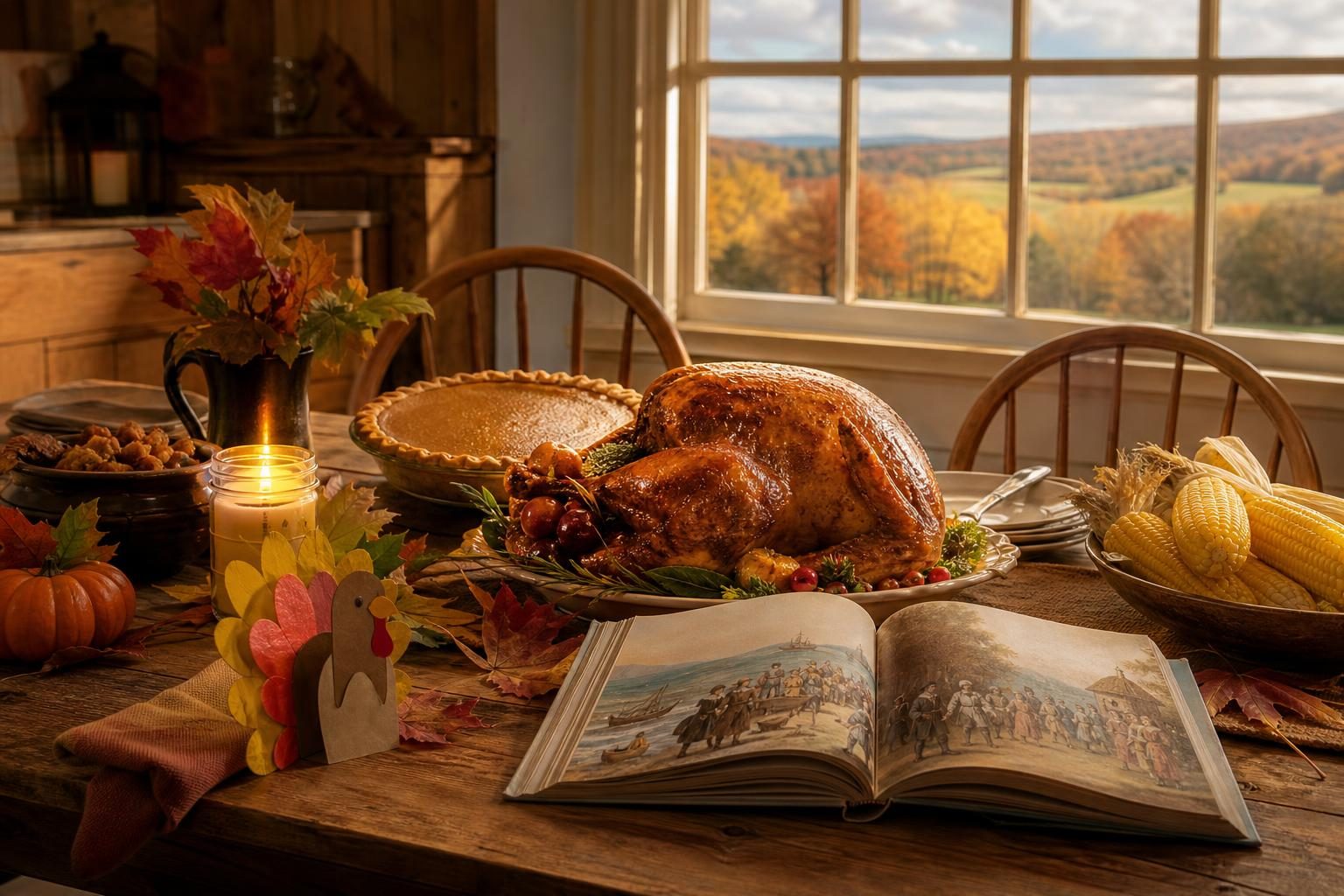
Start with the Pilgrims' first year. Only about half of the Mayflower's passengers and crew survived their first winter in New England, according to HISTORY.com [5]. The colony lived because of help from its neighbors. Tisquantum, known as Squanto, taught the settlers how to grow corn, and the colony formed an alliance with the Wampanoag that endured for more than 50 years, HISTORY.com reported [5].
When the first harvest came in, Gov. William Bradford organized a celebration in the fall of 1621 and invited the Wampanoag leader Massasoit [5]. The only eyewitness account, a letter by Edward Winslow, says Massasoit arrived with about 90 men, and the Wampanoag brought five deer to the feast, Live Science reported [6]. Some historians see the meal as much as a diplomatic event marking an alliance as a harvest feast [6]. Either way, it was two peoples sharing a table in peace.
The holiday's national roots run through the nation's founding. In 1789, President George Washington called for a day of public thanksgiving under the new Constitution and sent his proclamation to the governors, according to the National Archives [4]. During the Civil War, on Oct. 3, 1863, President Abraham Lincoln proclaimed a national day of thanksgiving to help unite a war-weary nation, after a campaign by the writer Sarah Josepha Hale, and set the last Thursday of November as the date [4][5].
That is the story of Thanksgiving: survival through hardship, help from neighbors, gratitude to God and a call to national unity in the middle of the bloodiest war in American history. Later generations would see conflict and betrayal between settlers and Native nations, and older students should learn that history honestly. But the holiday itself was born from thankfulness, not resentment.
Gratitude Is a Lesson Worth Teaching
Second grade is when children learn to say thank you and mean it. Washington and Lincoln both framed the day as one of gratitude to God for His blessings [4]. A child who learns to count blessings is learning something that will help them for the rest of their life. A child who learns that the nation's oldest family holiday is mainly a day of sorrow is being handed an adult argument before they can understand it.
Parents are not asking schools to hide hard history. They are asking schools to teach it in the right order and with balance: the gratitude and the friendship first, the full complexity as students grow.
What Comes Next
Families in Loudoun have every right to ask to see the lessons their children will be taught this month and to raise their concerns with teachers, principals and the school board. The guide became public because a watchdog asked for it through a records request [2], and that kind of transparency is exactly what parents across the country should expect.
Thanksgiving is Thursday, Nov. 26. In homes across Loudoun County and across America, families will gather, give thanks and pass the stuffing. That is a tradition worth handing down, and no school guide should teach children to be ashamed of it.
Sources
- [1]Washington Free BeaconThanksgiving Is a 'Day of Mourning,' Lesson Plan Recommended to Loudoun County Second Graders SaysOpens in a new tab ↗
- [2]Opens in a new tab ↗
- [3]Opens in a new tab ↗
- [4]National ArchivesThanksgiving: Historical PerspectivesOpens in a new tab ↗
- [5]HISTORY.comHistory of ThanksgivingOpens in a new tab ↗
- [6]Live ScienceWhat really happened at the 1st Thanksgiving?Opens in a new tab ↗
Have you ever been censored or shadow-banned on social media?
- Yes
- I think so
- No
- I'm not on social media
More in Pushback
Why More Than 1,300 Pastors Are Saying No to Britain's Conversion Practices Bill, and Why Americans Should Pay Attention
Today on Faith & Family with Ethan Calloway
Shapiro Says He's 'Very Open' to Federal School Choice. The Facts Say It's Time to Opt In
Today on Report Card with Rebecca Hartman
Shapiro Wants to More Than Double Pennsylvania's Minimum Wage. The State's Own Numbers Say the Market Already Beat Him to It
Today on Main Street Money with Marcus Hale
Were you there?
If you were at the scene, or this story touched your life, tell us what you saw and what it was like.
Discussion 0
Sign in or create a free account to join the discussion.
No comments yet. Start the discussion.