
 Today on First Principles with Benjamin Stone
The Facts Don't Back Up an AR-15 Ban: What the Constitution, the FBI and Millions of Owners Tell the Justices Before Dec. 2
Newly elected Democrats campaigned on a federal ban just as the Supreme Court prepares to hear challenges to Illinois and Connecticut laws. The record points the other way.
Filed November 22, 2026 · 📍 Supreme Court, DC 20543
Were you there? Share your story
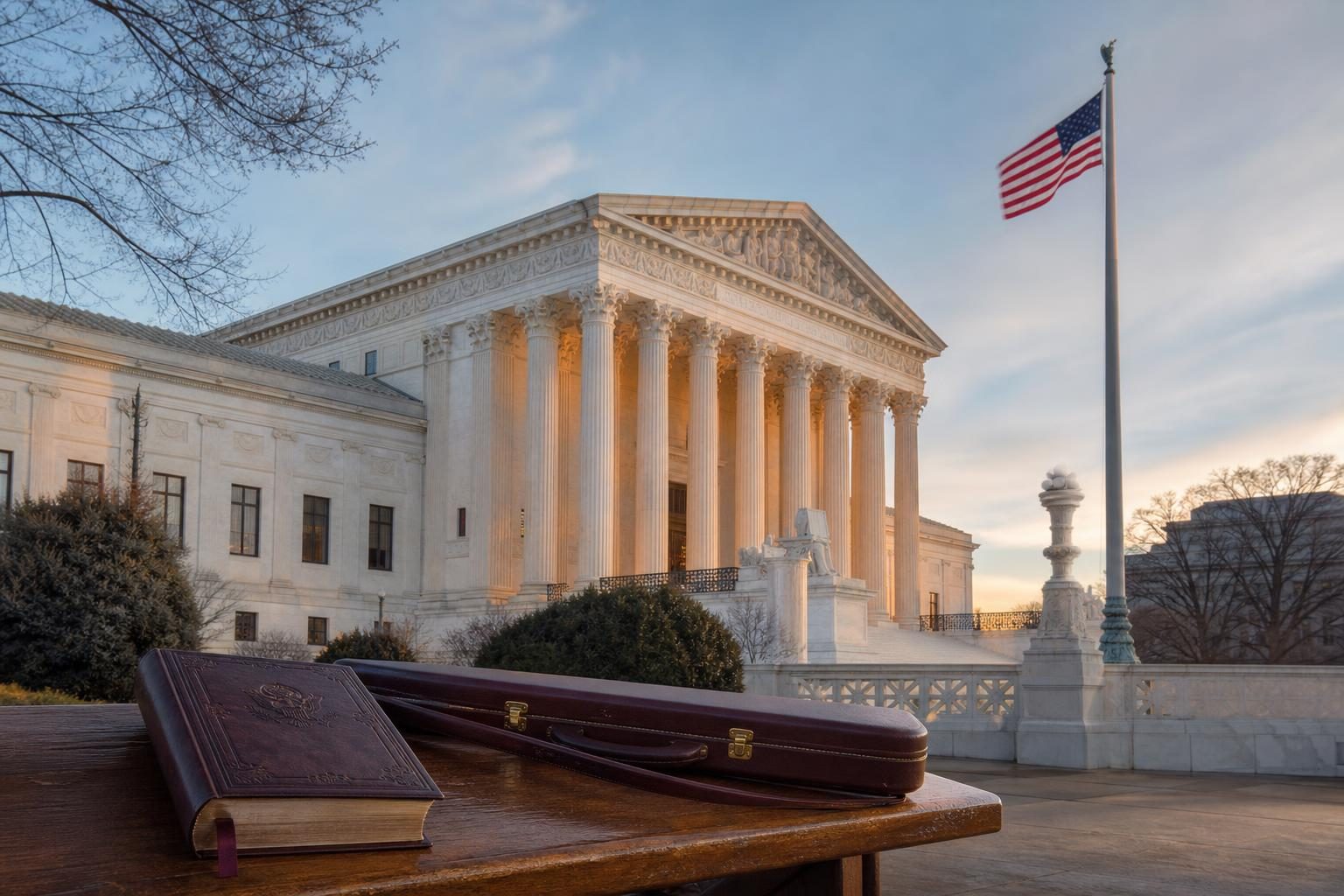
Key points
- The Supreme Court hears the consolidated Illinois and Connecticut AR-15 ban cases on Dec. 2.
- Several newly elected Democrats campaigned on a federal ban; 11 states and D.C. have bans.
- FBI data for 2019 recorded rifles of all kinds in 364 of 13,927 murders, versus 1,476 for knives.
- The industry estimates more than 24.4 million AR-15-style rifles have entered circulation since 1990.
The Supreme Court will hear arguments on Dec. 2 in a case that could undo bans on AR-15-style rifles in nearly a dozen states, and the timing raises the stakes because several newly elected Democrats campaigned on enacting a federal ban, The Daily Signal reported Sunday [1]. Eleven states and the District of Columbia, along with a number of cities and counties, already prohibit the rifles [1].
The justices will take up two consolidated cases: Viramontes v. Cook County, which challenges the Illinois county's ban, and Grant v. Higgins, which challenges Connecticut's law [1][2]. The governments defending the bans point out that every federal appeals court to consider the question has upheld such laws [2]. That is a fair point, and it is exactly why the Supreme Court's review matters. Lower courts can agree with one another and still be wrong about the Constitution.
The Constitution's test is common use
In District of Columbia v. Heller in 2008, the Supreme Court held that the Second Amendment protects arms in common use for lawful purposes, while leaving room to restrict weapons that are both dangerous and unusual. In New York State Rifle & Pistol Association v. Bruen in 2022, it told lower courts to judge gun laws by the text of the amendment and the nation's historical tradition of regulation.
The gun owners challenging the bans argue that the rifles at issue are protected under that framework because they are "in common use" by any plausible measure and therefore cannot be called dangerous and unusual [2]. They contend that the Seventh Circuit, in upholding Illinois' ban in Bevis v. City of Naperville, misapplied the history-and-tradition test [2].
The common-use standard is not a loophole invented by gun groups. It is the Supreme Court's own test, and it reflects a simple constitutional idea: the people, not the government, decide which ordinary firearms they keep for the defense of their homes and families.
What the numbers say
By any measure, the AR-15-style rifle is ordinary. The National Shooting Sports Foundation, the firearms industry's trade group, has estimated that more than 24.4 million modern sporting rifles, its term for AR-15-style and similar semiautomatic rifles, have entered circulation in the United States since 1990 [4]. Critics argue that production-based estimates overstate ownership, but even a sharply lower figure would leave these rifles among the most popular in the country.
The FBI's crime data also cuts against the case for a ban. In 2019, the most recent year in the bureau's expanded homicide table, rifles of every kind were recorded in 364 of 13,927 murders, while knives and other cutting instruments were recorded in 1,476 [3]. The FBI does not separate AR-15-style rifles from other rifles, and in more than 3,000 firearm murders that year the type of gun was not stated, so the true rifle figure is somewhat higher [3]. Even so, rifles of all kinds made up only a small share of murders, and handguns were the firearm most often used [3].
None of this minimizes the horror of the mass shootings in which these rifles have been used. Every life lost is a life made in the image of God, and every family that has buried a child deserves our prayers and our seriousness. But seriousness means following the evidence. Justice Department-funded researchers who studied the 1994 federal assault weapons ban reported that the banned guns and magazines were never involved in more than a modest share of gun murders and that any effect on gun violence was difficult to detect [5]. Congress let that law expire in 2004.
Who is pushing back
The challenge is being led by ordinary, law-abiding gun owners in Illinois and Connecticut [1][2]. They have powerful company: the Trump administration's Justice Department asked for 10 minutes of the one-hour argument to support the challengers, AmmoLand reported [6]. The federal government, in other words, is siding with the citizens rather than the bans.
Democrats who campaigned on a national ban should take note. If the justices hold that the Second Amendment protects rifles owned by millions of law-abiding Americans, no act of Congress can override that ruling. The better path for lawmakers who want to reduce violence is to focus on the criminals who commit it, enforce the laws already on the books, and protect schools and churches with the same care we give to courthouses and Capitol buildings.
The arguments are set for Dec. 2, and a decision is expected before the court's term ends next summer [1]. The question before the justices is whether a right the Constitution says "shall not be infringed" still means what it says when the rifle in question is one of the most popular in America.
Sources
- [1]The Daily SignalCan States Ban America's Most Popular Rifle? Supreme Court to Hear Landmark Case Dec. 2Opens in a new tab ↗
- [2]Supreme Court of the United StatesReply Brief for Petitioners, Viramontes v. Cook County, No. 25-238Opens in a new tab ↗
- [3]FBI Uniform Crime ReportingExpanded Homicide Data Table 8: Murder Victims by Weapon, 2015-2019Opens in a new tab ↗
- [4]Opens in a new tab ↗
- [5]Office of Justice ProgramsUpdated Assessment of the Federal Assault Weapons Ban: Impacts on Gun Markets and Gun Violence, 1994-2003Opens in a new tab ↗
- [6]Opens in a new tab ↗
Have you ever been censored or shadow-banned on social media?
- Yes
- I think so
- No
- I'm not on social media
More in Pushback
California Didn't Just Say No to the Billionaire Tax. Voters Locked the Door, and the Record Explains Why
This morning on The Bottom Line with Douglas Park
The Facts Don't Back Up a $20 Federal Minimum Wage: What Washington's Own Scorekeeper Found When the Ask Was $15
This morning on The Hart of the Economy with Evelyn Hart

The $4.9 Trillion Question: A Budget Watchdog Priced the Democrats' First 100 Days, and No One Has Said Who Pays
This morning on The Bottom Line with Douglas Park
Were you there?
If you were at the scene, or this story touched your life, tell us what you saw and what it was like.
Discussion 0
Sign in or create a free account to join the discussion.
No comments yet. Start the discussion.