World News
Houthi Barrage on Saudi Arabia Raises Hard Questions for America's Gulf Strategy
An Iran-backed Houthi barrage damaged an Aramco tower in Riyadh, and Saudi Arabia says missile debris fell in the Mecca region, as Yemen's ground war intensifies and tests America's commitments in the Gulf.
By DOMINIC KANEStaff Correspondent · WASHINGTON · Nov 12, 7:00 PM · 6 min. read
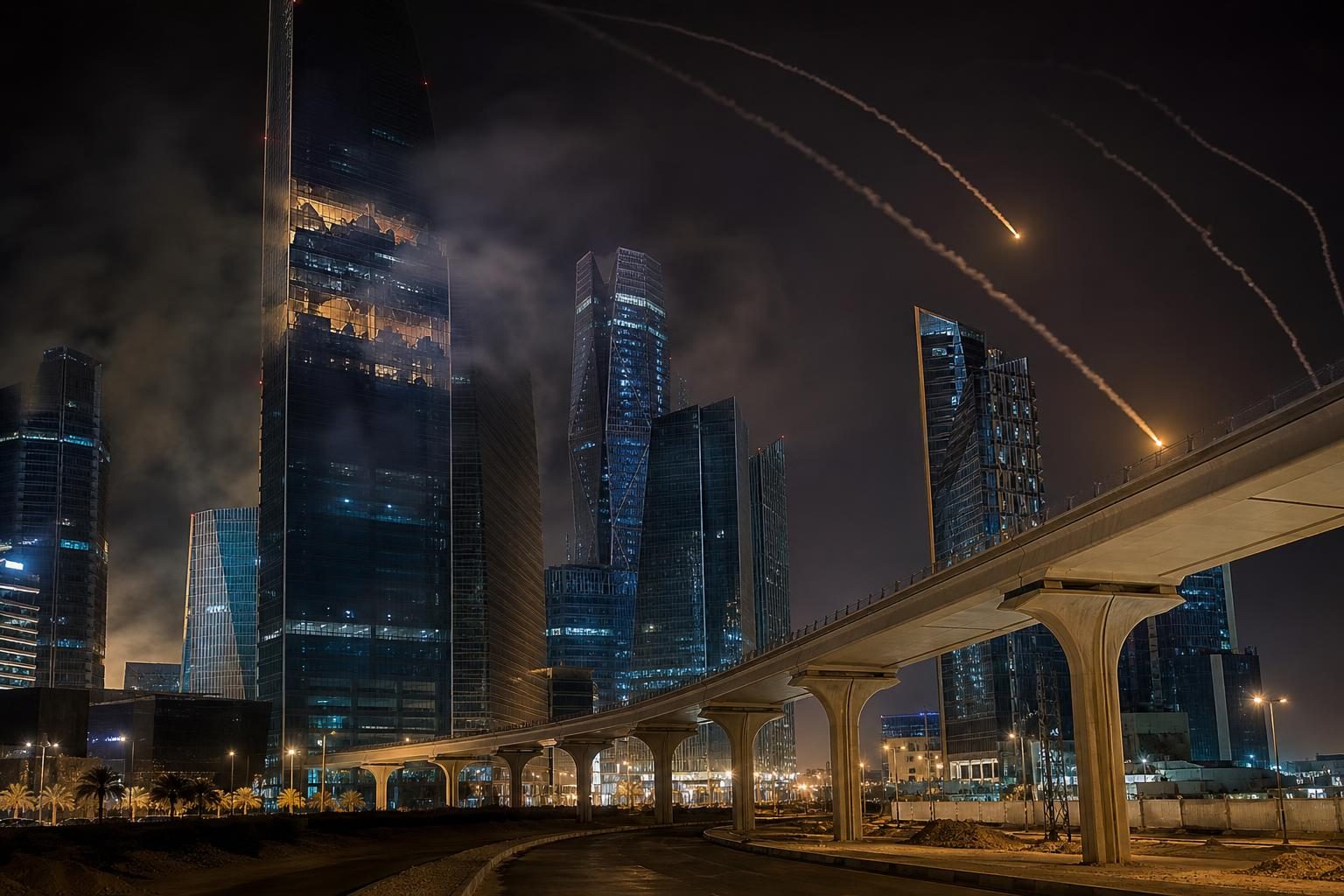
Illustration · Liberty Bell Report
The Iran-backed Houthi militia has carried Yemen's war to the front door of Saudi Arabia's showcase financial district. On Sunday, November 8, multiple witnesses told AFP that the Aramco tower in Riyadh's King Abdullah Financial District had been hit, leaving shattered glass and visible damage to part of the facade. The Houthis claimed responsibility for striking the oil giant's corporate office, and Saudi Arabia's energy ministry said debris from what it called an attempted attack shattered windows on several floors, Reuters reported.
That strike opened a week of escalation that has not let up. The question for Americans: what happens to U.S. interests when an Iran-backed militia is free to batter a key partner while Washington keeps its distance?
A Week of Fire Over the Kingdom
AFP called the financial district a prominent emblem of the kingdom's modernization drive, noting that it includes housing and a busy metro hub, and that targeting it would mark a major escalation. Coalition spokesman Turki al-Malki said Sunday that Saudi air defenses destroyed two Houthi ballistic missiles fired toward Riyadh, as loud blasts were heard in the capital.
On Monday, Saudi state media reported that an attack on the East-West Pipeline in the Medina region sparked a limited fire without affecting operations. On Tuesday, the coalition said it intercepted a ballistic missile and a cruise missile fired at Riyadh, another ballistic missile headed for the south and a drone over the oil-rich east, while civil defense alerts sounded in Riyadh, Abha and Khamis Mushait, Reuters reported.
Then came the Mecca region. Saudi civil defense said two ballistic missiles the Houthis fired toward the area on Wednesday were intercepted and destroyed, scattering debris across several locations, including the village of Sabuhah, Reuters reported. In a statement early Thursday, civil defense blamed the Houthis and denounced the "hostile targeting of civilian objects" as a serious breach of international humanitarian law. The report did not say whether anyone was hurt.
Claims and Counterclaims
Both sides' accounts deserve caution. Houthi military spokesman Yahya Saree said the group hit King Khalid International Airport in Riyadh and an oil facility at Abqaiq in the Eastern Province, claims on which Saudi Arabia offered no immediate comment. The Houthis also said they struck the pipeline in Riyadh Province, not Medina, and they have repeatedly denied Saudi accusations that they target Mecca and Medina. They had not commented on the Mecca-region debris, and they say their operations target military and strategic sites.
The Houthi-run Saba news agency reported Saudi airstrikes on a petrol station and a state oil company building in and around Sanaa. Still, the arc of this conflict is plain. A 2022 truce collapsed in July after the Houthis let an Iranian plane land in Sanaa in defiance of Saudi control over Yemeni airspace; the group then declared a maritime blockade of Saudi Arabia, struck its ships and oil facilities, and seized long stretches of Yemen's Red Sea coast, AFP reported.
The Ground War Inside Yemen
The missiles over Saudi cities are only half the fight. Inside Yemen, forces loyal to the internationally recognized government are waging a Saudi-backed counteroffensive, Operation Dawn of Yemen, to win back territory the Houthis seized in September, with coalition airstrikes in support, Al Jazeera reported. Government spokesman Majed Abdullah al-Nuzaili said Tuesday that his side carried out at least 29 airstrikes and 39 drone attacks, fired 62 rockets and conducted 744 artillery strikes on Houthi positions in Lahij, Taiz, Marib, al-Jawf, Hajjah and al-Bayda. He said early field reports showed "about 190 Houthi commanders and fighters were killed or injured," and that as many as 130 Houthi vehicles and combat assets were damaged or destroyed.
The Houthis tell a different story. Saree said Saudi-backed forces launched 109 air and missile strikes on Sanaa and Houthi-held areas in five provinces, killing and wounding many women and children, and he claimed heavy government losses in Lahij and al-Jawf. Al Jazeera could not verify either side's battlefield figures. What no one disputes is the suffering of ordinary Yemenis. The World Health Organization counts at least 1,771 people killed and 7,959 wounded in the fighting since August, with more than 300,000 driven from their homes.
The Hormuz Connection
Why should a fight in Yemen matter to families in Ohio or Texas? Geography. With the wider conflict disrupting shipping through the Strait of Hormuz, Riyadh has been using the East-West Pipeline to send about 4 million barrels of crude a day to the Red Sea port of Yanbu, roughly 4% of global supply, according to Reuters. Tankers loading at Yanbu must then pass through the Bab el-Mandeb Strait. Fighting has sharpened since September, when the Houthis pushed toward that chokepoint, and Reuters notes the escalation now threatens it. Put simply, the pipeline the Houthis keep hitting is the kingdom's main detour around Hormuz.
Markets, for now, are betting on diplomacy. Brent crude was down nearly 5% at $93.75 a barrel by midday Monday, its lowest since early September, after a 16% plunge the week before, Reuters reported. Sellers took their cue from President Trump's statement that he was highly unlikely to order new attacks on Iran while talks to end the conflict moved forward, even as senior U.S. and Gulf officials doubted a deal was near. One trading firm, TACenergy, said the remarks emboldened sellers "even while the actual fighting is not slowing down". A sobering figure for Americans: the Strategic Petroleum Reserve has dropped to 279.5 million barrels, its lowest since October 1982, Energy Department data show.
Where Is Washington?
So far, the administration has kept American forces out of this fight. In September, Mr. Trump twice declined Saudi Crown Prince Mohammed bin Salman's pleas to bomb the Houthis and instead provided intelligence and targeting data, with U.S. officials telling the Saudis he wanted American forces focused on Iran and the Strait of Hormuz, Newsweek reported.
The hardest test came on October 10, when a Houthi missile struck a passenger terminal at Riyadh's King Khalid International Airport, killing 13 people, including a U.S. citizen, and wounding more than 300. Asked whether the United States would join Saudi strikes, the president answered, "We may. We're going to look at it". A month later, the missiles are still flying toward Riyadh.
There are reasons for caution. In 2025, Mr. Trump bombed the Houthis for several weeks before accepting an Oman-brokered truce that spared U.S. ships, and the Houthis have reportedly assured American diplomats in Muscat that the Bab el-Mandeb will stay open to everyone except Saudi vessels. But Saudi officials say the kingdom is running low on interceptors, and American supplies of Patriot interceptors are already thin, Newsweek reported. Sources told Reuters, Newsweek noted, that Iran's Revolutionary Guards helped steer the Houthis' Red Sea offensive and urged escalation; Tehran denies any role.
Others are stepping into the gap. Saudi Arabia, Pakistan and Turkey signed a mutual defense pact in Mecca in August and later agreed to a rapid deployment of forces to the kingdom, though Turkey has ruled out an offensive role. Yemeni officials told AFP that thousands of Syrian troops are set to deploy to Saudi Arabia and Yemen, with some already in place.
The Hard Questions Ahead
Restraint has real merit; no one wants American sailors drawn into another open-ended war. But restraint is not a strategy when it leaves a partner absorbing blow after blow.
First, can an arrangement that shields American ships while leaving Saudi ones fair game hold, when a U.S. citizen has already died in a Houthi strike on a Saudi airport? Second, Newsweek reported that Washington needs Saudi airspace to resume major combat against Iran, though Riyadh lobbied against that step in August. How much leverage does America keep with Tehran if the kingdom's skies are left to others to defend? Third, with the strategic reserve at a four-decade low and the main Hormuz bypass under repeated attack, what is the plan if one of these strikes finally lands hard? And who fills the vacuum if America does not? A Gulf security order leaning on Pakistani, Turkish and Syrian deployments is not one organized around American leadership.
What comes next will turn on whether the Houthis hit the pipeline or Yanbu again, and whether diplomacy with Iran yields anything while Tehran insists it will not negotiate unless Washington meets seven conditions from a June interim agreement. Meanwhile, Christians of good will can pray for Yemen's battered civilians and for the safety of Americans in the region. Strength, wisely used, remains the surest path to peace.
Sources
- AFP via Yahoo News: Riyadh financial district targeted, Aramco tower damaged: witnesses (link)
- Reuters via Khaleej Times: Oil falls almost 5% as Trump signals restraint on Iran (link)
- Reuters via The Star: Saudi-led coalition says it shot down Houthi missiles aimed at Riyadh (link)
- Reuters via The Jerusalem Post: Saudi Arabia says debris from intercepted missiles fell in Mecca region (link)
- Al Jazeera: Yemeni forces, Houthis exchange attacks, claim to inflict heavy losses (link)
- Newsweek: Trump mulls Houthi strikes: 3 scenarios (link)
— 30 —