Science & Space
One Light-Day From Home: Voyager 1, Launched in 1977, Becomes the First Human-Made Object So Far From Earth
A radio hello now takes a full day to reach the probe and another day to come back, and the little spacecraft built with 1970s technology is still sending science from interstellar space.
By HANNAH LINDGRENStaff Correspondent · CALIFORNIA · Nov 18, 11:31 AM · 3 min. read
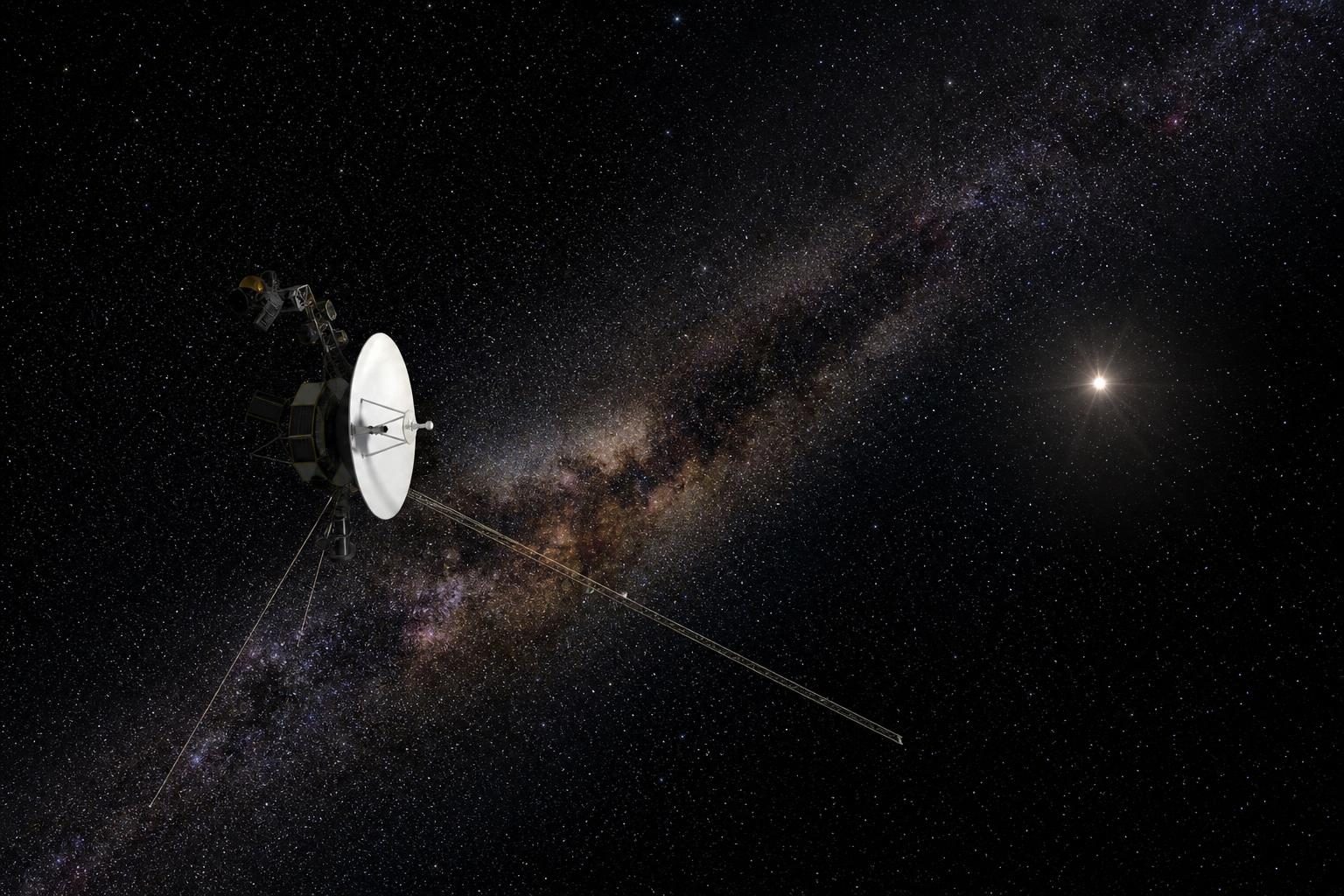
Illustration · Liberty Bell Report
Far beyond the planets, a spacecraft that left Earth nearly half a century ago crossed an invisible line on Wednesday that no human-made object had ever reached. Voyager 1 is now one light-day from Earth, so far away that a radio signal traveling at the speed of light needs a full day to reach it.
What a Light-Day Means
A light-day is the distance light travels in 24 hours. For Voyager 1, that is about 26 billion kilometers, or roughly 16 billion miles, Deutsche Welle reported. Only one human-made object has ever traveled that far, and its journey into interstellar space continues.
The practical meaning is striking. When mission controllers send a command, it now takes about a day to arrive, and the spacecraft's reply needs another day to come back, Space.com reported. Just saying hello is a two-day round trip.
To put that in perspective, sunlight reaches Earth in a little over eight minutes. A day of light travel is about 170 times the distance between the Earth and the Sun. Voyager 1 has covered that ground at more than 30,000 miles per hour, year after year, with no stop for repairs.
The Los Angeles Times reported that, after half a century in space, Voyager 1 would on Wednesday reach the point where light needs a full day to travel between it and Earth.
Built to Last
Voyager 1 launched in 1977, and it and its twin, Voyager 2, are still beaming back data from interstellar space as they approach the 50th anniversary of their launch next year, CBS News reported. The Voyagers have been moving at more than 30,000 miles per hour for 49 years, NPR reported, citing a person with the mission.
Voyager 1 left Earth on a faster path than its twin, which is why it got here first. Space.com reported that Voyager 2 is expected to reach the one light-day mark in November 2035.
The person who last laid hands on Voyager 1 before launch called the milestone "a tribute to the engineers who designed something that can last that long," the Los Angeles Times reported. That is the right way to see it. The probe was designed and built with 1970s technology, by engineers who could not have known how long their work would last. It was sent to explore the outer planets, and it has outlived nearly every expectation set for it.
Nothing Happens, and That Is the Point
Newsweek noted that nothing dramatic happens to the spacecraft itself when it passes the one light-day mark. There is no wall to break through and no alarm to sound. The milestone is a measure of distance and of endurance, and of patience on the ground: every conversation with Voyager now requires waiting a day for an answer.
Every year of data from interstellar space is a bonus nobody could count on when Voyager left Cape Canaveral, and both probes are still sending it. Their twin journeys have given scientists their only direct measurements from beyond the bubble the Sun blows around the planets, and the longer they last, the more they teach.
Why It Matters
In a week dominated by outages, wars and politics, Voyager 1 offers something different: proof of what Americans can do when they set a hard goal and build to meet it. A mission planned to tour the outer planets became humanity's longest-distance messenger instead, and a source of pride for the engineers, scientists and taxpayers who made it possible.
There is wonder in it, too. Long before telescopes and space probes, the psalmist looked up and wrote, "The heavens declare the glory of God." Voyager 1 has spent nearly 50 years showing just how vast those heavens are, and how small and precious our home is within them.
The little spacecraft keeps going, a day's journey of light away, still listening for word from home.
Sources
- Space.com: 1 light-day from Earth! NASA's Voyager 1 probe hits huge milestone in interstellar space (link)
- NPR: NASA's Voyager 1 spacecraft reaches a distance of 1 light-day from Earth (link)
- Los Angeles Times: NASA's Voyager 1 will soon be so far away that its messages take a day to reach Earth (link)
- Deutsche Welle: NASA's Voyager 1 reaches a light-day away from Earth (link)
- CBS News: Voyager 1 sets new distance record of one 'light day' from Earth (link)
- Newsweek: NASA Reveals What Happens When Voyager 1 Reaches Historic Distance (link)
— 30 —