Pushback
One Year Into 'Free' Child Care for All, New Mexico Still Lacks the Seats, and Oil Money Is Paying the Bill
NPR's first-year look finds real gains for working mothers. It also shows a program sold as universal reaching about half of young children, needing thousands more workers and leaning on the oil and gas revenue many progressives want to phase out.
By DOUGLAS PARKStaff Correspondent · NEW MEXICO · Nov 15, 7:00 AM · 4 min. read
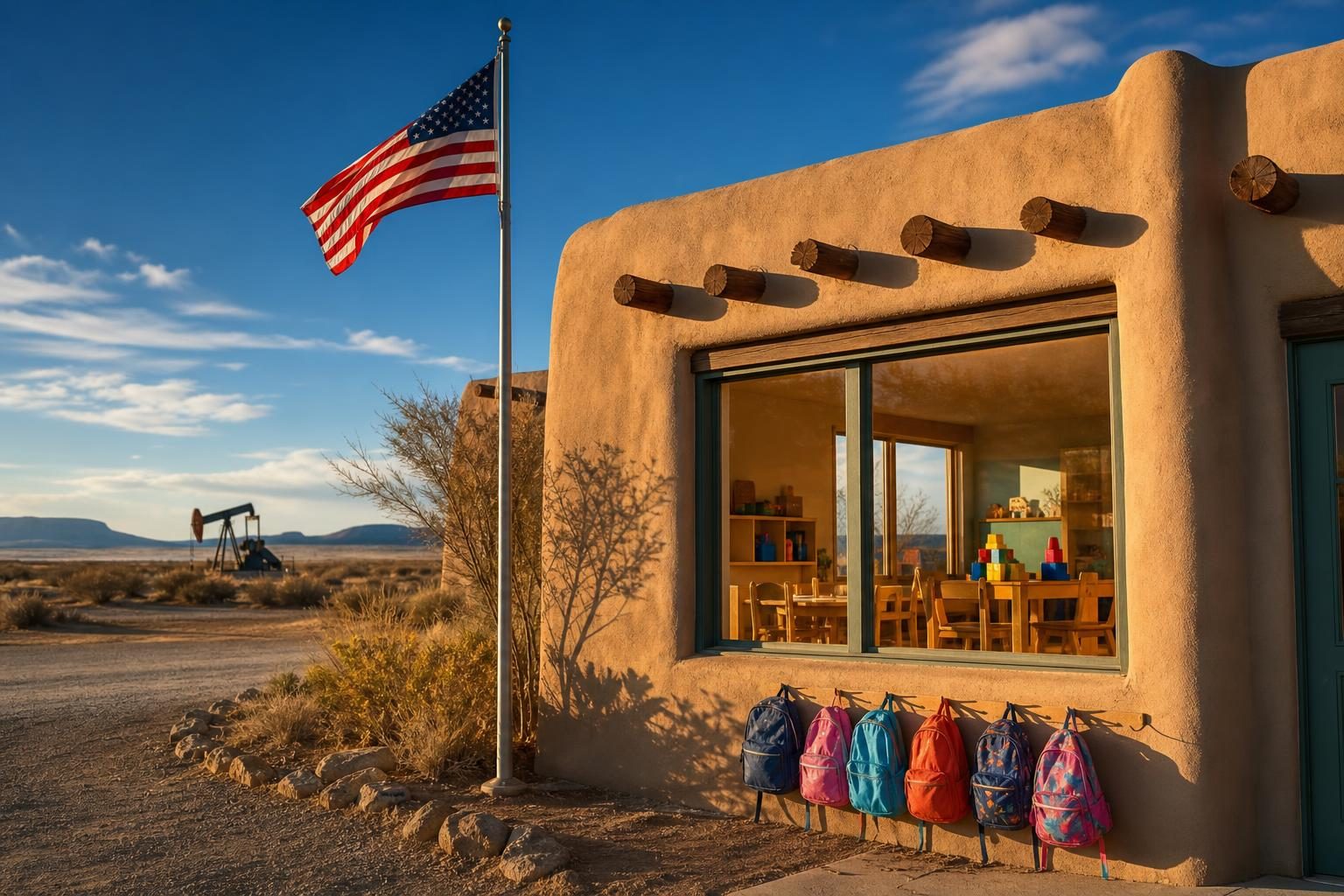
Illustration · Liberty Bell Report
A year ago this month, New Mexico became the first state to offer free child care to every eligible family regardless of income, NPR reported Sunday in a first-anniversary look at the program. Gov. Michelle Lujan Grisham announced the plan in September 2025, and lawmakers wrote it into state law in March 2026. Supporters now hold it up as a model for other states.
Before anyone does, the facts in NPR's own reporting deserve a hard look.
What Supporters Say Has Worked
Credit where it is due. NPR reported that more than 16,000 additional children have enrolled since the program began, according to the state. It also cited an Arizona State University analysis finding that full-time employment among lower-income mothers in New Mexico rose by 23 percent after the change. Families who were stuck on waiting lists or paying a large share of their income for care have real relief, and no one should dismiss that.
The Quebec experience points the same way on that question. A new working paper featured by the National Bureau of Economic Research finds that Quebec's subsidized child care had an enduring positive effect on mothers' employment, with the long-run earnings effect growing to twice the size of the participation effect.
What the Numbers Also Show
Now the other side of the ledger.
First, "universal" is a promise, not yet a fact. About half of the state's roughly 67,000 children age 5 and under are enrolled, NPR reported. The state's own government says that to reach a truly universal system it must create nearly 14,000 more child care slots and recruit 5,000 more educators. Advocates have openly questioned whether a program can be called universal when there are not enough spots for the families who want them, especially in rural areas and for infants and toddlers, the Pew Charitable Trusts reported.
Second, much of the new enrollment did not go to families who were shut out before. More than half of the newly enrolled children were already eligible for help under the state's previous income rules, according to the state figures NPR reported. That means a large share of the cost is going to make care free for families who already qualified for aid or who could afford to pay something.
Third, look at who is paying. The Early Childhood Education and Care Fund, created in 2020, was built from surplus oil and gas tax revenue, and it now supplies the majority of the money for the universal program, Pew reported. Pew put the fund at about $11 billion, with distributions expected to contribute at least $500 million a year. New Mexico's free child care, in other words, runs on the Permian Basin, the same oil patch that many on the left want to shrink. A program that depends on high oil prices and strong production is only as secure as the industry its champions often campaign against.
Fourth, the evidence on children is more mixed than the slogans. Economists Michael Baker, Jonathan Gruber and Kevin Milligan studied Quebec's move to very low-cost care for children under 5 in 1997. They found a lasting negative impact on children's non-cognitive skills, the behavior and emotional habits that matter so much in life, with no consistent effect on cognitive skills. Exposed cohorts later showed worse health, lower life satisfaction and higher crime rates, with the crime effects concentrated among boys, according to the study published in the American Economic Journal: Economic Policy. That does not mean every child in care is harmed. It does mean policymakers should not pretend that more hours in institutional care is automatically good for every child.
Who Is Pushing Back
The debate is not only coming from outside New Mexico. When lawmakers wrote the funding plan, the state Senate passed a version that would require co-payments from higher-earning families under certain economic conditions, and the governor objected that a mandatory co-pay for even a limited number of families is not universal by definition, according to coverage of the vote. Those senators were asking a fair question: why should a family of modest means help pay for free care for a family that earns several times as much?
A Better Answer
Conservatives want what every parent wants: children who are safe, loved and ready to learn, and parents who can provide for them. The best way to get there is to put the choice in parents' hands. Help that follows the family, through a larger child tax credit or support that can go to a church nursery, a neighborhood provider, a grandmother or a parent who stays home, respects the fact that there is no single right answer for every child.
New Mexico has run a bold experiment, and the honest report card after one year is incomplete. Gains for working mothers are real. So are the empty seats, the missing workers, the oil-dependent funding and the warning signs from Quebec. Other states should study all of it before they sign up.
Sources
- NPR: New Mexico wanted free childcare for all. This is what's worked — and what hasn't (link)
- Pew Charitable Trusts: Are State Trust Funds an Answer to Rising Child Care Costs? (link)
- Yahoo News: NM Senate passes bill to pay for universal child care (link)
- SSRN (American Economic Journal: Economic Policy): Non-Cognitive Deficits and Young Adult Outcomes: The Long-Run Impacts of a Universal Child Care Program (link)
- National Bureau of Economic Research: Subsidized Childcare and Mothers' Labor Outcomes in Quebec (link)
— 30 —