Investigations & Special Reports
Signed Off, Then Brought Down: City Records Show a Risky Dig Was Approved Beside 1321 Flatbush Before It Fell
New reporting says New York's Buildings Department approved a risky way to dig beside 1321 Flatbush Avenue and let visible cracks go unaddressed for years. Eight people are dead, and the city still owes their families answers.
By KEVIN NAKAMURAStaff Correspondent · NEW YORK · Nov 21, 10:40 AM · 5 min. read
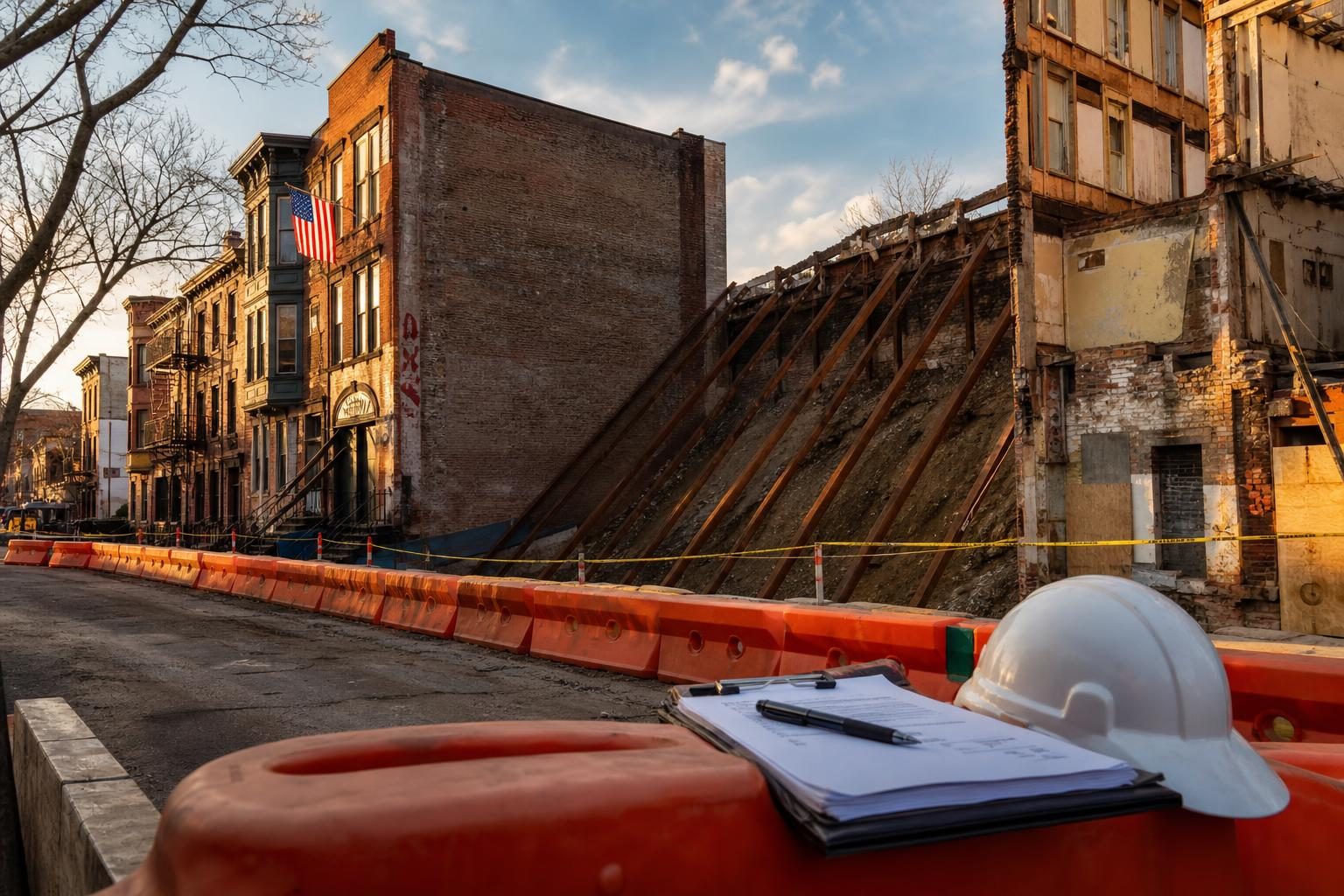
Illustration · Liberty Bell Report
Ten days after a three-story building at 1321 Flatbush Avenue in Brooklyn came down and killed eight people, the questions about what went wrong are no longer only about the construction crew next door. They are about the agency that is supposed to stand between New Yorkers and exactly this kind of disaster.
The New York Times reported Saturday that experts say the city's Department of Buildings approved a risky method of supporting the old building while workers dug the site beside it, and that the building collapsed months later. The New York Post, in its own reporting, said city building inspectors had for more than a decade overlooked large cracks that were visible across the doomed tenement's facade and never took action to correct them.
Neither report settles the cause of the collapse. Investigators have not issued findings, and the city defends its review of the plans. But taken together with records reported earlier this week, they draw a picture that every New Yorker who lives beside a construction site should study.
What the Times Found
At the heart of the Times report is a choice about how to hold up an old building when the ground next to it is being dug out. When excavation runs close to an existing foundation, engineers have two broad options. One is underpinning, which means extending the old building's foundation deeper, section by section, so it rests on soil that will not be disturbed. The other is to leave the neighbor's foundation as it is and protect it by shaping the soil, shoring and bracing the excavation.
Records reported earlier this week show the city approved the second path for the wall that mattered most. The Department of Buildings approved excavation plans that relied on benching, sloped mounds of earth left in place, rather than the underpinning that a geotechnical study had recommended, according to a report carried by Yahoo News. The approved plans called for digging into the soil at a 45-degree angle to a depth of roughly 15 feet beside the building's old rubble foundation, The Real Deal reported.
The same plans called for extensive shoring and bracing along most of the construction lot, including the backyard of 1321 Flatbush, but none right next to the building itself, according to the reports. In other words, the most vulnerable wall on the block appears to have had the least engineered protection.
The Times reported that experts it consulted considered the approved method risky for that setting.
Cracks in Plain Sight
The building that fell was old and, by several accounts, already in trouble. The Post reported that large cracks had been visible throughout the facade for more than a decade and that city inspectors never took action to correct them.
A pre-construction survey filed with the city in March rated the building's north facade in poor condition, according to records described in news reports. A survey like that exists for one reason: to warn everyone involved that a neighboring structure is fragile before the digging starts. Whether anyone at the Buildings Department responded to that warning is one of the central questions now.
It is worth being careful here. A crack in a brick facade is not proof that a building is about to fall, and old New York buildings are full of them. But when a survey flags a facade as poor and an excavation plan then removes soil at an angle beside the same building's foundation, the city's review is supposed to connect those two facts.
A Stop-Work Order That Didn't Stop the Work
The record at the construction site next door raises its own questions. On March 20, city inspectors found demolition underway at the neighboring property without adequate overhead protection for adjoining buildings, and the department issued a violation and a stop-work order, NBC New York reported. When inspectors came back on April 23, they found demolition had resumed in defiance of the order, leading to a second violation. NBC New York reported that the violation named the demolition contractor, N Tech Design of America, and that it is now listed as resolved.
The Real Deal separately reported that the contractor on the site beside the collapse had stacked up fines.
Fines and violations are only as strong as the follow-through behind them. A stop-work order that a contractor can simply ignore, and a violation that later shows up as resolved in a database, will not protect the family on the third floor next door.
What the City Says
The Department of Buildings has defended its plan review. The department said the earthwork and support-of-excavation plans for the three-story project at 2625 Bedford Avenue went through a full plan exam and were found to comply with the city's requirements, according to the report carried by Yahoo News.
That answer deserves to be taken seriously, and it may turn out that the plans technically met the code. But it is not the end of the inquiry. If plans that complied with the rules still left a fragile building unprotected, then the rules, or the way they are applied, have failed. If the plans were not followed in the field, then the question becomes who was watching.
The Questions Still Open
The trade publication ENR, reviewing the available records, reported that it remains unclear whether 1321 Flatbush was ever actually underpinned. The records do not establish what excavation-support pieces had been installed along the property line, or what the most recent readings of movement, cracks and vibration showed before the building came down, ENR reported.
Those gaps matter. Monitoring readings are the early-warning system on a job like this one. If the sensors showed movement and no one stopped the work, that is one kind of failure. If no one was taking readings at all, that is another. The families deserve to know which it was.
Several other questions remain unanswered in the public record so far:
Did anyone at the Buildings Department read the March survey that rated the facade poor, and if so, what did they do?
Why did the approved plans protect the backyard of the building with shoring and bracing but not the wall beside the dig?
Who checked the excavation once it began, and how often?
What happened between the April violation for ignoring a stop-work order and the day of the collapse?
Why It Matters
Keeping buildings standing is one of the most basic jobs a city government has. It is not glamorous. It does not make headlines when it is done well. But it is the kind of work that ordinary families, many of them renters in older buildings in neighborhoods like Flatbush, depend on without ever thinking about it.
Eight people did not come home after that afternoon. A city that can find money and energy for every new program should be able to make sure the inspectors it already employs act on warnings sitting in their own files. Accountability here is not about scoring points against one administration or another. It is about whether the people charged with public safety did their jobs, and whether the system they work in lets warnings fall through the cracks.
The investigations now underway need to answer those questions in public, with names, dates and documents. If the plans were flawed, the approval process must change. If inspectors ignored visible danger for years, that must change too. And if contractors can shrug off a stop-work order, the penalties need teeth.
Before the next excavation begins beside the next fragile building, the city should be able to show, step by step, that someone with the power to stop the work is actually watching. That is the least the families of the eight deserve.
Sources
- The New York Times: Before a Fatal Building Collapse, Officials Signed Off on a Dubious Plan (link)
- New York Post: NYC inspectors 'overlooked' large cracks on doomed Brooklyn building years before it collapsed (link)
- Yahoo News: NYC approved construction plans near site of deadly Brooklyn building collapse despite major red flags: records, sources (link)
- The Real Deal: Contractor on Site Next to Flatbush Collapse Stacked Fines (link)
- ENR: UPDATED: Brooklyn Collapse Records Reveal Gap Between Plans and Site Work (link)
- NBC New York: Demolition next to collapsed building continued despite stop work order, violation says (link)
— 30 —