
 This morning on Command Post with Dan Whitaker
China's Ford-Size Nuclear Carrier Nears Launch at Dalian, a Wake-Up Call for America's Shipyards
New imagery and analysts say China's fourth carrier, the Type 004, could launch as early as 2027 and rival the USS Gerald R. Ford in size. Here is what it means for Taiwan, the Pacific and a U.S. Navy still short of ships.
Filed November 24, 2026 · 📍 Washington, DC 20001
Were you there? Share your story
Key points
- Analysts told Defense News the Type 004 could launch at Dalian as early as 2027, with full deployment taking five to 10 years.
- Janes estimates a finished length of 336 to 339 meters, in the same class as the 333-meter USS Gerald R. Ford.
- CSIS rates nuclear power as likely, which would give the ship global reach without tankers; Beijing has confirmed none of it.
- The Pentagon says China aims for nine carriers by 2035, while the U.S. Navy has 291 battle force ships against a legal goal of 355.
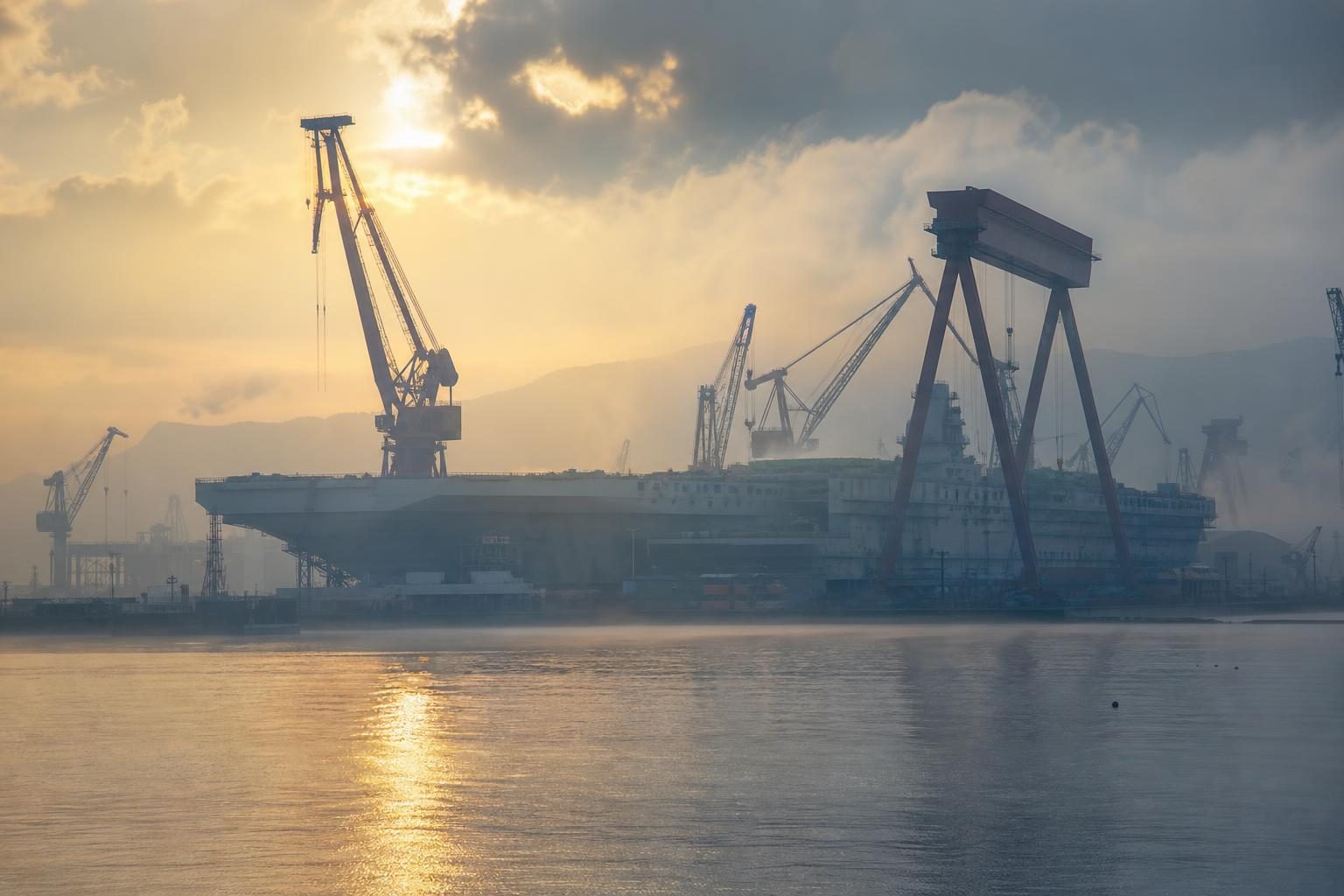
China's next aircraft carrier is no longer a smudge on a satellite photo. It is a hull roughly the size of an American supercarrier, and analysts now say it could be floated out as early as next year.
Defense News reported Monday that the ship, known in the West only as the Type 004, is nearing completion at a shipyard in the northern port city of Dalian, and that analysts expect it to be larger than any carrier China has built so far and to run on nuclear power [1]. Beijing has not officially disclosed the vessel's specifications, so nearly every number attached to it is an outside estimate drawn from overhead imagery [2]. The estimates are still worth taking seriously, and Americans should pay close attention to where they point.
What the Latest Images and Reporting Show
Collin Koh, a defense scholar at Nanyang Technological University, told Defense News that aerial photographs show the basic form of the hull already built, which he said bodes well for a launch in 2027 [1]. Koh said the ship's apparent dimensions would make it somewhat larger than the Fujian, currently the biggest carrier in China's fleet [1].
Measurements by the Center for Strategic and International Studies, cited by Defense News, put the unfinished hull at about 322 meters long and 46 meters wide as of October, and the think tank described it as far larger than any other class of surface warship in China's navy [1]. Janes reported that CSIS also found the new hull already bigger than the Fujian's at a comparable stage of construction, when that ship measured roughly 316 meters by 40 meters [2].
A launch is a milestone, not the finish line. Analysts quoted by Defense News estimated that getting the ship fully deployed could take five to 10 years after it first touches water [1].
Bigger Than the Fujian, Close to the Ford
The comparison that matters most is with America's newest carrier class. Janes measured the satellite imagery from the stern to the point where the bow is projected to end and estimated a finished length of 336 to 339 meters [2]. Janes puts the USS Gerald R. Ford at about 333 meters with a full-load displacement near 101,000 tonnes, which would place the Chinese ship in the same size category and possibly make it marginally longer [2].
Length is only part of the picture. Alexander Huang, who chairs the Council of Strategic and Wargaming Studies in Taipei, told Defense News he classes the vessel as a true supercarrier based on its electronics, tonnage and aircraft capacity [1]. Lyle Goldstein, who directs the Asia program at the Defense Priorities think tank, estimated the ship could carry 75 to 90 aircraft once it is deployed [1]. Those are educated guesses, not published specifications, and they should be read that way.
Why a Reactor Changes the Map
What truly sets the Type 004 apart is its likely power plant. CSIS rated nuclear propulsion as likely after imagery from May 4, 2026, revealed two compartments inside the hull, each roughly 15 meters on a side, that resemble reactor containment structures, Janes reported [2]. If that assessment holds, the ship would be the first nuclear-powered carrier in China's navy [1].
David Silbey, a military historian at Cornell University, told Defense News that nuclear power would give the carrier practically limitless staying power and let it deploy anywhere on the globe without depending on the refueling tankers that conventionally powered carriers need [1]. Koh added that a reactor would also give the ship more energy for launching aircraft than China's existing electromagnetic catapult system provides [1].
Koh's bottom line was blunt. "It seems to signal a certain global ambition," he told the outlet [1].
That is the heart of the matter. Huang noted that China's three current carriers are all based in the south and suggested the fourth could be assigned to northern China, where it might also handle training and maintenance roles alongside operations [1]. For Taiwan, a fourth deck means more jets and more directions from which pressure could come. For America and its allies across the Pacific, a ship that never needs to stop for fuel is a statement that Beijing intends to operate far beyond its own coastline, and to do so for as long as it likes.
From Three Carriers to Nine
The carrier is not a one-off. The Pentagon's annual report to Congress on China's military, released in December 2025, said the PLA Navy aims to produce six more carriers by 2035 for a total of nine, USNI News reported [3]. China already operates three carriers, the Liaoning, the Shandong and the Fujian, which puts it second only to the United States, and the report called the commissioning and sea trials of the Fujian a key modernization development [3]. USNI News noted that work on the Type 004 had begun in 2025 and described the nine-carrier goal as the largest carrier buildup in the region since World War II [3].
Those carriers sail atop the world's largest fleet by hull count. The Defense Department has described China's navy as the biggest in the world, with a battle force of more than 370 ships and submarines, a figure that does not even include roughly 60 small patrol boats armed with anti-ship cruise missiles, according to the Congressional Research Service [4]. The Pentagon projected that force would grow to 435 ships by 2030 [4].
America's Shipbuilding Gap and the Plan to Close It
The U.S. Navy, by its own count, operates 291 battle force ships, well short of the 355 that federal law requires, Stars and Stripes reported in May [5]. The service's new long-range plan, branded the Golden Fleet, projects 299 battle force ships plus 68 auxiliary vessels and 83 unmanned vessels by 2031, with a nuclear-powered Trump-class battleship as its centerpiece [5]. The Navy argues the battleship is needed because its Arleigh Burke-class destroyers are nearing the limits of their design [5].
On carriers, Naval News reported in May that the Navy plans to buy the future CVN-82 one year earlier than previously scheduled, in fiscal 2029 rather than 2030, using added funding, and to set a new design baseline beginning with that ship to boost lethality and survivability and make the ships easier to build [6]. The same report listed expected delivery years of 2027 for CVN-79, the future John F. Kennedy, followed by 2031 for CVN-80, 2034 for CVN-81 and 2039 for CVN-82 [6]. In other words, the next American carrier to join the fleet is due in roughly the same window in which China's newest could hit the water.
The industrial gap behind those dates is real, though often overstated. A widely repeated Navy briefing slide claimed China has about 230 times America's shipbuilding capacity. The Congressional Research Service cautions that the comparison measures gross tonnage of mostly simple commercial cargo ships, and that China's edge in building complex, heavily armed warships may be far smaller [4]. That is some comfort, but only some. Tonnage and skilled shipyard workers are what a navy draws on when it has to replace losses or surge in a crisis, and on that score Beijing holds the stronger hand today.
What Comes Next
The next milestone to watch is a float-out at Dalian, which analysts told Defense News could come as early as 2027 [1]. After that come years of fitting out, sea trials and air-wing training before the ship is a genuine combat asset [1]. Beijing has confirmed neither the reactors nor the timetable, and estimates of the finished length still rest on projections of a bow that is not yet built [2].
At home, the Navy's plan to pull a carrier purchase forward and the Golden Fleet blueprint both depend on lawmakers funding them year after year [5][6]. Plans are cheap; hulls are not.
This is where peace through strength stops being a slogan. Deterrence keeps the peace only when an adversary looks across the water and concludes it cannot win, and that judgment is shaped in dry docks long before any crisis begins. China is pouring steel at Dalian with a clear purpose. The surest way to keep that ship in port is for America to keep building its own, steadily and on schedule, until the balance of power in the Pacific is beyond question.
Sources
- [1]Defense NewsChina's fourth aircraft carrier, bigger than others and nuclear-powered, nears completionOpens in a new tab ↗
- [2]Opens in a new tab ↗
- [3]Opens in a new tab ↗
- [4]Congressional Research ServiceChina Naval Modernization: Implications for U.S. Navy Capabilities - Background and Issues for CongressOpens in a new tab ↗
- [5]Stars and StripesNavy details how it will realize 'Golden Fleet' initiative, including nuclear-powered battleshipOpens in a new tab ↗
- [6]Opens in a new tab ↗
Should U.S. military aid to Israel end early?
- Yes, Israel can afford its own weapons
- Phase it out slowly
- No, keep it while Iran is a threat
More in Military & Defense
MI5 Warns Ukraine Suppliers: Russia May Strike
This morning on Border Watch with Cole Brennan
Pentagon Courts GM, Ford for a Drone Surge
This morning on Command Post with Dan Whitaker
Farewell to the Reefer: The Navy Retires the Peacoat After More Than a Century at Sea
This morning on Command Post with Dan Whitaker
Were you there?
If you were at the scene, or this story touched your life, tell us what you saw and what it was like.
Discussion 0
Sign in or create a free account to join the discussion.
No comments yet. Start the discussion.