
 This morning on Faith & Family with Ethan Calloway
The Plate, the App and the Pew: How Faithful Americans Are Keeping Their Churches Funded in a Less Religious Age
New reports show Protestants moving their tithes online while Catholics still give in person. The bigger test, on this first Sunday of Advent, is whether the next generation learns to give at all.
Filed November 29, 2026 · 📍 Sacramento, CA 95814
Were you there? Share your story

Key points
- Axios reports 56% of Protestant worshippers give electronically versus 42% of Catholic and Orthodox worshippers.
- Religion's share of U.S. charitable giving fell from 49% in 1991-95 to 24% in 2021-25, per the Lake Institute.
- Americans still gave $151.6 billion to religion in 2025, and fewer donors are giving more per person.
- Pew finds the decline in America's Christian share has slowed and may have leveled off; the next generation is the real test.
On the first Sunday of Advent, millions of American families will drop an envelope in a basket, tap a phone against a kiosk or scan a code printed in the bulletin. However they do it, they are keeping alive one of the oldest habits of the Christian life: giving back to God a portion of what He has given.
How that habit works is changing fast, Axios reported Sunday, in a look at what it called the new reality facing the Sunday collection plate in a less religious America [1]. Technology can keep donations flowing even when people miss a Sunday, the report found, but it cannot guarantee that younger generations will give [1]. Both halves of that finding matter, and the second one matters most.
Two Ways to Give
The first thing the new data shows is that America's churches are running on two different giving cultures. Two 2026 reports from Ministry Brands, a company that supplies software to congregations, point to growth driven by digital convenience at Protestant churches and by physical attendance at Catholic parishes, according to Axios [1].
The numbers reflect the split. In a survey of worshippers, 56% of Protestant respondents said they give electronically, compared with 42% of Catholic and Orthodox respondents combined, Axios reported [1]. Among Ministry Brands' Protestant church customers, recurring gifts, the kind that come out automatically every week or month, now make up 35% of digital giving [1].
Some congregations have gone further. At Life Covenant Church in Torrance, California, worshippers can text a donation or scan a QR code printed in the bulletin, and lead pastor Tim Morey told Axios the church does not pass a plate at all [1]. Matthew Manion of Villanova University told Axios that churches with no way to accept gifts electronically are making it harder for their own people to support them [1].
Catholic parishes, by contrast, still lean on the moment in the Mass when the basket goes down the pew. That is not simply resistance to change. For many families, the offertory is part of worship itself, a visible act done together, often with a child's hand dropping in the envelope.
The Bigger Number Behind the Plate
Behind the change in method is a harder change in share. Three decades ago, religion drew nearly half of all the money Americans gave to charity. Today it draws roughly a quarter, according to the Lake Institute on Faith & Giving at Indiana University, as cited by Axios [1].
The Lake Institute's own analysis of the Giving USA 2026 report lays out that decline in five-year steps. Religion received 49% of all donations in 1991 through 1995, 38% in 2001 through 2005, 33% in 2011 through 2015, and 24% over 2021 through 2025 [2].
The dollars are still large. Americans gave $151.6 billion to religion in 2025, according to Giving USA figures cited by Axios, though those dollars lost purchasing power once inflation is taken into account [1]. A church-giving report from Tithely, citing Giving USA and the Lake Institute, put religion's share of all 2025 giving at 24.6% and found that religious giving fell 0.2% after inflation, making religion the only operating sector of charity that did not grow last year [3].
Attendance tells a similar story. The share of Americans who say they seldom or never attend religious services has climbed from 42% to 53%, Axios reported [1]. Gallup found in 2021 that the share of Americans who belong to a church, synagogue or mosque had fallen to 47% in 2020, the first time in its eight decades of polling that membership dropped below half [5].
What the Data Does Not Say
Those numbers are sobering, but they are not the whole picture, and they are not a eulogy.
Pew Research Center's most recent Religious Landscape Study found that 62% of American adults identify as Christian, and that the long decline in the Christian share of the population has slowed and may have leveled off since around 2019 [4]. That is not a revival by itself. It is, however, a sign that the steady slide many forecasters treated as inevitable may not be.
And the faithful who remain are carrying more of the load. Axios reported that fewer donors are now giving more per person [1]. In practice that means the families who show up week after week, and the members who set up a recurring gift and never miss a month, are holding up the ministries, food pantries, youth groups and missions that whole communities depend on.
That matters well beyond the church walls. When a congregation runs a soup kitchen, a recovery group or a Christmas toy drive, the money for it usually comes from the same offering plate, or the same app, that pays the pastor and keeps the lights on.
An Old Habit in a New Form
Nothing about a QR code changes what giving is supposed to be. The Bible's teaching on generosity has never been about the container. In the Gospel of Mark, Jesus watches the wealthy put large sums into the temple treasury and then praises a poor widow who gave two small coins, because she gave out of her poverty rather than her surplus (Mark 12:41-44). The apostle Paul told the Corinthians that each person should give as he has decided in his heart, "for God loves a cheerful giver" (2 Corinthians 9:7).
Seen that way, the rise of recurring digital gifts is not a betrayal of tradition. In some ways it echoes an older one: the principle of firstfruits, of setting aside the gift before anything else is spent. A tithe that leaves the account on the first of the month, before the bills and the shopping, is a discipline many pastors have urged for generations.
But convenience has a cost if it becomes invisible. A gift that happens automatically can stop being an act of worship and start being just another subscription. Churches that move online would be wise to keep giving visible in other ways, by praying over the offering, telling the congregation what its gifts accomplished and inviting families to give together.
Teaching the Next Generation to Give
The real test, as Axios put it, is the next generation [1]. Young adults who did not grow up in church have no habit of giving to one. Even many who did grow up in a pew may never have seen their parents write a check or hand over an envelope, because the gift went out through an app on a phone.
That is why the old basket still has something to teach. A child who drops a coin in the plate learns, in a way no screen can teach, that giving is something you do with your own hands, in front of God and your neighbors. Parents who give digitally can recover that lesson at home: by sitting down with their children to decide how much to give, by letting a son or daughter tap the button, and by talking about why the family gives at all.
Churches have a part to play, too. Clear reports on where the money goes, honest stewardship and real accountability build the trust that makes people want to give. So does preaching about generosity as a joy rather than a fundraising pitch.
The Season of the Gift
Advent is a season about a gift. Christians spend these four weeks preparing to celebrate the moment when God gave His Son to the world. It is a fitting time to ask what kind of givers we are teaching our children to be.
The collection plate may be passed less often in some churches, and the dollars may be moving through apps and kiosks. But the generosity behind them is as old as the faith itself. If families keep teaching it, and churches keep earning it, the next generation will find its own way to bring its gifts to the altar.
Sources
- [1]Opens in a new tab ↗
- [2]Lake Institute on Faith & GivingGiving USA 2026 Report: What the Latest Data Means for Faith-Based GivingOpens in a new tab ↗
- [3]Opens in a new tab ↗
- [4]Pew Research CenterDecline of Christianity in the U.S. Has Slowed, May Have Leveled OffOpens in a new tab ↗
- [5]Opens in a new tab ↗
Pope Leo XIV drew more than a million people in Argentina. Would you travel to see the pope?
- Absolutely
- Maybe, if he came to the U.S.
- No, but I'd watch on TV
- No
More in Faith & Religion

He Ran Toward the Gunfire: Bondi Beach Hero Earns Australia's Highest Bravery Award
This morning on From the Bench with Margaret Callahan

Arrested at 16, Still Waiting to Be Heard: The Fight to Save Pakistani Christian Shahzad Masih
This morning on From the Bench with Margaret Callahan
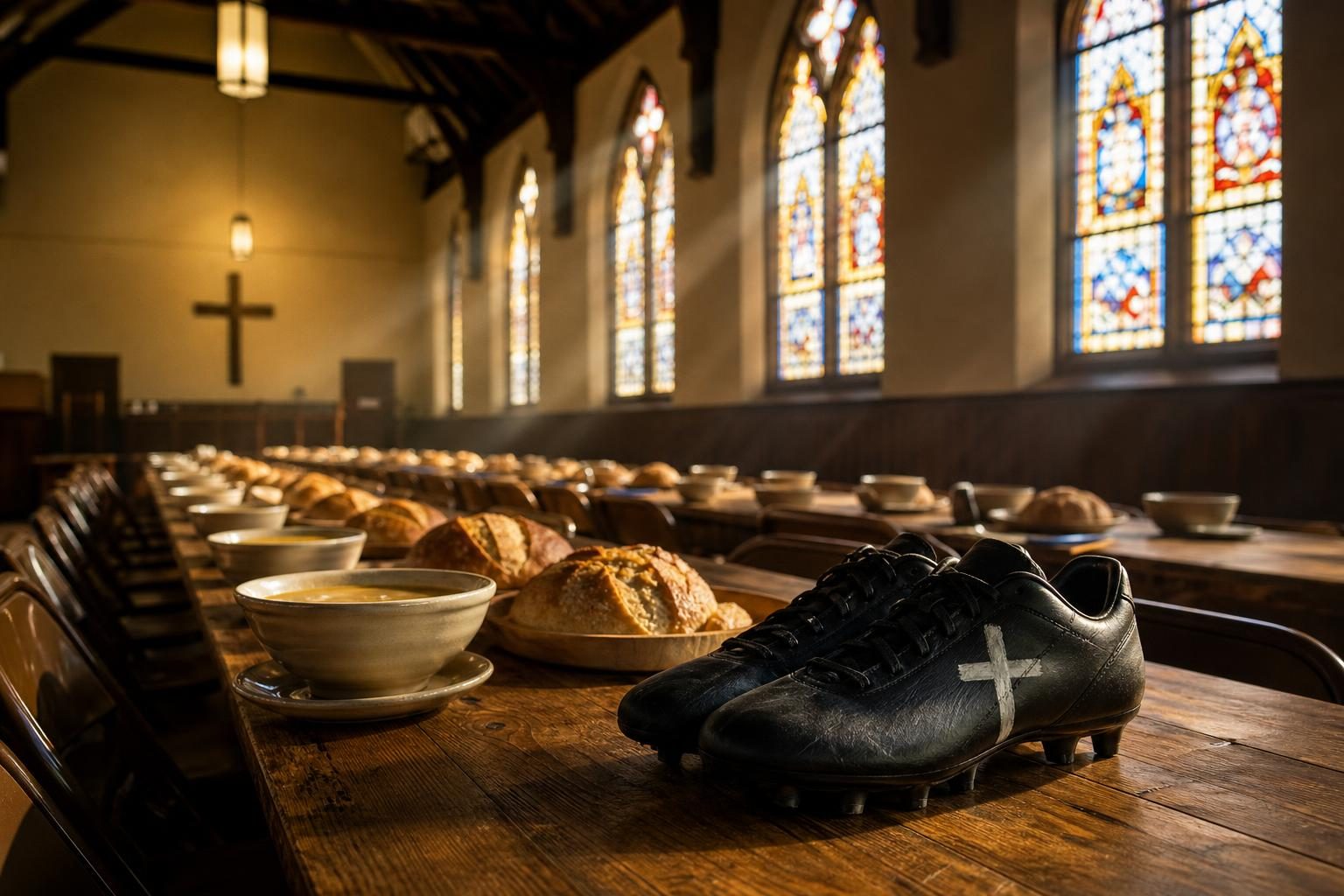
Fed in His Name: The Christian Charities on This Year's NFL Cleats Are Doing What Jesus Asked
Last night on From the Bench with Margaret Callahan
Were you there?
If you were at the scene, or this story touched your life, tell us what you saw and what it was like.
Discussion 0
Sign in or create a free account to join the discussion.
No comments yet. Start the discussion.