
 Today on Faith & Family with Ethan Calloway
Alberta Takes On Ottawa's Hate Law to Shield Sermons and Scripture
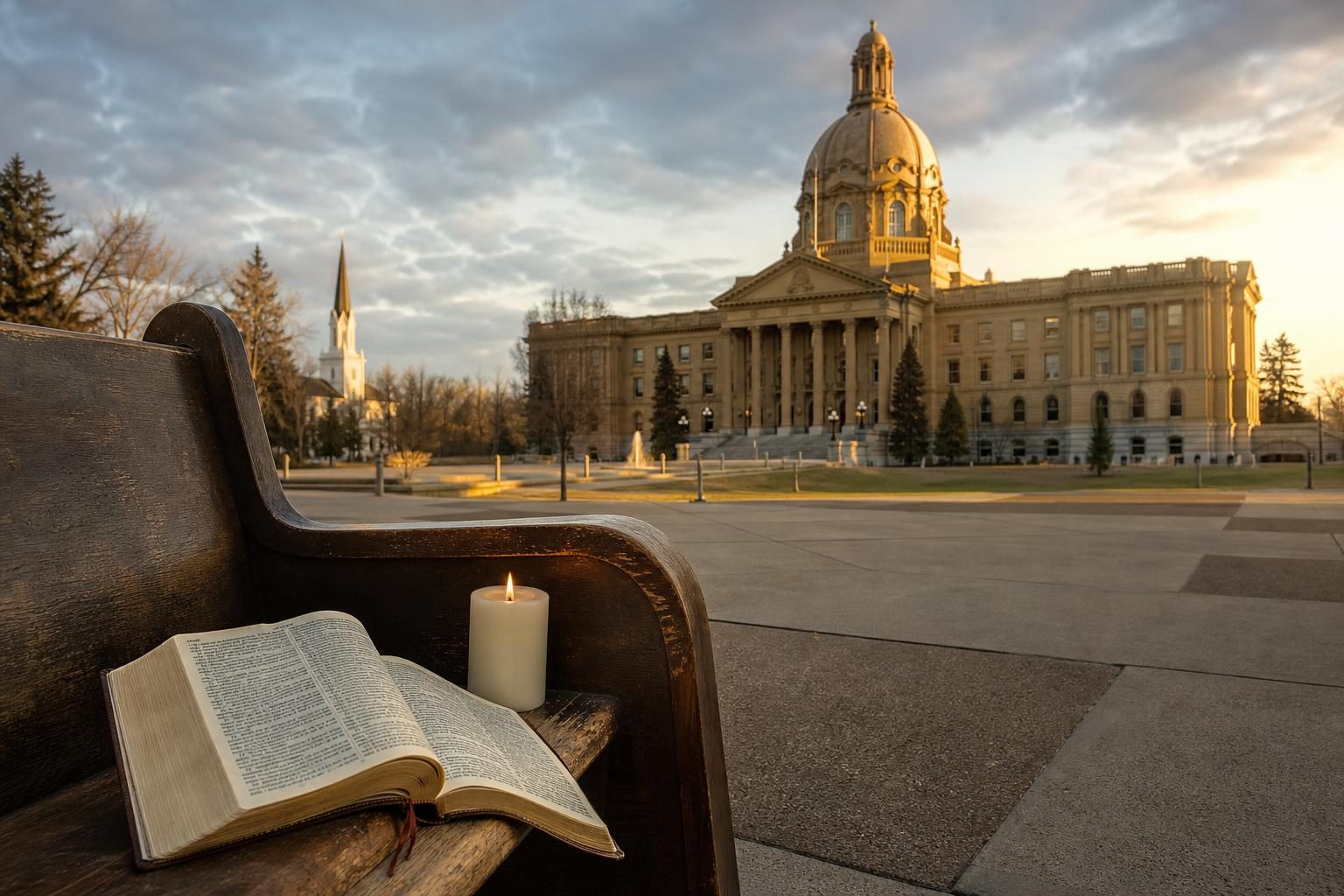
Premier Danielle Smith moved a Sovereignty Act motion against the federal Combatting Hate Act, which repealed a decades-old Criminal Code defence for good-faith religious speech.
Filed November 24, 2026 · 📍 Washington, DC 20001
Were you there? Share your story
Key points
- Alberta moved a Sovereignty Act motion Tuesday against Ottawa's Combatting Hate Act
- The federal law repealed a Criminal Code defence for good-faith religious opinion
- Catholic bishops warned the change creates uncertainty for clergy and believers
- Ottawa says sermons and scripture are not criminalized and the Charter protects faith
Alberta Premier Danielle Smith opened a new front in Canada's fight over religious freedom on Tuesday, moving a motion under the province's Sovereignty Act that takes aim at Ottawa's Combatting Hate Act, the federal law that stripped a long-standing protection for religious speech out of the Criminal Code [1][2].
Smith and Justice Minister Mickey Amery argue the federal law removed what they call a "good faith religion opinion defence," and they warned the change could be used to limit public worship and the freedom of believers, CTV News reported [1]. The government's announcement framed the motion as a stand for the fundamental rights and freedoms of Albertans, according to CBC News [2].
Speaking to reporters Tuesday afternoon, Amery said the provincial challenge is meant to spare Albertans from hesitating when they voice their religious convictions, CTV reported [1].
What Ottawa Changed
The dispute centers on Section 319(3)(b) of the Criminal Code, a defence that for decades protected people who, in good faith, expressed an opinion on a religious subject or an opinion rooted in a religious text. During committee work on Bill C-9, the Bloc Quebecois offered an amendment, tabled by MP Rheal Eloi Fortin, to delete that defence, and Liberal members of the Commons justice committee voted to approve it, The Catholic Register reported [3]. Fortin argued the defence could allow people to say things the Criminal Code otherwise bars, and Bloc leader Yves-Francois Blanchet had made the change a condition of his party's support for the bill, according to the Register [3].
The House of Commons passed the bill at third reading on March 25 by a vote of 186 to 137, the Register reported [4]. Parliament gave the measure final approval in June, repealing the religious-texts defence, The Catholic Herald reported [5]. Ottawa announced that month that the new hate-crime measures had become law [6].
Beyond the speech provisions, the law makes it a crime to block people from reaching places of worship or other places used by an identifiable group, CTV noted [1]. Few believers would object to protecting a congregation's path to its own front door. The objection is to what the bill took away at the same time.
Why Believers Are Paying Attention
Catholic leaders raised the alarm early. The Canadian Conference of Catholic Bishops and Cardinal Frank Leo of Toronto both condemned hate speech while warning that removing the exemption creates uncertainty for clergy, educators and all people of faith, the Register reported [3].
That uncertainty is the heart of the matter. A pastor preaching on marriage, a priest reading from the Epistle to the Romans, or a teacher in a Christian school explaining what the church has always taught should never have to wonder whether a prosecutor will call it hate. For generations, the Criminal Code itself answered that question. Now the answer depends far more on the judgment of police, prosecutors and judges.
The federal government insists those fears are misplaced. Justice Minister Sean Fraser has said freedom of religion is already fully and robustly protected under the Charter of Rights and Freedoms, the Register reported [3]. Federal officials have also said the law does not criminalize religious teaching, sermons, scripture, peaceful assembly, political advocacy or the expression of opinion and disagreement [6].
Supporters of Alberta's move answer that a reassurance from the government of the day is not the same as a defence written into the Criminal Code, one that any accused person can raise in court no matter who holds power in Ottawa. Charter rights are real, but they are weighed case by case, and the people who bear the cost of a test case are usually small congregations and ordinary believers, not the officials who wrote the law.
What the Sovereignty Act Can Do, and What Comes Next
Alberta passed the Sovereignty Act in December 2022, and Smith's government has since used it to challenge federal clean electricity regulations in 2023 and the federal cap on oil and gas emissions in 2024 [1][2]. This time, the province is invoking it on behalf of conscience and worship [1].
Criminal law belongs to Parliament in Canada, but provinces run much of its day-to-day enforcement through their own prosecutors and police. Initial reports on Tuesday did not spell out exactly what direction Alberta intends to give its prosecutors once the motion passes, and that detail will matter a great deal to churches and faith groups watching the debate [1][2].
The motion now goes before the legislature for debate. Ottawa has defended the Combatting Hate Act as a needed response to rising hatred, while religious leaders have pressed for clearer protection for sincere teaching [3][6]. Whatever the outcome in Edmonton, the clash puts a hard question in front of Canadians, and before Americans who prize the First Amendment: whether the freedom to preach and teach the faith should rest on the plain text of the law, or on the goodwill of whoever happens to be enforcing it.
Sources
- [1]Opens in a new tab ↗
- [2]Opens in a new tab ↗
- [3]The Catholic RegisterCommittee approves to remove religious speech defence in hate billOpens in a new tab ↗
- [4]The Catholic RegisterBill C-9 advances to SenateOpens in a new tab ↗
- [5]The Catholic HeraldCanada passes hate crime bill after repeal of religious texts defenceOpens in a new tab ↗
- [6]Department of Justice CanadaCanada's stronger hate crime protections become lawOpens in a new tab ↗
Pope Leo XIV drew more than a million people in Argentina. Would you travel to see the pope?
- Absolutely
- Maybe, if he came to the U.S.
- No, but I'd watch on TV
- No
More in Faith & Religion

A Record 30,000 Walk With Christ Through Sydney as Australia Readies for the World's Eucharistic Congress
This morning on From the Bench with Margaret Callahan
Where Faith Is Freest: New Rankings Put Alabama and Arkansas on Top for Religious Liberty, Michigan Last
This morning on From the Bench with Margaret Callahan

The President Who Stood Up for America's Faithful
This morning on Faith & Family with Ethan Calloway
Were you there?
If you were at the scene, or this story touched your life, tell us what you saw and what it was like.
Discussion 0
Sign in or create a free account to join the discussion.
No comments yet. Start the discussion.