
 Yesterday on The Power Grid with Priya Desai
Natural Gas Is Powering the AI Boom: What a Harvard Count of 403 Giant Data Centers Means for Your Electric Bill
A new peer-reviewed study finds America's hyperscale data centers use about as much power as a mid-sized state, mostly from gas and coal. The real fight now is over who pays for the next power plant.
Filed November 17, 2026 · 📍 Berkeley, CA 94704
Were you there? Share your story
Key points
- A Harvard-led study of 403 U.S. hyperscale data centers found they used about as much electricity in a year as Wisconsin, Michigan or Indiana.
- About 54% of that power came from fossil fuels, led by natural gas at 38% and coal at 15%, according to the study in Nature Sustainability.
- A Department of Energy-backed report projects data centers could use 6.7% to 12% of U.S. electricity by 2028, up from 4.4% in 2023.
- Washington is split between a pause, as Sen. Josh Hawley urges, and faster permitting that makes data centers cover the grid costs they create.
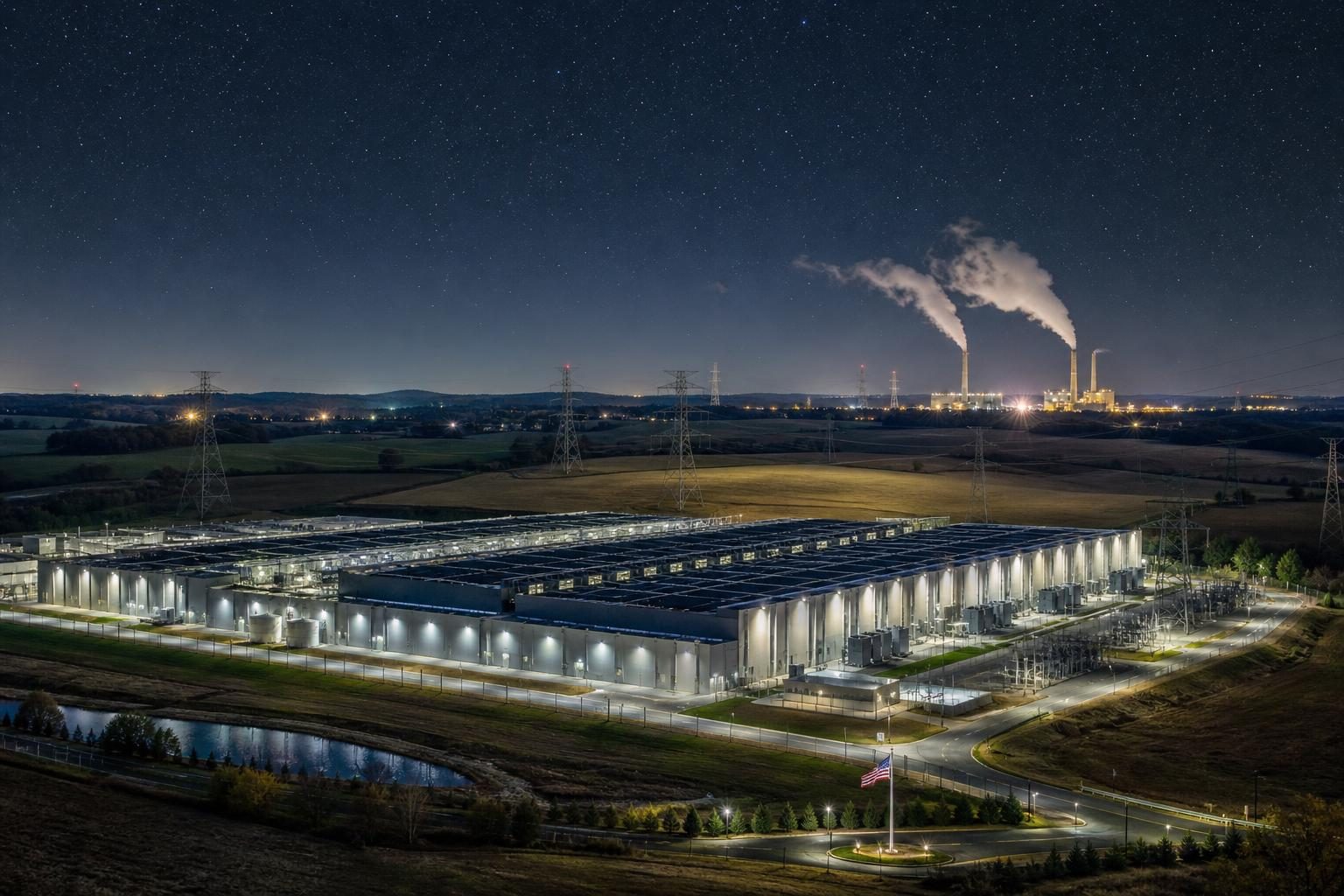
America's biggest data centers, the warehouse-sized server farms that run cloud computing and artificial intelligence, used about as much electricity in a year as the entire state of Wisconsin, Michigan or Indiana, according to a new Harvard-led study reported Monday by Time [1].
The peer-reviewed paper, published in Nature Sustainability, compiled facility-level information on 403 hyperscale data centers operating in the United States between May 2024 and April 2025, and estimated how much power they used, where that power came from and how much carbon dioxide it produced [2]. The lead author is Gianluca Guidi, and the team includes Harvard biostatistician Francesca Dominici [2].
For families watching their utility bills and for a country trying to win the race for artificial intelligence, the findings are worth reading closely. The headline is not that data centers are a menace. It is that the AI economy runs on reliable power, and right now most of that reliable power comes from American natural gas.
What the Study Found
The researchers found that roughly 54% of the electricity powering these facilities came from fossil fuels, mainly natural gas at about 38% and coal at about 15% [2]. The rest came from nuclear, hydropower, wind and solar on the regional grids where the centers are located.
The study estimated that the facilities were responsible for about 25.7 million metric tons of carbon dioxide over the year studied, two to three times higher than an earlier estimate for 2018, Quartz reported [4]. The authors noted that they did not have enough data to examine every hyperscale data center in the country, and because their study period ended in April 2025, today's demand and emissions are likely higher [1][4].
Geography matters. Virginia, Ohio, Iowa and Oregon together accounted for a majority of the electricity demand the study covered [2]. Time reported that Oregon, which hosts more hyperscale data centers than Iowa or Ohio, had far lower emissions because its grid leans heavily on cleaner sources [1]. Virginia, which tops the list, sits at the center of the story [2].
A Boom That Is Just Getting Started
The Harvard count is a snapshot of a fast-moving target. A report from the Lawrence Berkeley National Laboratory, released by the Department of Energy, found that data centers of all kinds used about 4.4% of U.S. electricity in 2023, or about 176 terawatt-hours [5]. The same report projected that figure could reach 325 to 580 terawatt-hours by 2028, or roughly 6.7% to 12% of national electricity use [5]. In 2018, by the report's count, data centers used just 1.9% of the nation's power [5]. The share more than doubled in five years, and on the report's projections it could double or triple again before the decade is out.
That range is enormous, and it reflects real uncertainty about how quickly AI will spread through the economy. But even the low end means utilities must build new generation and new transmission lines at a pace the country has not seen in decades. After years of flat electricity demand, the grid is suddenly being asked to grow again.
Why Natural Gas Is Carrying the Load
Environmental groups have seized on the fossil-fuel share as proof that AI is bad for the climate. There is a more useful way to read the same number. Data centers run around the clock. They cannot shut down when the wind dies at night or clouds roll in over a solar farm. They need power that is available every hour of every day, and the study shows that in most of the country that has meant natural gas, backed by coal [2].
That is a credit to the American shale revolution, which turned the United States into a natural gas powerhouse and gave the country an affordable fuel that can be dispatched on demand. The same study that worries climate activists also helps explain why the AI boom is happening here rather than in places where power is scarcer and costlier. The policy lesson is to keep producing, keep building pipelines and keep existing plants running until new capacity, including a new generation of nuclear reactors, is ready to replace them.
Who Should Pay
The harder question is who pays for the power plants and power lines that these facilities require. Ordinary households should not see their bills rise so that some of the wealthiest companies in the world can build server farms. That concern has scrambled the usual political lines.
Sen. Josh Hawley, the Missouri Republican, has called for a national pause on new data centers until Congress passes what a spokesperson described as a bill of rights guaranteeing no rate increases for consumers, Decrypt reported [6]. Hawley had earlier introduced legislation with Democratic Sen. Richard Blumenthal that would require new data centers to generate their own power [6]. On the other side, the Senate voted 73-25 to advance a bipartisan permitting bill that would speed approvals for energy infrastructure while making data centers cover the added grid costs they create, according to Decrypt [6]. Public unease is real: Decrypt cited a Pew analysis finding that 60% of Americans would be uncomfortable with a new data center in their area [6].
The left has its own version of the pause. A bill from Sen. Bernie Sanders and Rep. Alexandria Ocasio-Cortez to halt construction until new federal safeguards are in place has drawn 20 Democratic cosponsors, KMPH reported [3]. Conservatives should be wary of borrowing the instinct to simply stop building. A blanket moratorium would not lower anyone's bill; it would freeze investment, send capital and jobs overseas and hand a strategic head start in artificial intelligence to rivals such as China, which is racing to build its own computing power. The better course is to keep building and make sure the builders, not the neighbors, carry the cost.
There is common ground in those positions. Whether through a pause, a requirement that data centers bring their own generation, or a permitting bill that assigns them the grid costs, the principle is the same: those who create the new demand should pay for the new supply. That is a free-market principle, not a hostile one. It protects families on fixed incomes, farmers and small businesses, and it gives tech companies the certainty they need to build.
What Comes Next
Expect the issue to move quickly in Congress and in state capitals, where utility regulators will keep wrestling with how to charge giant new customers for the service they need. Some developers are already planning to build their own power next to their campuses, an approach that fits the bring-your-own-generation idea in Hawley and Blumenthal's bill [6]. And researchers, including the Harvard team, will keep counting, because the 2024-2025 snapshot is already out of date [1]. For readers who live near one of these campuses, the most practical step is to follow your state utility commission, where the rules on who pays for new plants and power lines are actually written, and to tell your legislators where you stand.
The choice ahead is not between AI and affordable power. With American gas, a nuclear revival and fair rules on who pays, the country can have both. What it cannot afford is to block the power plants AI needs while leaving families to cover the bill for the ones that do get built.
Sources
- [1]Opens in a new tab ↗
- [2]Nature SustainabilityAssessing the carbon emissions and energy consumption of US hyperscale data centresOpens in a new tab ↗
- [3]Opens in a new tab ↗
- [4]Opens in a new tab ↗
- [5]U.S. Department of EnergyDOE Releases New Report Evaluating Increase in Electricity Demand from Data CentersOpens in a new tab ↗
- [6]Opens in a new tab ↗
Should Congress speed up permits for pipelines and power plants?
- Yes, build more American energy
- Yes, but respect tribal and local input
- No, keep environmental reviews
More in Energy & Environment
Germany Finally Cuts the Power Tax for Families as the Iran War Drives Up Energy Bills: A Lesson in What Energy Abundance Is Worth
This morning on The Power Grid with Priya Desai

Mines, Fires and a Missing Sailor: Iran Takes Its War to the Tanker Lanes of Hormuz, and Oil Markets Hold Steady
Last night on The Power Grid with Priya Desai

Japan Pitches an 'Asian IEA' in Manila: A Shared Oil Safety Net as the Iran War Keeps Tankers Under Threat
Yesterday on The Power Grid with Priya Desai
Were you there?
If you were at the scene, or this story touched your life, tell us what you saw and what it was like.
Discussion 0
Sign in or create a free account to join the discussion.
No comments yet. Start the discussion.