
 Tonight on Breaking Now with Nathan Brooks
Taking Back the Road South: Haiti's Forces Storm Martissant After Five Years of Gang Rule
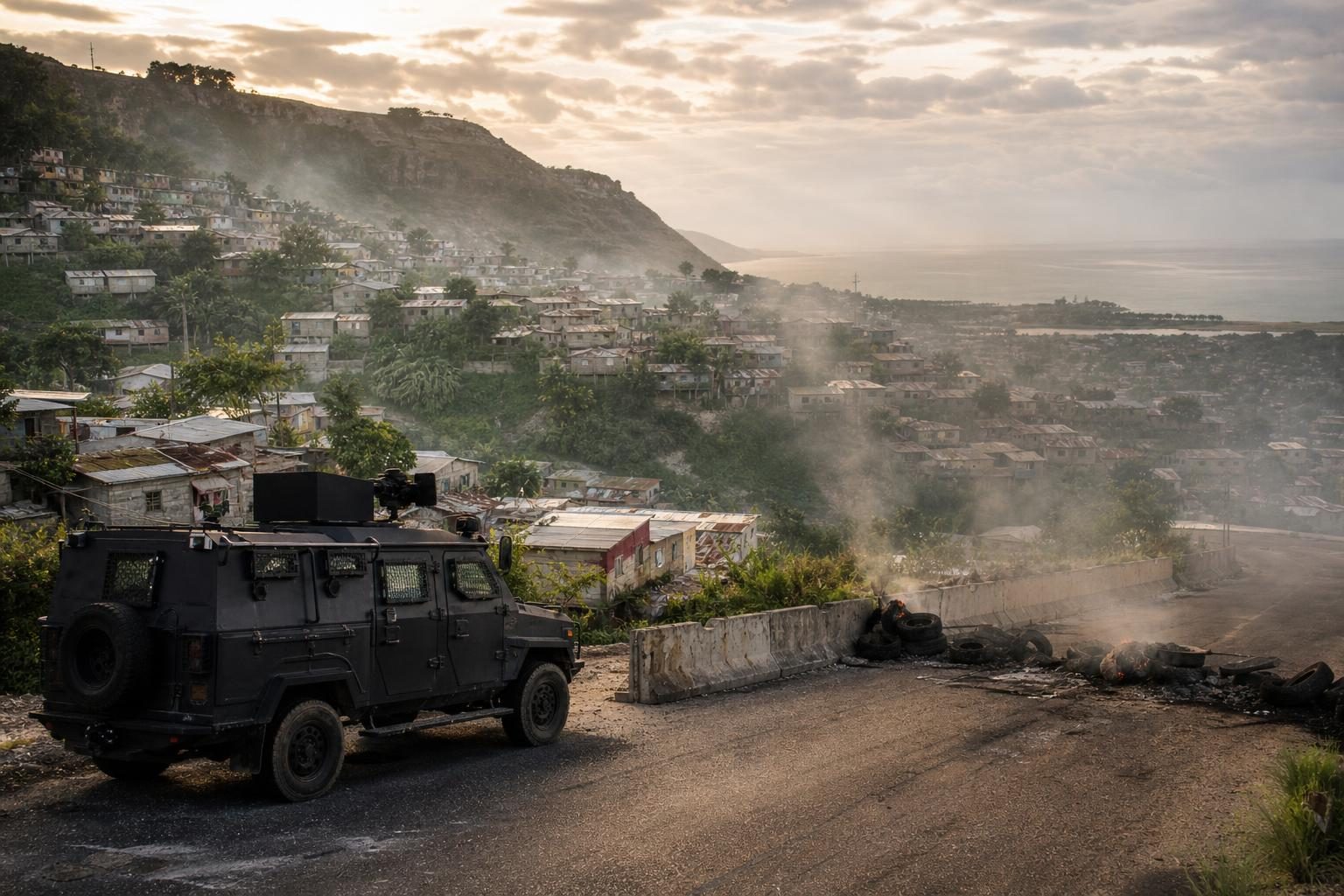
Police say at least 34 suspected gang members were killed as Haitian officers and a private task force pushed into the corridor that links Port-au-Prince with the country's south and west.
Filed November 19, 2026 · 📍 World desk · Washington, DC
Were you there? Share your story
Story tracker
Our anchors are following this story. New details will appear here as they come in.
Key points
- Haiti's police say at least 34 suspected gang members were killed in a raid on Martissant.
- Martissant sits on Route 2, the main road from the capital to the south and west, and gangs have held it since 2021.
- Vectus Global personnel joined the raid; police said Salvadoran troops did not.
- Thousands rallied in Port-au-Prince this week to praise Bukele's troops; 1.5 million Haitians are displaced.
For five years, the road out of Haiti's capital toward the country's south and west has belonged to gangsters. On Thursday, Haitian security forces moved to take it back.
Haiti's National Police said at least 34 suspected gang members were killed in a raid on Martissant, a district on the edge of Port-au-Prince that sits on a key route out of the capital and has been held by gangs since 2021, Al Jazeera reported [1]. The Associated Press, in a report carried by ABC News, described heavy fighting as armed forces battled to regain control of the corridor [2].
The death toll comes from the police [1], and the operation was still unfolding as the first reports came in. But even at this early stage, it is one of the most direct challenges in years to the gangs' grip on a stretch of road that much of Haiti depends on.
What Happened in Martissant
According to the national police, officers carried out the raid alongside an anti-gang task force that includes personnel from Vectus Global, the private security company founded by Blackwater founder Erik Prince [1]. Police said none of the roughly 2,500 Salvadoran troops now in Haiti took part in Thursday's operation [1].
The UN-backed gang suppression force said its personnel came under fire as they advanced, the AP reported [2].
Thursday's push is the latest in a run of more aggressive operations against Haiti's armed groups. Earlier this month, on the orders of Salvadoran President Nayib Bukele, Salvadoran troops attacked the homes of two major gang leaders known as Jeff and Lanmò San Jou, according to the AP [2].
Why This Road Matters
Martissant is not just another neighborhood. It sits on Route 2, the main road linking Port-au-Prince with Haiti's western and southern regions, and the gangs' seizure of the area more than five years ago disrupted the country's economy, the AP reported [2].
A gang that controls the main highway controls who and what moves along it: food, fuel, goods for market, families visiting relatives and the supplies that aid groups carry to people in need. Every day that the corridor stays in criminal hands is another day the rest of the country pays a toll in time, money and fear.
The timing matters, too. Gangs took Martissant in 2021 [1], the same year President Jovenel Moïse was assassinated in July [2]. Haiti has not had a president since, and the country is now preparing for its first elections in more than a decade, according to the AP [2]. Elections cannot be free and fair if voters, candidates and ballots cannot travel safely between the capital and the provinces.
Who Is Doing the Fighting
Haiti's response to its gang crisis has drawn in an unusual mix of forces, and Thursday's raid showed several of them at work.
At the center is Haiti's own National Police, which announced the operation and its results [1].
Alongside them is the Gang Suppression Force. The U.N. Security Council approved it on Sept. 30, 2025, under a resolution drafted by the United States and Panama, replacing a smaller Kenya-led mission, Al Jazeera reported at the time [5]. The resolution authorized up to 5,550 personnel for an initial 12 months and, unlike the earlier mission, gave the force the power to detain suspected gang members [5]. Twelve council members voted in favor, while China, Russia and Pakistan abstained [5].
Then there is El Salvador. President Bukele has roughly 2,500 troops in Haiti [1], and they have been carrying out their own operations against gang leaders [2].
Finally, there is the private sector: Vectus Global, whose personnel are part of the task force that joined Thursday's raid [1].
The Gang Suppression Force has carried a built-in weakness from the start. Like the Kenya-led mission before it, the force depends mostly on voluntary contributions from U.N. member nations, which have often been unpredictable, Al Jazeera reported when the force was created [5].
That concern was raised across the political spectrum. Human Rights Watch said the force needed sustained and predictable funding, enough personnel and strong human rights safeguards, while Russia's envoy argued that earlier tools had failed to produce lasting results and China's envoy warned the plan could make Haiti's situation worse [5].
Thursday's raid suggests that, whatever the funding gaps, Haiti and its partners are no longer content to wait. The question is whether the money, manpower and political will can last long enough to turn a successful raid into a lasting change.
Haitians Want Their Streets Back
For all the debate abroad about who should be fighting Haiti's gangs, many Haitians appear to have made up their minds. This week, thousands of people demonstrated in Port-au-Prince to praise Bukele and the Salvadoran troops fighting the gangs, NBC News reported [3].
That is a striking scene in a country where foreign forces have often been viewed with suspicion, and it reflects how desperate ordinary families have become. In June, as U.N. Secretary-General António Guterres visited Haiti, the number of people displaced by the violence reached 1.5 million, according to Euronews [6].
Behind that number are families driven from their homes by men with guns, children pulled out of school and neighborhoods emptied of the people who built them. When residents fill the streets to cheer the soldiers fighting the gangs, they are telling the world what they want most: to live in safety.
The Hard Questions
The tougher approach has its critics, and their concerns deserve a fair hearing. The Council on Foreign Relations has asked who is protecting civilians as Salvadoran troops fight Haiti's gangs, and argued that the crackdown is likely to displace still more people as Salvadoran forces, the Gang Suppression Force, Haiti's police and Vectus push gangs out of neighborhoods across Port-au-Prince [4].
Those are legitimate questions. Fighting in crowded urban neighborhoods puts innocent people at risk, and a campaign that frees a district only to leave it empty would be a hollow victory. Haiti's partners have every reason to insist on discipline, accountability and care for civilians caught in the crossfire.
But the alternative to action is not peace. It is the status quo: armed groups controlling the roads and more than a million people pushed from their homes [6]. A government's first duty is to protect its people from predators. As the Apostle Paul wrote in his letter to the Romans, rulers are meant to be a terror to evil works, not to good ones. The test of this offensive is whether it lives up to that standard.
What Comes Next
The real measure of success is not Thursday's raid. It is what happens in the weeks that follow. Clearing gunmen from Martissant is one thing; holding the ground, restoring police posts, reopening Route 2 to normal traffic and letting families return home is the harder work.
Americans have a direct stake in the outcome. The United States helped write the resolution that created the Gang Suppression Force [5], and stability in Haiti shapes migration and security across our own hemisphere.
For the people of Haiti, the stakes could not be higher. With elections ahead [2], a reopened road south would be more than a military success. It would be proof that the state can still protect its citizens, and that the gangs' rule is not permanent.
Liberty Bell Report will keep following the offensive as Haitian officials and the gang suppression force release more details.
Sources
- [1]Opens in a new tab ↗
- [2]ABC News (Associated Press)Heavy fighting erupts in Haiti as armed forces fight gangs to regain control of key corridorOpens in a new tab ↗
- [3]NBC NewsThousands demonstrate in Haiti's capital to praise Bukele and Salvadoran troops fighting gangsOpens in a new tab ↗
- [4]Council on Foreign RelationsEl Salvador's Troops Are Fighting Haiti's Gangs. Who Is Protecting Civilians?Opens in a new tab ↗
- [5]Opens in a new tab ↗
- [6]Opens in a new tab ↗
Israel's new parliament is sworn in. Who would you rather see lead Israel?
- Benjamin Netanyahu
- Gadi Eisenkot
- Someone new
- That's for Israelis to decide
More in World News
Somalia Gives the UAE's Ambassador 72 Hours to Leave, Accusing Abu Dhabi of Violating Its Sovereignty
Tonight on World Watch with Grace Whitfield
Netanyahu's Office Defends Aide Who Relayed Election-Day Tip
Tonight on World Watch with Grace Whitfield

Tories Tap James Cleverly to Take On Sadiq Khan, Promising Safer Streets and Renewed Pride in London
Today on World Watch with Grace Whitfield
Were you there?
If you were at the scene, or this story touched your life, tell us what you saw and what it was like.
Discussion 0
Sign in or create a free account to join the discussion.
No comments yet. Start the discussion.