
 This morning on Command Post with Dan Whitaker
Still Burning Off Finland: The Kaliningrad-Bound Ship Fights a Sinking Risk as Russia's Baltic Enclave Sounds a Rare Air Alert
A day after drones set the Sparta II ablaze in the Gulf of Finland, firefighting went on through the night, the crew headed home, and Kaliningrad's governor blamed a 'suspicious object' for an air-raid alert. NATO meets Monday on Russian missiles that fell in Poland.
Filed November 22, 2026 · 📍 World desk · Washington, DC
Were you there? Share your story
Part of our continuing coverage: Drone Strike Sets Russian Military Cargo Ship Ablaze Off Finland
Key points
- The Russian cargo ship Sparta II was still on fire Sunday in Finnish waters, with authorities warning it could sink.
- All 16 crew members were evacuated and are returning to Russia aboard a Russian vessel, according to Finland's Border Guard.
- Kaliningrad's governor said a suspicious object from the direction of Lithuania set off a rare air alert late Saturday.
- NATO allies hold emergency talks Monday after Russian cruise missiles and a drone came down in southeastern Poland on Friday.
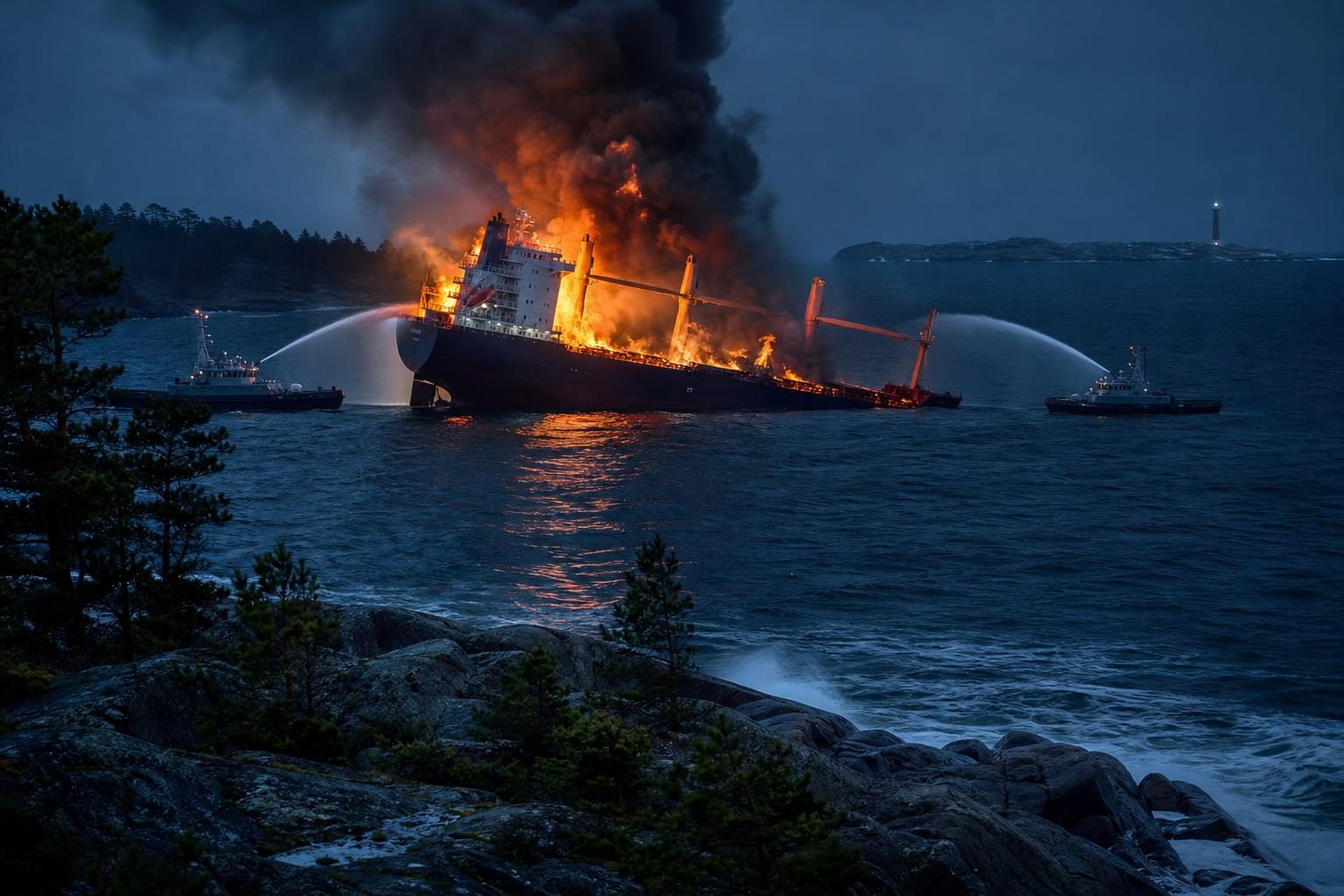
The Russian cargo ship struck by drones in the Gulf of Finland was still burning on Sunday, more than a day after the attack, as Finnish crews poured water on the stricken vessel and officials warned it could go to the bottom, according to Al Jazeera and the Helsinki Times [2][4]. The ship, the Sparta II, had been sailing for Russia's Baltic exclave of Kaliningrad when it was hit on Saturday and lost control, drifting into Finnish territorial waters [1][2].
Hours later, sirens sounded in Kaliningrad itself, the heavily militarized Russian enclave wedged between NATO members Poland and Lithuania, the Associated Press reported [1]. Taken together, the two events marked one of the most tense weekends in the Baltic since Russia's full-scale invasion of Ukraine began.
A Fire That Would Not Go Out
Finland's Border Guard said all 16 crew members were evacuated, first into lifeboats and then onto a nearby Russian vessel that took part in the rescue, and that the sailors were on their way back to Russia, according to the Helsinki Times [4]. No injuries among the crew were reported in those accounts [4].
The blaze proved stubborn. Vessels spent Saturday night and Sunday morning spraying the ship with water cannons, Al Jazeera reported [2]. The Helsinki Times said the burning ship was anchored off the Finnish coast near Loviisa, that there was a risk it could sink, and that Finland planned to have Russian vessels tow it out of Finnish waters once conditions allowed [4].
Who launched the drones remained officially unconfirmed. Russian officials suggested the drones were Ukrainian, and a Finnish defense spokesman said Ukraine was the likely source, the AP reported, while Kyiv had not commented [1]. Moscow's account placed the strike in international waters about three nautical miles from Russia's maritime border [1].
Finland's prime minister, Petteri Orpo, said the war was spilling over into his country's immediate vicinity, The Guardian reported [3]. Helsinki notified NATO and reimposed temporary limits on flights and shipping in the eastern part of the gulf [1][2].
Sirens in Kaliningrad
Late Saturday, an air alert sounded in Kaliningrad's Nemansky district. The region's governor, Alexei Bezprozvannykh, said air defenses had reacted to a suspicious object coming from the direction of Lithuania, the AP reported, and he said the incident posed no threat to supplies reaching the region [1]. He offered no evidence for where the object came from.
Separately, the Kyiv Independent reported that a Ukrainian monitoring channel, citing Russian accounts, relayed claims of drones attacking the Russian Baltic Fleet's base at Baltiysk, along with unverified suggestions the drones may have been launched from a vessel [6]. Those claims could not be independently confirmed, and the AP said it could not verify images of drone activity near the base that circulated online [1][6].
NATO's Eastern Flank on Edge
The Baltic incidents came two days after Russian weapons fell on NATO soil. On Friday, two Russian Kh-101 cruise missiles and a jet-powered drone came down in southeastern Poland during a Russian barrage against Ukraine, though no one on the ground was hurt, according to Stars and Stripes [5]. NATO Secretary General Mark Rutte, visiting Warsaw on Saturday, called the incident a grave violation and pledged that the alliance would defend every inch of Polish territory, Stars and Stripes reported [5].
The alliance's North Atlantic Council is set to hold emergency talks on Monday, and the top U.S. commander in Europe, Gen. Alexus Grynkewich, is assessing whether NATO's air defenses on the eastern flank need to be strengthened, according to Stars and Stripes [5].
Why It Matters
For American troops and taxpayers, the lesson of the weekend is that the Baltic is no longer a quiet backwater. Finland and Sweden joined NATO precisely because Russia's war made the region less safe, and a burning Russian supply ship off a NATO coastline, sirens in Kaliningrad and missiles on Polish farmland are the kind of events that can spiral if leaders are careless. Steady deterrence, clear communication with allies and a strong American presence remain the best way to keep a war in Ukraine from becoming a wider one.
The next steps to watch are the fate of the Sparta II, Monday's NATO session and whether Moscow tries to use the weekend's incidents to justify new pressure on its Baltic neighbors.
Sources
- [1]AP via CTV NewsAir alert sounds in Kaliningrad hours after Russia-bound ship attacked in the Gulf of FinlandOpens in a new tab ↗
- [2]Opens in a new tab ↗
- [3]Opens in a new tab ↗
- [4]Helsinki TimesFirefighting efforts continue on Russian cargo ship in Finnish waters amid sinking riskOpens in a new tab ↗
- [5]Stars and StripesNATO emergency talks on tap as US commander assess defenses after Russian missiles hit PolandOpens in a new tab ↗
- [6]Kyiv IndependentExplosions reported near Russian Baltic Fleet base in Kaliningrad Oblast amid drone alertsOpens in a new tab ↗
Israel's new parliament is sworn in. Who would you rather see lead Israel?
- Benjamin Netanyahu
- Gadi Eisenkot
- Someone new
- That's for Israelis to decide
More in World News

Trump Puts Iran on Notice: No Deal by the New Year Could Bring Renewed Strikes, as Tehran's Allies Keep Firing at the Gulf
Today on The Briefing Room with Claire Donovan

'The Water Was on Fire': Swimmer Braves Hormuz War Zone
This morning on Launch Pad with Hannah Lindgren

Night of Arson Hits Four West Bank Villages as Eisenkot and Ben-Gvir Clash Over What to Call It
This morning on World Watch with Grace Whitfield
Were you there?
If you were at the scene, or this story touched your life, tell us what you saw and what it was like.
Discussion 0
Sign in or create a free account to join the discussion.
No comments yet. Start the discussion.