
 Yesterday on The Vance Edge with Sienna Vance
Selling America Out? This Week the Administration Moved to Shut China's Chip Back Doors
A New York Times columnist says the Nvidia scandal shows a White House careless about security, but the past week's new chip rules, criminal probe and Treasury deadline tell a different story.
Filed November 17, 2026 · 📍 White House, DC 20500
Were you there? Share your story
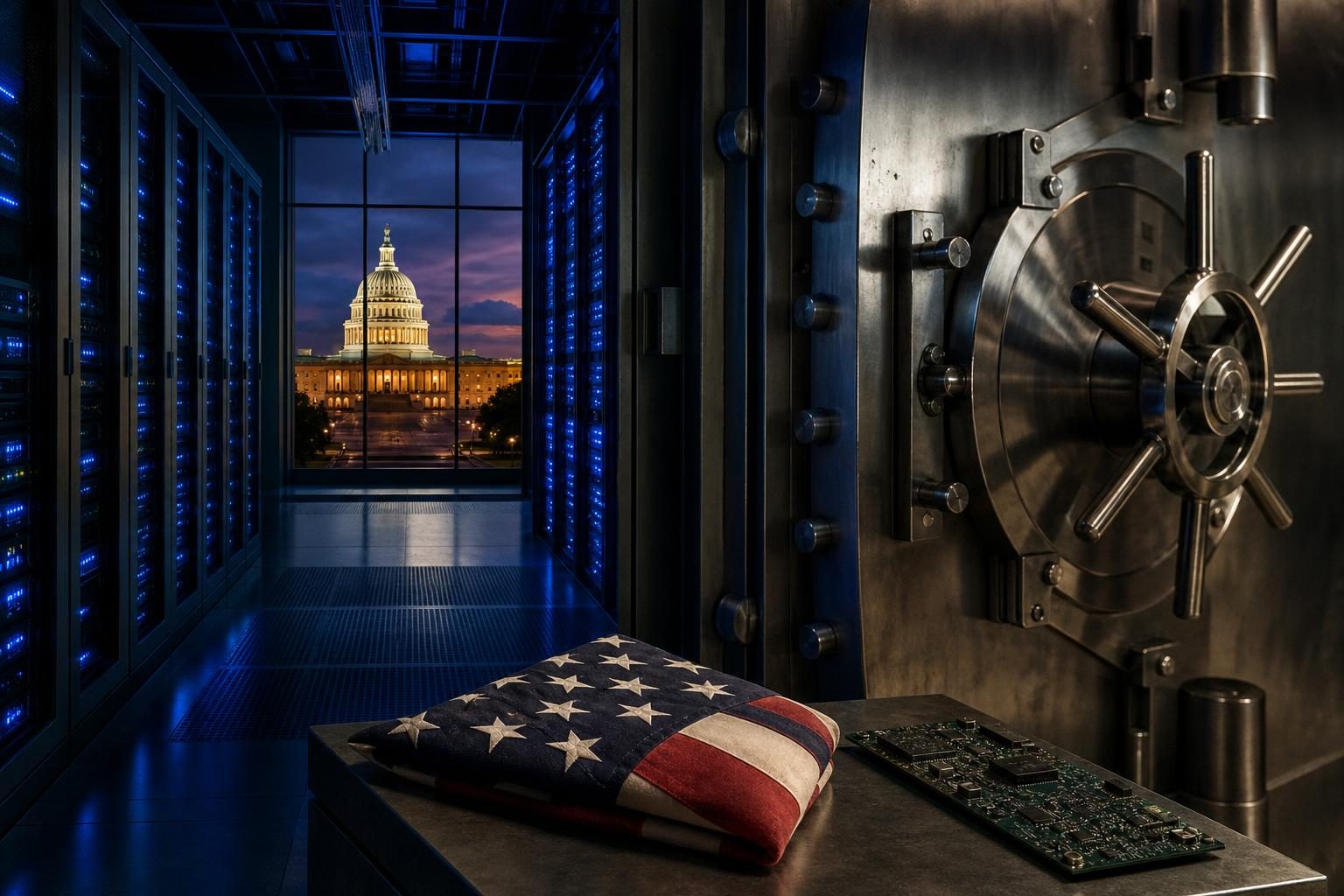
Part of our continuing coverage: Trump Administration Moves to Shut the Cloud Back Door That Let Chinese Firms Rent America's Best AI Chips
Key points
- Commerce issued a rule Monday to close the remote-access chip loophole and require licenses in five transit countries.
- Commerce and Justice confirmed a Megaspeed probe that began in 2024, with Justice leading a criminal case.
- Treasury's Bessent gave Nvidia's board about 10 days to explain its China sales and faulted Commerce for delays.
- Speaker Johnson says Congress is developing a consensus on limiting chip exports to China.
Michelle Goldberg, a New York Times opinion columnist, argued on Monday that the scandal surrounding Nvidia and its former chief executive, Jensen Huang, is less about a personal affair than about a White House careless with America's security. Her headline accuses the administration of being willing to sell out the country, and according to a summary by Raw Story, she calls President Trump's handling of the affair a "national betrayal" and contrasts it with the Biden administration's push to slow China's progress in artificial intelligence [1].
The facts behind the anger are real. Huang resigned last week after it was revealed that he had a relationship with a woman linked to the chip reseller Megaspeed who is alleged to be a Chinese spy; both Beijing and Megaspeed deny wrongdoing [1]. Raw Story also notes Trump said this week he would not mind Huang returning to lead the chipmaker [1]. Reuters says it has not been able to verify the espionage allegations [4].
Those are fair subjects for criticism. But judging an administration's seriousness means weighing what it did once the problem surfaced, and the past seven days point the other way.
What Washington Did This Week
On Monday, the Commerce Department's Bureau of Industry and Security issued an interim rule aimed squarely at the cloud back door. Chinese companies were barred from importing the most advanced American processors, yet could legally rent that same computing power from data centers in places like Singapore, Malaysia and Thailand, Al Jazeera reported [2]. The new rule requires a U.S. license for those remote arrangements, and it singles out five countries, Indonesia, Malaysia, Singapore, Thailand and Brazil, as diversion risks whose advanced-chip imports now need licenses as well [2]. The bureau said the aim is to keep existing restrictions from being sidestepped through remote computing deals in third countries [2]. Time noted that the rule landed just days before the president's meeting with Chinese leader Xi Jinping [3]. That is hardly the timing of a White House courting Beijing.
Also on Monday, the Commerce and Justice departments confirmed in a joint statement that they are investigating Megaspeed, the Singapore-based firm at the center of the scandal [4]. According to Reuters, Commerce opened its inquiry in 2024 after spotting suspicious activity; in June 2025, U.S. agents working with Singaporean law enforcement carried out an on-site check at the company and interviewed the company's then chief executive; Nvidia afterward put Megaspeed on a "no sell" list; and the Justice Department has since taken the lead in a criminal investigation [4]. A government indifferent to security does not spend two years building a case against a suspected chip conduit.
An Administration Holding Itself to Account
Then there is Treasury Secretary Scott Bessent. On Fox News on Sunday, Bessent said Nvidia's board and its outside counsel owe answers within about 10 days on whether the company pushed questionable China sales to boost its results [5]. He urged the board to bring in a chief executive from outside the company and said some of Nvidia's buyers were shell companies fronting for Chinese interests [5].
Bessent has been just as blunt about his own government, faulting the Commerce Department, led by Secretary Howard Lutnick, for ignoring reports that Megaspeed was moving Nvidia technology to China and for delays in placing the company on the export blacklist [4]. Axios reported that other administration officials have accused Lutnick of stalling tougher curbs [5]. Fairness requires noting the other side: Monday's joint statement from Commerce and Justice defended Lutnick against that criticism [4].
Critics see a cabinet at war with itself. A better reading is that the system is working: a Treasury secretary pressing a fellow department and a corporate board for answers is not a cover-up but accountability in plain view. Scripture says iron sharpens iron, and an administration that shrugged at national security would not be arguing over how fast to blacklist a company suspected of funneling chips to China.
Who Is Pushing to Tighten the Door, and What Comes Next
The pressure is not only coming from inside the executive branch. House Speaker Mike Johnson said last week that he favors limiting chip exports to China and sees "a developing consensus in Congress" on the matter, while cautioning that many facts remain to be determined, Reuters reported [6]. Bills in play include the AI Overwatch Act, giving Congress more power over advanced chip exports; the Chip Security Act, requiring that advanced processors be tracked to stop smuggling; the Match Act, pressing allies to restrict chipmaking equipment bound for China; and the Remote Access Security Act [6]. A remote-access bill sponsored by Rep. Michael Lawler has already passed the House [2].
The next tests come quickly. Nvidia reports quarterly results after Tuesday's closing bell, its first since Huang's departure, with Bessent's question about China sales hanging over it [5]. Trump sits down with Xi this week with the new rule already on the books [3]. And Bessent's deadline for Nvidia's board runs out next week [5].
Goldberg is right that Americans should demand seriousness about guarding the technology that will shape this century. But the past week shows Treasury, Commerce, the Justice Department and Congress moving to shut China's back doors, not prop them open. Stewardship is measured by what leaders do once a problem surfaces. This week, they acted.
Sources
Have you ever been censored or shadow-banned on social media?
- Yes
- I think so
- No
- I'm not on social media
More in Pushback
Sanders Puts Medicare for All on a Four-Year Clock. The 154 Million Americans With Job-Based Coverage Deserve Answers First
Today on The Bottom Line with Douglas Park
Hochul Wants Answers on an ICE Site in Batavia. New York's Own Law Is Why It's Being Built
Today on Border Watch with Cole Brennan
A 25-Year-Old Network Isn't a Bargain: The Facts Behind the Fight Over Duffy's $50 Billion Air Traffic Plan
Today on Open Road with Frank Kowalski
Were you there?
If you were at the scene, or this story touched your life, tell us what you saw and what it was like.
Discussion 0
Sign in or create a free account to join the discussion.
No comments yet. Start the discussion.