
 Tonight on Order in the Court with Harold Whitmore
A Poll Dip Is Not a Verdict: The Constitution and the States Still Stand Behind Capital Justice
Gallup found death penalty support slipped to 49%, but its own margin of error, a 66% Pew finding, Supreme Court precedent and Thursday's Oklahoma execution show the issue is far from settled.
Filed November 12, 2026 · 📍 Supreme Court, DC 20543
Were you there? Share your story
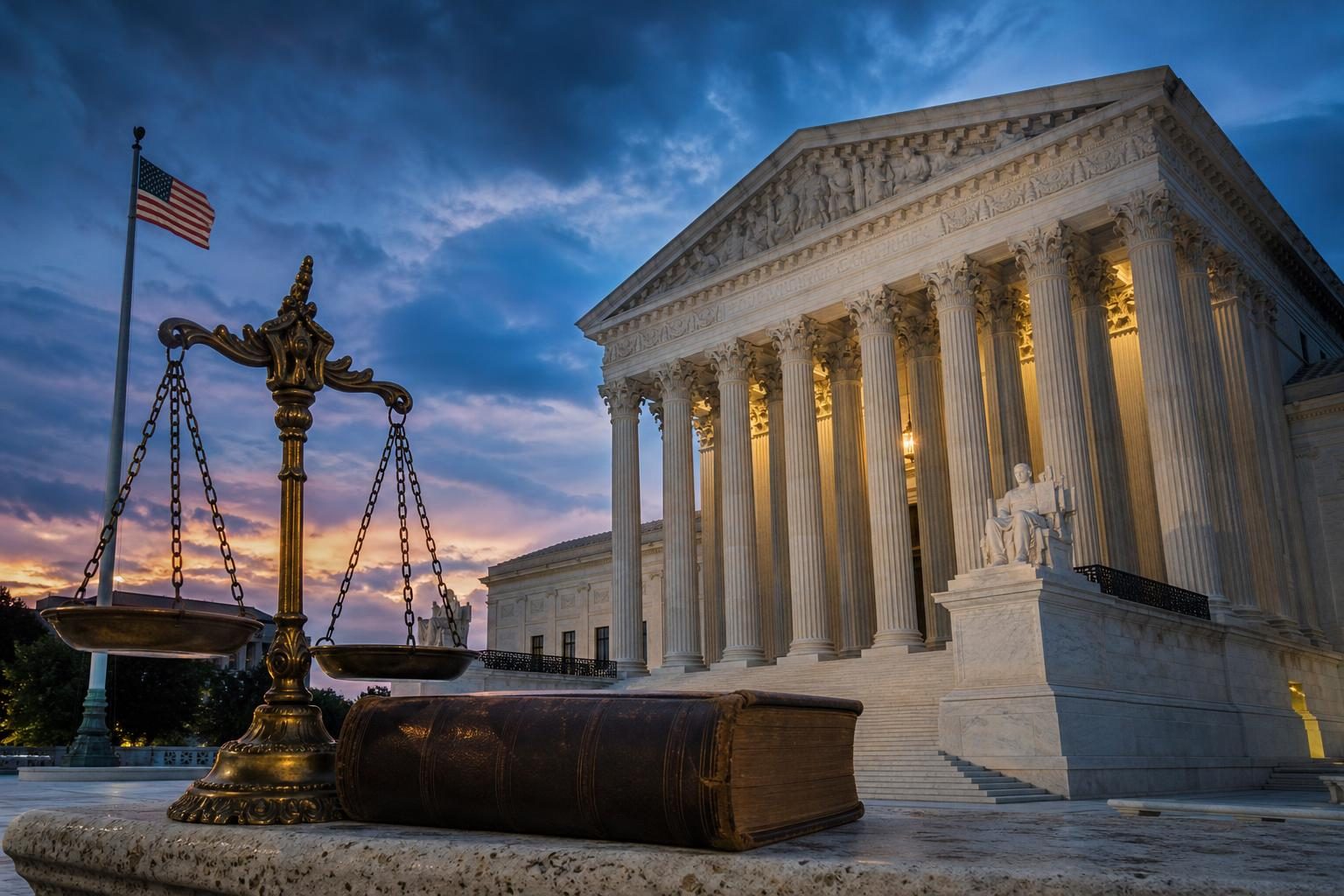
Part of our continuing coverage: Gallup: Support for the Death Penalty Falls Below 50% for the First Time Since 1971
Key points
- Gallup found 49% favor and 45% oppose the death penalty, a figure it called statistically similar to last year's 52%.
- Pew Research Center found 66% support in July, though it warns online and phone polls are not directly comparable.
- The Supreme Court has held that the Constitution allows capital punishment, and the Fifth Amendment contemplates capital trials with due process.
- Oklahoma executed James Pavatt on Thursday and Texas scheduled another execution for later in the day, with the nation on pace to top 40 executions this year.
Gallup reported Tuesday that 49% of Americans favor the death penalty for a person convicted of murder and 45% oppose it, the first reading below a majority since 1971, when support also stood at 49% [2]. Al Jazeera presented the result as capital punishment losing majority backing and linked the slide to worries about fairness, racial bias, cost, botched executions and the chance of executing an innocent person, adding that scholars have long doubted deterrence [1]. The Epoch Times suggested that coverage of Tennessee's failed execution of Christa Pike may have helped pull the number down [5].
The trends are real. Gallup found support at 73% among Republicans, 50% among independents and 28% among Democrats, a 47-point drop for Democrats since 1994 [2]. Only 39% of adults ages 18 to 29 are in favor, versus 54% of those 50 to 64, and Gallup warned that "Support for capital punishment may decline further if trends among younger generations continue" [2].
What the Poll Itself Shows
Read the fine print before declaring a turning point. Gallup itself called this year's 49% statistically similar to last year's 52%, and its sample of 1,200 adults carries a margin of error of plus or minus four points [2]. Interviewing began on Oct. 1, the day after the Pike execution attempt failed; Tennessee's governor has since paused executions pending an investigation [2]. A poll taken amid one disturbing headline may capture a mood as much as a settled judgment.
Other research differs. Pew Research Center, polling 3,554 adults in July, found 66% in favor and 32% opposed, with 68% calling the death penalty morally justified for a crime like murder [3]. Pew cautions that its online panel tends to show more support than phone polls like Gallup's, so the two are not directly comparable [3]. When the way a question is asked can shift the answer by nine points or more, no single number is a national verdict [3].
Honesty requires facing the hardest concern. Pew found 73% of Americans believe there is some risk an innocent person could be executed [3]. For Christians who hold that every person bears the image of God, that risk demands utmost seriousness. The record points to careful process, not abolition. In the Texas case set for Thursday, an appeals court threw out John Allen Rubio's first capital murder conviction because a co-defendant's statements had been wrongly admitted; he was retried, convicted and again sentenced to death [6].
What the Constitution and the Court Say
In Bucklew v. Precythe in 2019, Justice Neil Gorsuch wrote for the Supreme Court that the Fifth Amendment openly contemplates trials for capital crimes and the loss of life as a penalty, as long as due process is observed [4]. His opinion put it simply: "The Constitution allows capital punishment" [4]. At the founding, the Court noted, death was the standard sentence for serious crimes [4].
The Eighth Amendment, the justices explained, was understood to forbid methods that add terror, pain or disgrace to a death sentence, not to promise a painless death [4]. Under the standard drawn from Glossip v. Gross, an inmate challenging a method must offer a workable alternative that would substantially lower the risk of severe pain [4].
After the Court struck down state death penalty laws as then written in Furman v. Georgia in 1972, states rewrote them, and in 1976 the justices upheld Georgia's revised statute in Gregg v. Georgia [5]. Executions resumed in January 1977 [5], when Gallup measured support at 66% [2]. Bucklew also stressed that both the state and crime victims have a real interest in seeing sentences carried out without undue delay, and that last-minute stays should be the rare exception [4].
Who Is Still Enforcing the Law
The states are not waiting on pollsters. Thursday morning, Oklahoma executed James Pavatt, 73, at McAlester for the 2001 murder of Rob Andrew, a father shot as he arrived to pick up his two young children; after a chaplain read to him from the Bible, Pavatt was pronounced dead at 10:12 a.m. Central time [6]. Texas scheduled Rubio's execution for later Thursday in Huntsville for the 2003 killings of three small children he was raising in Brownsville [6]. The nation is on pace to top 40 executions for a second straight year, led by Florida, the Associated Press reported [6].
Even Al Jazeera called President Trump an exception to the national drift, citing his first term's surge in federal executions and his pledge to continue [1]. Capital punishment remains law in 27 states, Al Jazeera reported, citing the Death Penalty Information Center [1].
On the other side, California Gov. Gavin Newsom plans to commute all 548 death sentences in his state to life without parole [5], which experts cited by the AP say would be the largest mass clemency in American history [6]. That is one outgoing governor's decision, not a change in the Constitution.
Gallup's warning about younger Americans is a challenge to make the moral case again [2]. The record supports it: the Constitution permits the penalty, the Supreme Court has upheld it, and the states continue to carry it out under appellate review. A three-point dip inside a four-point margin is not a turning point. It is a call to defend justice for victims while guarding vigilantly against convicting the innocent.
Sources
- [1]Opens in a new tab ↗
- [2]Opens in a new tab ↗
- [3]Pew Research CenterMost Americans Favor the Death Penalty for Those Convicted of MurderOpens in a new tab ↗
- [4]Legal Information Institute, Cornell Law SchoolBucklew v. Precythe (2019), Opinion of the CourtOpens in a new tab ↗
- [5]Opens in a new tab ↗
- [6]WDBO (Associated Press)Oklahoma man is put to death for killing of girlfriend's husband, with a Texas execution to followOpens in a new tab ↗
Have you ever been censored or shadow-banned on social media?
- Yes
- I think so
- No
- I'm not on social media
More in Pushback
Congress Can Investigate, but the Constitution Sets the Terms
Tonight on The Vance Edge with Sienna Vance

A Veterans' Arch at Memorial Circle Stands in a Proud American Tradition
Today on First Principles with Benjamin Stone
Leverage Abroad, Honest Books at Home: Why the Trump-Vance Plan Puts Taxpayers First
Today on World Watch with Grace Whitfield
Were you there?
If you were at the scene, or this story touched your life, tell us what you saw and what it was like.
Discussion 0
Sign in or create a free account to join the discussion.
No comments yet. Start the discussion.