
 Tonight on The Bottom Line with Douglas Park
Three Weeks to Dec. 11: What the Funding Deadline Means for Your Family and Your Tax Dollars
As a handful of Senate Democrats try to tie the next stopgap to the Iran war, here is how the deadline works, what a lapse would touch, and the choices before Congress.
Filed November 20, 2026 · 📍 Washington, DC 20001
Were you there? Share your story
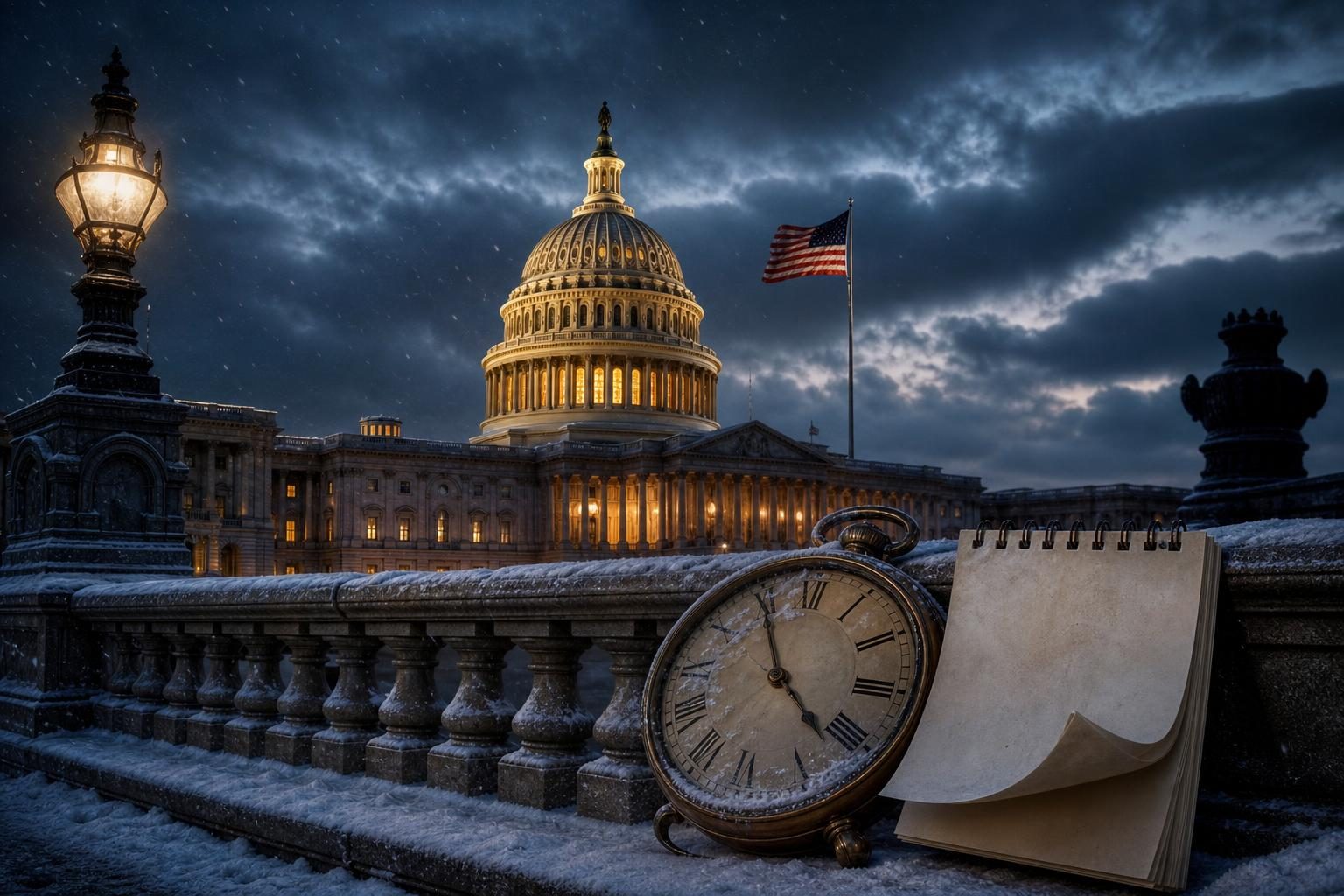
Part of our continuing coverage: House Democrats Step Back From a Christmas Shutdown Over Iran as Four Senators Hold Their Line Before the Dec. 11 Deadline
Key points
- Federal funding runs through Dec. 11; without a new law, the government is slated to shut down Dec. 12.
- Four Senate Democrats, led by Chris Van Hollen, want any stopgap to block Iran war funding; Majority Leader John Thune calls the demand short-sighted.
- Republicans need at least seven Democratic votes to reach 60 in the Senate, and several Democrats oppose risking a holiday shutdown.
- Student loan payments, Pell Grants and FAFSA processing would continue in a shutdown, but IRS slowdowns could delay some refunds and loan approvals.
Three weeks from tonight, the money that keeps most of the federal government running is scheduled to run out. Lawmakers have until Friday, Dec. 11, to pass full-year spending bills or another stopgap, and if they do neither, the government is slated to shut down on Dec. 12, NerdWallet reported [4]. The open question in Washington is not whether Congress can find the money, but whether a dispute over the war with Iran will get in the way.
A small group of Senate Democrats wants the next temporary spending bill to forbid the administration from using appropriated money for the war. Most Republicans, and a good number of Democrats, warn that the demand risks a shutdown just before Christmas. HNGN reported that the threat of a pre-holiday shutdown has moved to the center of the lame-duck session, the weeks between the November elections and the swearing-in of a new Congress [2].
Here is a plain guide to how the deadline works, who wants what, and what it could mean for families and taxpayers.
Where things stand
The government is running on a continuing resolution, the stopgap Congress uses when the regular appropriations bills are not finished on time. The law firm Holland & Knight, in an analysis of year-end deadlines, identified Dec. 11 as the most immediate deadline facing lawmakers, because that is when the current continuing resolution expires [6].
The lame-duck session gives outgoing lawmakers one last chance either to reach a long-term agreement or to push the deadline into 2027, according to NerdWallet [4].
The political ground is about to shift. Democrats will take control of Congress in January, and Senate Majority Leader John Thune has argued that because they will soon hold the majorities and the leadership posts, there is no need for a confrontation now, The Hill reported [1]. Until the new Congress is sworn in in early January, Republicans hold 53 Senate seats, Newsweek noted [3].
The Iran demand and the 60-vote math
On Nov. 12, Sens. Chris Van Hollen of Maryland, Bernie Sanders of Vermont, Michael Bennet of Colorado and Tammy Duckworth of Illinois issued a joint statement saying they would oppose any short-term deal that does not restrict the use of appropriated funds for the war, Newsweek reported [3]. Van Hollen has since urged fellow Democrats to withhold their votes from any Dec. 11 stopgap that keeps paying for the conflict, according to HNGN [2]. He has argued that Democrats would hold the stronger hand in a shutdown fight and has framed the choice as the president's, The Hill reported [1]. Van Hollen is also challenging Chuck Schumer for the top Democratic post in the Senate, Newsweek noted [3].
Sen. Tim Kaine of Virginia has taken a similar line. According to The Hill, Kaine believes any funding bill should bar money for the war unless Congress authorizes it, and he has said responsibility for any shutdown would rest with President Trump [1].
Thune has rejected the demand. He called it "short-sighted," questioned whether it was a realistic negotiating position and warned that insisting on a war rider could sink a deal to keep the government funded past Christmas, The Hill reported [1]. He also said he is increasingly worried that Democrats could bring about a third shutdown, noting that Americans have already lived through two long ones [1].
Many Democrats are uneasy as well. "Nobody I've talked to thinks a shutdown makes any sense," said Sen. Jeanne Shaheen of New Hampshire, the top Democrat on the Senate Foreign Relations Committee, according to Newsweek [3]. Sen. John Hickenlooper of Colorado has described a shutdown before the holidays as a hard problem and has declined to endorse Van Hollen's language, while Sen. Cory Booker of New Jersey has also cautioned about the political risks [1][3].
The arithmetic explains why that matters. A funding bill needs 60 votes to get past a Senate filibuster, so with 53 seats, Republicans need at least seven Democrats to pass a stopgap, Newsweek reported [3]. One policy analyst quoted by Newsweek pointed out that Democrats have only 47 votes of their own for a December fight, and a Democratic strategist argued that the party should wait until it holds full control of Congress in January [3].
What a lapse would mean at the kitchen table
For many households, the first worries are college bills and tax refunds. The College Investor, in an explainer on the deadline, reported that a December shutdown would not pause federal student loan payments, Pell Grants or FAFSA processing [5]. Loan servicers are private contractors and would stay open, so borrowers should keep paying on schedule [5]. The site encouraged families to submit the FAFSA before Dec. 11, while help desks are fully staffed, so that any problems can be fixed quickly [5].
The Internal Revenue Service is where a lapse could pinch. The College Investor warned that a shutdown could slow the agency as it prepares for the 2027 filing season [5]. NerdWallet reported that the IRS cannot verify income and Social Security numbers during a shutdown, which can delay some mortgages and other loan approvals as well as some refunds, and it cautioned that processing of federal student aid applications could also be slowed [4]. Families who claim the Earned Income Tax Credit should keep in mind that those refunds are held until mid-February under existing refund rules in any case, The College Investor noted [5].
Federal workers and travelers would feel it too. A Senate Republican aide warned that a December shutdown could snarl holiday travel, pointing to the air traffic controllers who began missing work during the 43-day shutdown last year after going weeks without a paycheck, Newsweek reported [3].
What else expires on Dec. 11
The funding deadline is not the only clock running. Holland & Knight reported that the National Flood Insurance Program's authorization and borrowing authority were extended in the current stopgap and now expire alongside government funding on Dec. 11 [6]. FEMA has proposed a far longer reauthorization, through 2035, but Congress has not passed one, the firm noted [6].
Federal surface transportation programs, which cover highways and transit, are also extended only through Dec. 11, a two-month window meant to give lawmakers time to negotiate a long-term bill, according to Holland & Knight [6]. The House has taken steps toward a bipartisan five-year framework, but the Senate has not produced a matching package, and the firm expects Congress to pass another extension into 2027 [6]. A separate deadline looms for the Community Health Center Fund, whose current mandatory funding expires Dec. 31 [6].
The options on the table
Holland & Knight laid out three main paths [6]. Congress could pass all or most of the 12 annual spending bills, either in one large omnibus or in smaller bundles known as minibuses. It could pass another continuing resolution that moves the deadline into early 2027. Or it could let funding lapse for some agencies while it finishes bills for others [6].
The short-term route appears to have the broadest backing. NerdWallet reported that leaders in both parties have publicly supported a stopgap that would keep the government funded until after the lame-duck session ends [4]. A clean extension of that kind would leave the remaining decisions to the new Congress, which Thune has suggested is reason enough for Democrats to wait [1]. The harder question is whether enough Democrats will vote for a stopgap that carries no Iran language, and HNGN reported that the party remains split on exactly that point [2].
Keep the government open, and debate the war on its own terms
Americans of good will disagree about the war with Iran, and Kaine and Van Hollen are making a serious argument about the role of Congress in matters of war. That argument deserves a full and fair hearing.
A shutdown, however, is the wrong place to have it. In our view, Congress should pass a clean stopgap, keep federal offices open through Christmas, and make sure the men and women in uniform and their families never have to wonder whether a paycheck will arrive. Households waiting on tax refunds, homeowners who rely on flood coverage and the controllers who keep holiday flights moving should not become bargaining chips in a dispute they did not create.
Whether the war should continue is a question for votes on war powers and authorization, where every member has to go on the record, not for a must-pass bill whose failure lands on people who had no say. Democrats will hold the gavels in January [1][3]. If they want to change course on Iran, they will have every tool to do so in the open, and the better path for all sides would be a return to regular order: debating, voting, and passing the 12 spending bills on time. That would be a fine Christmas gift to the taxpayers who fund it all.
Sources
With Democrats taking Congress, what should Republicans focus on first?
- Blocking bad bills
- Working on prices and costs
- Winning back the House in 2028
- Confirming judges before January
More in Politics

FULL APPEALS COURT: PROXY-VOTE HOUSE BROKE THE CONSTITUTION
Tonight on First Principles with Benjamin Stone

HACKERS BREACHED USDA FARM PAYMENT SYSTEM, SOURCES SAY
Tonight on Breaking Now with Nathan Brooks
Idaho's Republican Family Feud: Who Speaks for Conservatives?
Tonight on Hollister Tonight with Jack Hollister
Were you there?
If you were at the scene, or this story touched your life, tell us what you saw and what it was like.
Discussion 0
Sign in or create a free account to join the discussion.
No comments yet. Start the discussion.