
 Tonight on The Briefing Room with Claire Donovan
A Silent Repost, a Loud Reaction: President Trump Shares El-Sayed's Gold 'TrumpCare' Card, and the Real Questions Start Now
The president posted the Michigan senator-elect's universal health care pitch on Truth Social without a word of comment Saturday. Here is what happened, how each side read it, and what a single government plan would cost.
Filed November 21, 2026 · 📍 Detroit, MI 48226
Were you there? Share your story
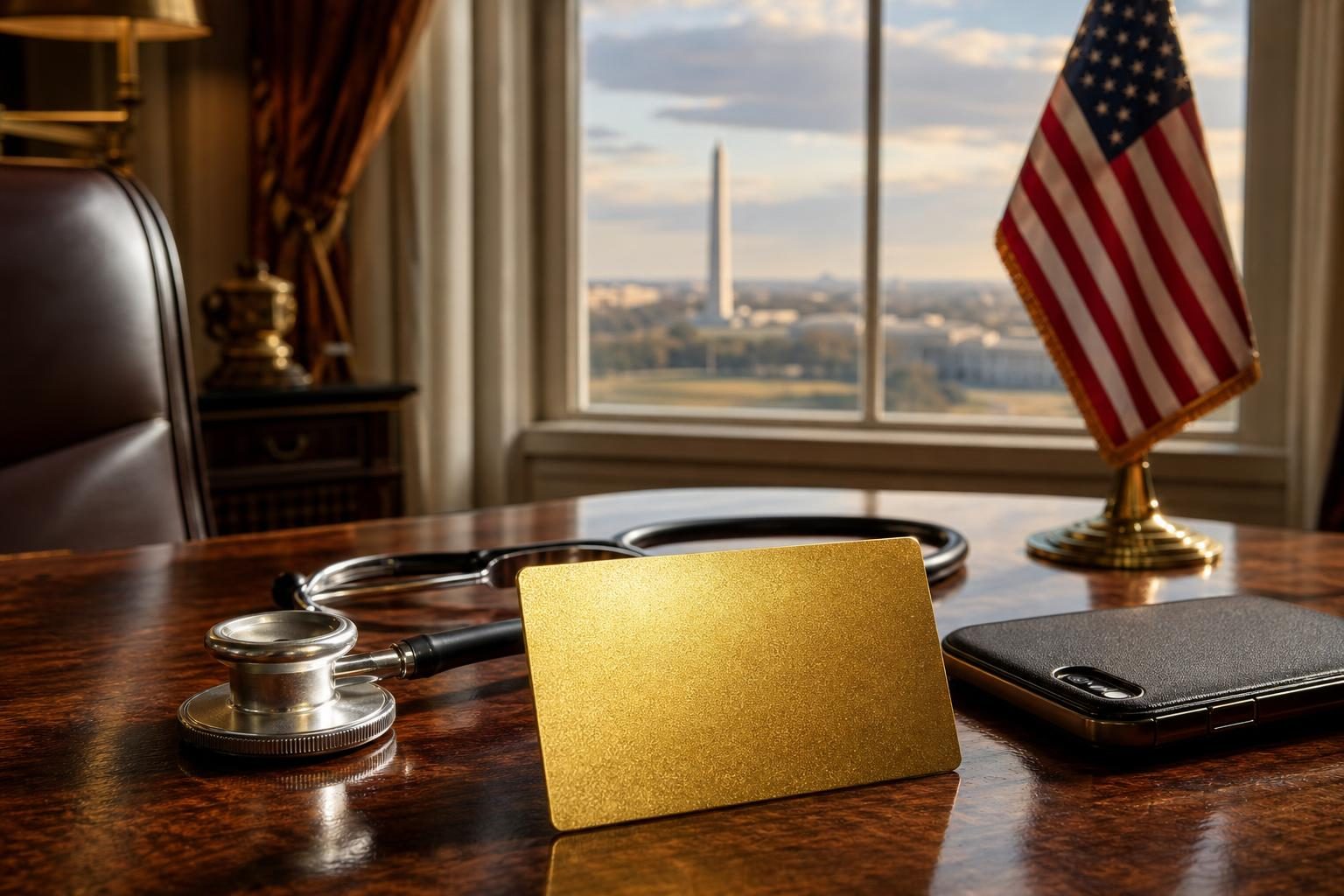
Part of our continuing coverage: A Gold 'TrumpCare' Card Can't Hide the Bill: The Facts on Medicare for All
Key points
- President Trump reposted Sen.-elect Abdul El-Sayed's gold 'TrumpCare' card on Truth Social with no caption.
- El-Sayed has spent weeks offering to put Trump's name on a Medicare for All-style plan.
- Conservatives read the post as trolling; some on the left read it as interest.
- A widely cited study put an earlier Medicare for All plan at $32.6 trillion over 10 years.
President Trump has a gift for saying a great deal without saying a word. On Saturday afternoon he shared, on his Truth Social account and with no caption of his own, the gold "TrumpCare" card that Michigan Sen.-elect Abdul El-Sayed has been dangling in front of him for weeks [1][3].
El-Sayed, a progressive Democrat headed to the Senate in January, has been pitching the president on a government-run, Medicare for All-style health plan, with a twist: he says he is happy to put Trump's name on it [5]. NBC News reported that the pitch had now caught the president's attention [2]. What it means is another matter.
What Happened on Truth Social
The post itself was simple. The president shared El-Sayed's mock-up of a gold-colored insurance card branded "TrumpCare," the image the senator-elect has used to promote his idea, and added nothing to it [3]. FOX 2 Detroit reported that El-Sayed answered quickly, inviting the president to give him a call [1].
That was the whole exchange. There was no White House statement, no plan, no bill text and no promise. Breitbart's headline captured it plainly: the card was posted without comment [3].
How the Pitch Started
El-Sayed has been working this angle since shortly after his election. In an interview reported by KPTV, he said he would vote for a "TrumpCare" for all if the president put his name behind universal coverage [5]. He has since repeated the offer in interviews and on social media, betting that the president's well-known fondness for big, bold, branded projects might open a door that years of Democratic proposals have not [2][5].
It is a clever bit of politics. It also skips past the hard part, which is what the plan would actually do and who would pay for it.
Reading the Silence
Each side saw what it hoped to see. RedState read the repost as the president trolling El-Sayed, turning the senator-elect's stunt back on him [4]. NBC News framed it as a sign that the idea had at least reached the president's desk [2]. Some on the left treated the post as an opening; FOX 2 Detroit noted El-Sayed's eager reply [1].
My take, after covering this White House: the president enjoys a good counterpunch, and he enjoys being talked about. A repost with no words lets him do both. It does not commit him to anything, and nobody should mistake it for an endorsement. The administration's health care record has focused on lowering costs and widening choices, not on folding every American into a single government plan.
The Bill Behind the Gold Card
A gold card is free. The plan behind it is not. When economist Charles Blahous of the Mercatus Center studied Sen. Bernie Sanders' Medicare for All bill in 2018, he estimated it would add at least $32.6 trillion in federal spending over its first 10 years [6]. To be fair to supporters, the same study found the plan could modestly reduce the nation's total health spending, by about $2 trillion [6]. Those savings rest on assumptions about much lower payments to providers, which critics dispute [6].
The bigger question is not the price tag alone. A single-payer system would largely replace the private and job-based coverage that most working families have today [6]. For a family that likes its plan and its doctor, renaming that system after a Republican president would not change how it works.
The president's supporters voted for lower costs, more transparency and more control in the hands of patients. A government monopoly on insurance points the other way, whatever name is printed on the card.
What Comes Next
El-Sayed takes his Senate seat in January, and he has made clear he will keep pressing the idea [5]. If he wants to be taken seriously, the next step is a written plan with real numbers, not a graphic.
For now, the president has done what he often does: thrown the ball back across the net and let everyone else argue about it. Saturday's post started a conversation. It did not start a health care plan, and Americans who rely on their coverage deserve to know the difference.
Sources
With Democrats taking Congress, what should Republicans focus on first?
- Blocking bad bills
- Working on prices and costs
- Winning back the House in 2028
- Confirming judges before January
More in Politics

Cruz Races to Seat Trump's Dallas Judge Before Democrats Take the Senate as Cornyn Holds Back His Blue Slip
Today on The Sterling Report with Ava Sterling
Miller Cracks Down on Aides Keeping Private Paychecks
Today on The Briefing Room with Claire Donovan

Freed by Trump, Oath Keepers Founder Now Turns on Him
This morning on The Briefing Room with Claire Donovan
Were you there?
If you were at the scene, or this story touched your life, tell us what you saw and what it was like.
Discussion 0
Sign in or create a free account to join the discussion.
No comments yet. Start the discussion.