World News
U.N. Inspectors Don't Know Where Iran's Underground Enrichment Plant Is, as Its Guards Claim a Hit on a U.S. Radar in Bahrain
A confidential IAEA report says Tehran has kept inspectors away from a declared plant at Isfahan for a year, while the Revolutionary Guards claim a strike on an American radar and Washington keeps the blockade tight.
By GRACE WHITFIELDStaff Correspondent · WASHINGTON · Nov 13, 7:00 AM · 5 min. read
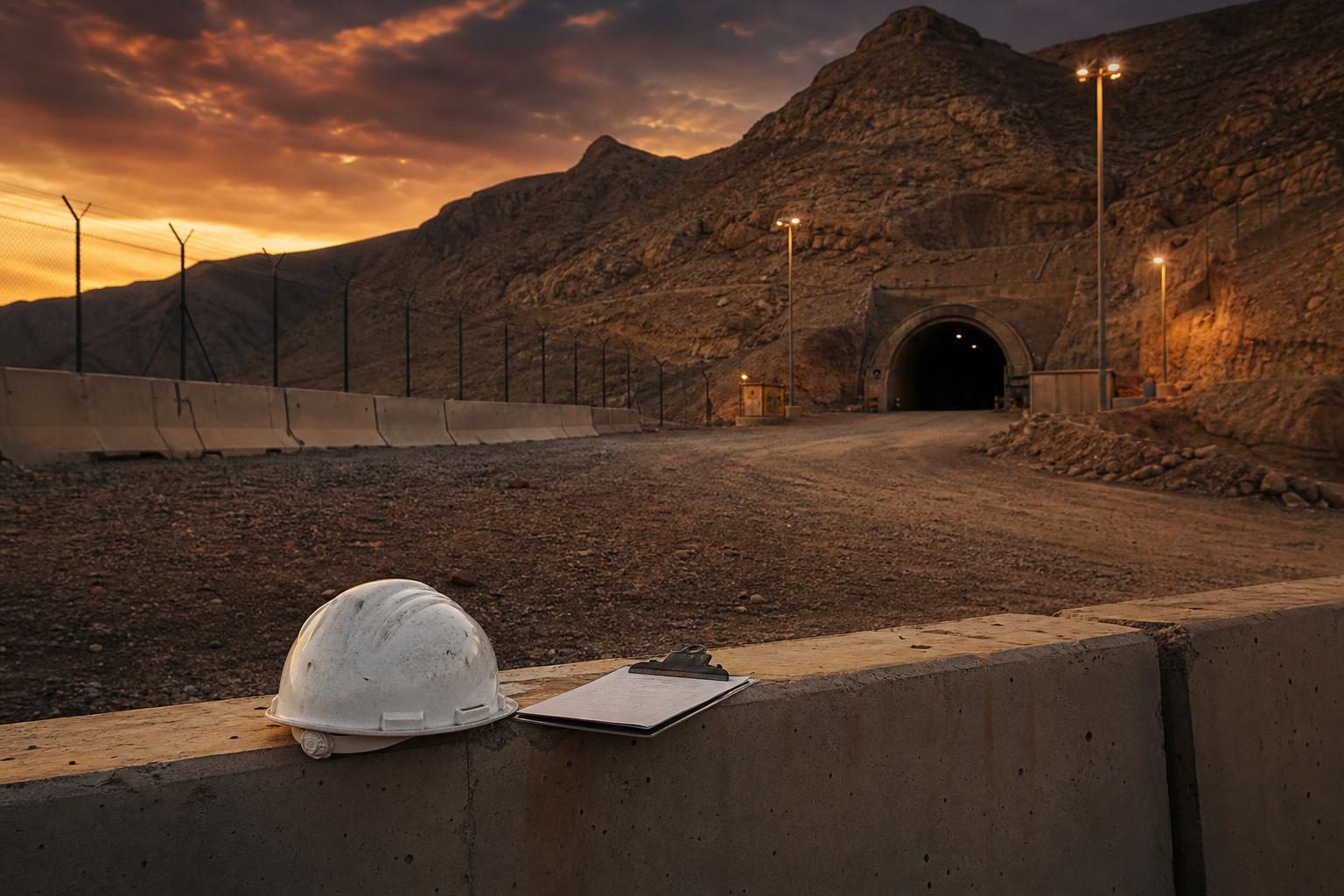
Illustration · Liberty Bell Report
For months the hardest question about Iran's nuclear program has been a simple one: what is Tehran keeping out of sight? On Friday the United Nations' own inspectors gave a troubling answer. In a confidential quarterly report to member states, the International Atomic Energy Agency said it is increasingly concerned about an underground uranium-enrichment plant at Isfahan that Iran declared last year but has never allowed inspectors to visit, Reuters reported in a story carried by The Jerusalem Post.
The agency's admission is stark. According to the report, the IAEA does not know the plant's exact location, its status for safeguards purposes, or whether it holds any nuclear material at all. The facility, which the agency calls the Isfahan Fuel Enrichment Plant, has been on the books for a year, yet the world's nuclear watchdog still cannot say where it is or what is inside it.
That news landed on the same morning Iran's Revolutionary Guards claimed a new strike on American forces in the Gulf, a reminder that the war that began in February is not over even as diplomats talk.
A Claimed Strike on a U.S. Radar in Bahrain
The Islamic Revolutionary Guard Corps said Friday that its forces destroyed a U.S. early-warning radar in Bahrain, according to Iranian state media cited by Euronews. The Guards said their aerospace force carried out the attack in response to an air strike on a telecommunications tower in Sirik County in Iran's southern Hormozgan province on Thursday. Hours before the claim, Iran's official IRNA news agency reported that Sirik had been hit by what it called enemy fire, Al Jazeera reported.
The IRGC-affiliated Fars agency said the radar installation was targeted and destroyed, while Al Jazeera's own headline described the site as targeted, and there was no immediate comment from Washington or from Bahrain's government in Manama. Readers should treat the damage claim as Iran's word until the United States confirms or denies it. Bahrain hosts the headquarters of the U.S. Navy's Fifth Fleet.
In its statement, the Guards called the strike a serious warning to Washington to end what they described as aerial provocations and oil smuggling in the Strait of Hormuz, and said their forces were on full alert to respond without geographical limits if attacks continue. According to Reuters, as reported by Al Jazeera, it is the first time since early September that Iran has claimed an attack on American military assets in a Gulf country.
America Keeps the Strait Open and the Pressure On
The American position has been steady. U.S. Central Command said Wednesday that its forces were working around the clock to keep the Strait of Hormuz open to commercial shipping while strictly enforcing what it called an ironclad naval blockade of Iranian ports, Euronews reported. CENTCOM said about 1.7 billion barrels of crude have moved through the strait under U.S. protection since the summer.
That protection is showing up in the oil numbers. OPEC's monthly report this week showed the OPEC+ group pumped 41.23 million barrels a day in October, about 97 percent of its pre-war February level by a Reuters calculation, with Saudi Arabia alone back above 10.5 million barrels a day, Al Jazeera reported. The same report noted that the conflict had cut off roughly a fifth of the world's oil supply that normally moves through Hormuz, and that U.S. gasoline fell below $4 a gallon this week.
President Trump said Thursday that Washington no longer needs an agreement with Iran and asked Vice President JD Vance, who had played a role in the diplomacy, to focus on issues at home, according to Euronews. The president also said Saudi Arabia, Qatar, Kuwait, the United Arab Emirates and Bahrain had asked him to hold off on broader attacks. He has said he is prepared to return to war if the diplomatic track offered by Qatar fails, while Secretary of State Marco Rubio has argued that economic pressure is working well enough that large-scale military operations are not needed, Al Jazeera reported.
In an interview with Salem News, cited by CBN News, the president said he has not ruled out another attack. "If I saw things going the other way I would do that," he said. He added that it would count as a defeat if Iran's current regime were still in power at the end of his term.
Tehran's Terms: Lift the Blockade First
Iran, for its part, is setting conditions before it will even sit down. Qatar and Pakistan are mediating, and Tehran has made any return to formal talks conditional on lifting sanctions, ending the naval blockade, releasing frozen assets and halting the war on all fronts, according to Euronews.
Iran's parliament speaker and lead negotiator, Mohammad Bagher Ghalibaf, told Al Jazeera on Wednesday that those demands were sent to Washington through a Qatari mediator and form part of a memorandum signed in Islamabad in June. He said the Strait of Hormuz will never return to its pre-war status, that Iran and Oman have reached an understanding to oversee it, and that the ball is now in America's court. He also predicted that Mr. Trump would face pressure from the new Democratic Congress in January.
Iran's security chief, Mohsen Rezaei, warned that if the United States launches another war, every military base involved from West Asia to Europe would be treated as a legitimate target, Al Jazeera reported. CBN News reported a similar threat posted online by the head of Iran's Supreme National Security Council.
Israel Prepares, but Waits
In Israel, the picture is mixed. Al Jazeera, citing Israeli media including the public broadcaster KAN, reported that Israel's security cabinet ordered the military to step up preparations for a possible attack on Iran. CBN News, citing Channel 13, reported that Israel has no immediate plans to strike, an assessment presented to former military chief Gadi Eisenkot, who is now trying to form the country's next government. KAN also reported that CENTCOM recently told the Israeli military to prepare for a possible resumption of fighting, and Gulf states reportedly received similar warnings.
Why the Isfahan Report Matters
The war began on February 28 with U.S. and Israeli strikes on Iran, Al Jazeera noted. Its central purpose, as the administration has framed it from the start, was to make sure the Islamic Republic never gets a nuclear weapon. Friday's IAEA report is a reminder of why that goal still matters. A government with nothing to hide does not declare an enrichment plant and then keep inspectors from finding it for a year.
That is the context Tehran's demands leave out. Iran wants the blockade lifted, its money released and the war declared over before it negotiates. Yet the one body every side calls neutral cannot confirm whether a buried enrichment site contains uranium. Relief without inspections would reward exactly the secrecy the IAEA is warning about.
For American families, the stakes are practical as well as strategic. The strait carries a fifth of the world's oil in normal times, and the steady recovery in Gulf output is a big reason gasoline prices have eased. Keeping that water open while denying Iran a bomb is the balance Washington is trying to hold.
What Comes Next
The confidential report has now gone to the IAEA's member states, and the pressure for access to Isfahan will only grow. Washington has not yet responded publicly to Iran's radar claim. Qatar's mediation continues, and Tehran says it is waiting for a formal American answer to its conditions. With the president saying he does not need a deal, and Iran saying it will not talk until its demands are met, the pressure campaign looks set to continue into the winter, and the question of what lies beneath Isfahan will hang over every step.
Sources
- The Jerusalem Post: UN nuclear watchdog IAEA raises alarm over uninspected Iranian uranium enrichment plant at Isfahan (link)
- Euronews: IRGC says it destroyed US radar in Bahrain after attack on southern Iran (link)
- Al Jazeera: Iran says it targeted US radar site in Bahrain (link)
- CBN News: Israel's Government in Transition: No Plans for Iran Strike but US CENTCOM Urges Prep for Renewed Fight (link)
- Al Jazeera: Hormuz Strait will 'never return' to pre-war status, Iran's Ghalibaf says (link)
- Al Jazeera: Oil production nears pre-Iran war levels, OPEC says (link)
— 30 —