Pushback
Twelve States Refuse to Let One Judge Shut the Door on Trackable Mail Ballots for 2028
Republican attorneys general are appealing a ruling that froze the Postal Service's ballot-mail rule, and the record on postmarks, deadlines and voter trust gives their case real weight.
By JACK HOLLISTERStaff Correspondent · WASHINGTON · Nov 14, 3:00 AM · 4 min. read
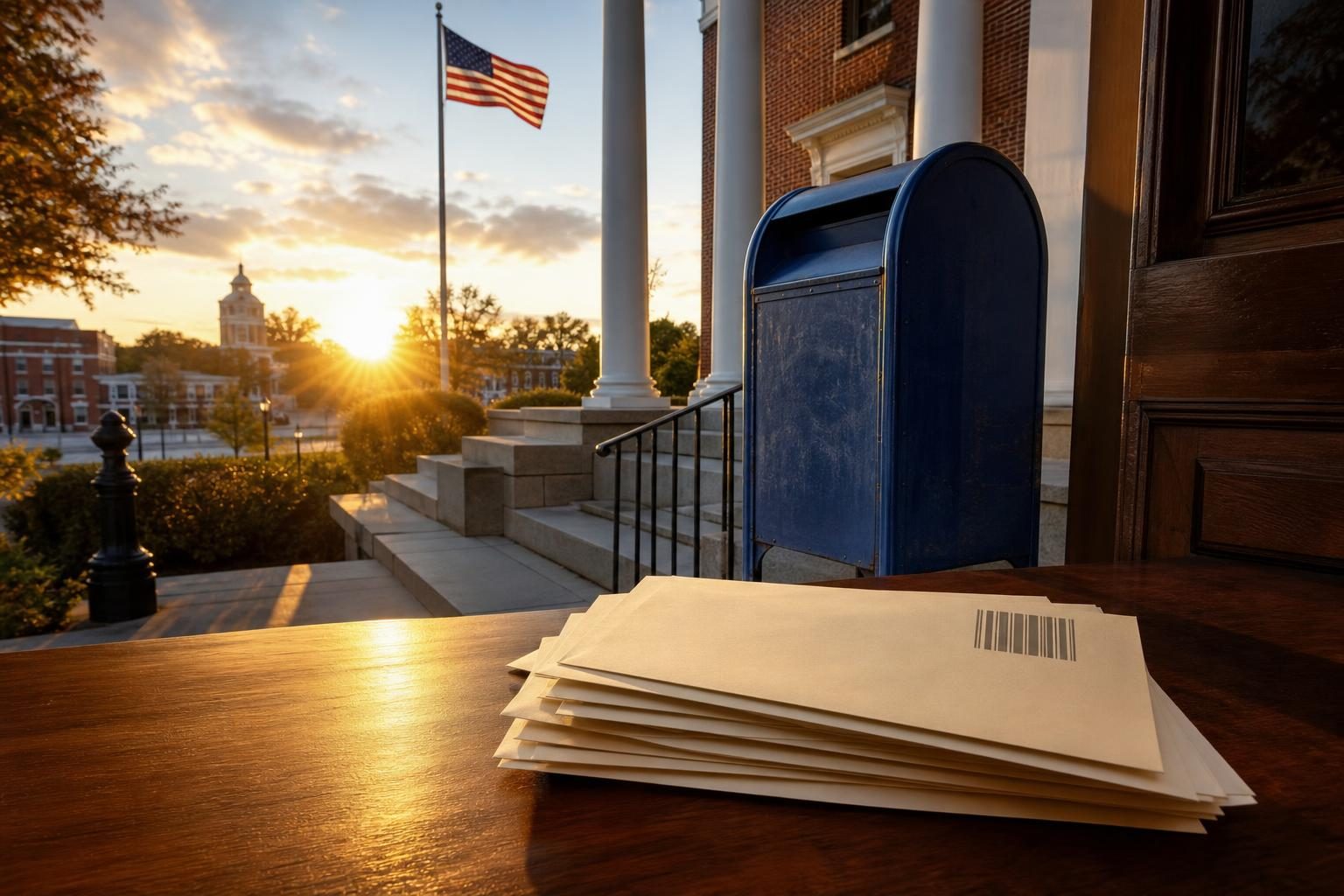
Illustration · Liberty Bell Report
Twelve Republican attorneys general are not letting one federal judge have the final word on how ballots move through the U.S. mail. NPR reported that on Thursday, the last day allowed, the states began appealing a September order that bars the Postal Service from carrying out its revised ballot-mail rule in any federal election, including the 2028 presidential race. The states are Alabama, Florida, Indiana, Kansas, Louisiana, Missouri, Montana, Nebraska, Oklahoma, South Carolina, South Dakota and Texas.
What the judge and the critics said
The rule, which grew out of President Trump's executive order on mail voting, was released in late August and would require states to hand over lists of voters' names and addresses so their ballots could be delivered. It also calls for ballot envelopes that carry an official election-mail logo, can be read by high-speed scanners and bear a barcode unique to each voter.
U.S. District Judge Carl Nichols of Washington, a Trump appointee, blocked the rule in three combined lawsuits brought by the Democratic Party and civil-rights groups including the NAACP, finding the agency had likely overstepped its authority, Axios reported. He allowed that envelope, labeling and tracking requirements might be within the Postal Service's power, but held that the voter-list and online-portal provisions set conditions on who could get a mail ballot, and because the pieces were intertwined, he froze the whole rule.
The Supreme Court had already kept the rule out of the midterms. On Sept. 14, in an unsigned order, the justices refused to lift a separate Boston injunction, saying the government was unlikely to win; Justices Samuel Alito and Clarence Thomas dissented. According to NPR, the Justice Department has now told the court it will not appeal Nichols' ruling, leaving the states to carry the case.
The facts the critics leave out
Justice Brett Kavanaugh wrote separately that there is "at least a fair prospect" that the final rule falls within the Postal Service's authority. His objection was timing: state and local election offices did not have enough time to put it in place before November. The justices acted on an emergency request and have not decided whether the agency holds this power.
The tracking pieces, which even Nichols said may be lawful, target a genuine weakness. Under a Postal Service rule in effect since Dec. 24, 2025, a postmark generally shows when a letter is first processed at a postal plant, not when a voter dropped it off, Stateline reported. A ballot mailed on time can carry a postmark dated after Election Day, a serious problem in states that count late-arriving ballots postmarked by Election Day. The agency now tells voters to mail ballots at least a week early and to ask for a hand-stamped postmark at the counter. A barcode tied to each voter's envelope offers a record that does not hinge on when a sorting machine happens to stamp a date.
Then there is Election Day itself. Congress set one national Election Day, and in June the Supreme Court split 5-4 in Watson v. Republican National Committee over whether that means ballots must arrive by then. Justice Amy Coney Barrett, joined by Chief Justice John Roberts and the court's three liberal justices, held that the federal statutes set when ballots must be cast, not when they must be received. Alito, joined by Thomas, Neil Gorsuch and in part by Kavanaugh, warned that the ruling risks further eroding public confidence in elections. The decision left the question to legislatures, and most require ballots in hand by Election Day; only 14 states and the District of Columbia allow a grace period. Votebeat counted more than 745,000 absentee ballots that arrived after Election Day in 2024 in 11 of the 15 jurisdictions that accept them.
Public trust is the heart of the matter. In a Pew Research Center survey taken Sept. 28 to Oct. 4, 53% of registered voters said they were confident that mail and absentee ballots would be counted as intended, well below confidence in in-person voting. Only 42% of Republican voters agreed, compared with 64% of Democrats. When that many Americans doubt one method of voting, steps that make each ballot traceable deserve a full hearing, not a blanket freeze.
Who is pushing back and what comes next
For now, the 12 states stand alone in defending the rule against Nichols' order. The Boston injunction the Supreme Court left in place covered only this year's midterms, NPR reported, so Nichols' order is the one that reaches 2028. Because Nichols sits in Washington, the states' appeal heads to the U.S. Court of Appeals for the D.C. Circuit.
NPR also reported that it is unclear how long some of the states will press on after Democrats' strong showing in this month's midterms. Walking away would be a mistake. Kavanaugh's opinion signals the core legal question is open, and his chief complaint, a lack of time, does not apply to an election two years off.
The states are asking a fair question: if ballots travel through the federal mail, why can't the federal mail set clear, trackable standards for them?
Sources
- NPR: GOP state officials push to revive Trump's mail voting restrictions for 2028 election (link)
- Axios: Trump's mail-ballot rules blocked by another federal judge (link)
- CNBC: Supreme Court rejects Trump bid to lift block on U.S. Postal Service mail-in ballots rule (link)
- Votebeat: Supreme Court allows states to accept mail ballots that arrive after Election Day (link)
- Stateline: USPS says mail-in ballots might not get postmark on same day they're dropped off (link)
- Pew Research Center: Broad public confidence in elections in the U.S., but partisans differ over concerns about access, security (link)
— 30 —