Pushback
Security First, Then the Truth: What the President Actually Said About the FBI Breach, and the Record Behind His 'Russia Hoax' Point
Headlines say President Trump sees an upside to a cyberattack on the FBI. He called the breach not good. His larger point, that Americans still deserve the full story of the Russia probe, rests on the government's own findings.
By CLAIRE DONOVANStaff Correspondent · NEW YORK · Nov 21, 3:30 PM · 3 min. read
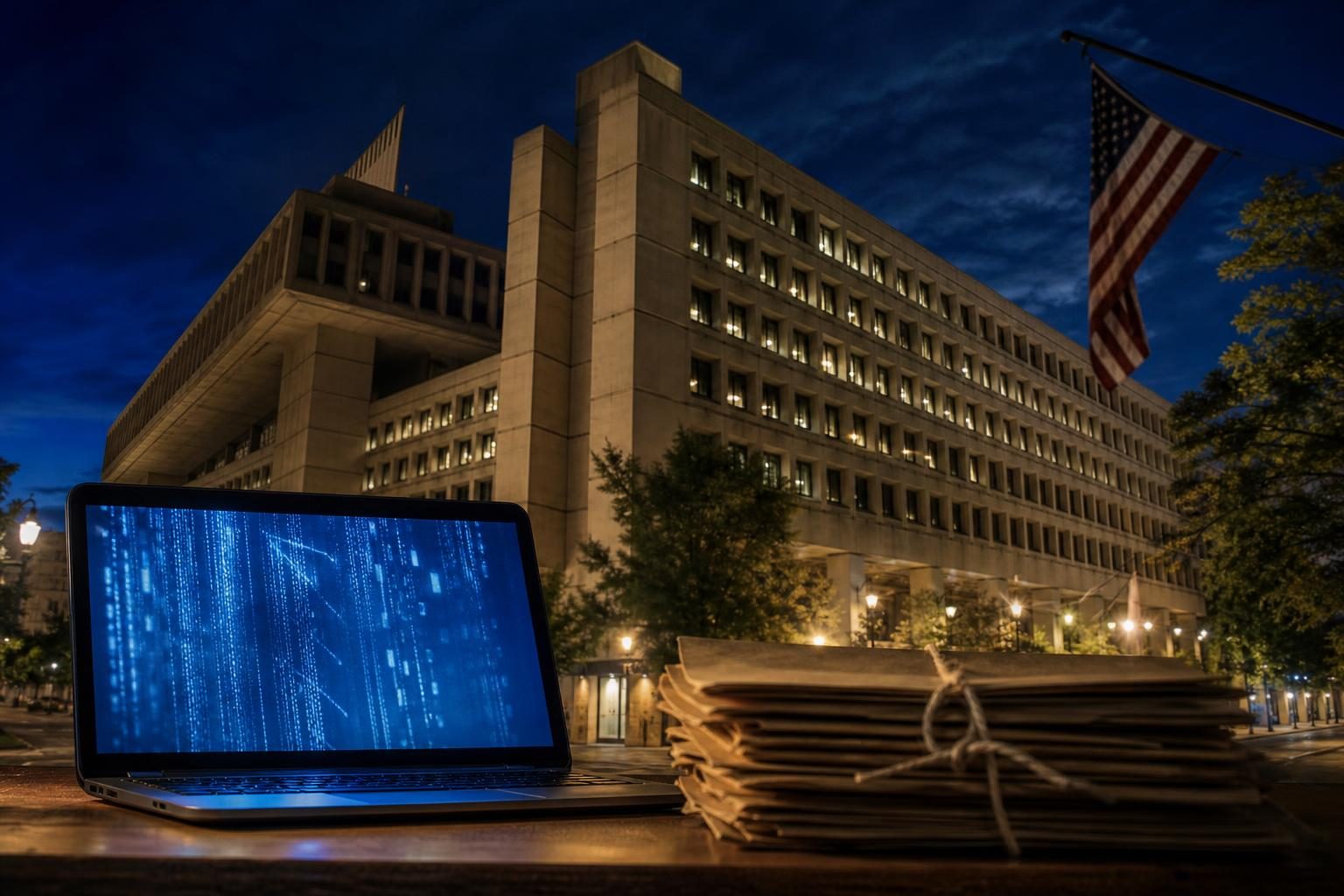
Illustration · Liberty Bell Report
Some of Saturday's headlines made it sound as if the President was cheering a cyberattack on the FBI. The New York Post wrote that he thinks there may be an upside to the breach, and CNBC said he suggested there could be a positive spin. The full quote tells a different story, and the history behind it deserves a fair hearing.
What he actually said
Asked about reports that hackers had breached the FBI's National Crime Information Center, the President was direct about the danger. "It's not good. I don't like that," he said, according to the New York Post. The Daily Wire reported that he confirmed the reports in a Fox News interview.
Only then did he add that he always likes to put things in a positive light, the reports said, suggesting that the intrusion might expose information that would not otherwise come out, including about what he has long called the Russia hoax. The Washington Examiner reported that he also mentioned voter fraud and what he called the Ukraine hoax, and that the cyberattack is deeply concerning to the President. CNBC noted that this would be the second recent intrusion into the FBI's systems.
That is not a President rooting for hackers. It is a President who said, first, that a breach of a law enforcement database is bad, and then voiced a frustration millions of Americans share: that the full truth about how the FBI investigated him has never been told by the FBI itself.
The record behind the frustration
Americans do not have to take the President's word on the Russia investigation. The government's own watchdogs documented serious problems.
In December 2019, the Justice Department's inspector general, Michael Horowitz, found 17 significant errors or omissions in the FBI's applications to surveil former Trump campaign adviser Carter Page under the Foreign Intelligence Surveillance Act. To be fair, Horowitz also concluded that the investigation's opening met the FBI's standards and said he did not find documentary evidence that political bias drove that decision. But the surveillance errors he catalogued were not small, and they went uncorrected through multiple renewals.
In May 2023, Special Counsel John Durham went further. His final report concluded that the FBI opened its full investigation, known as Crossfire Hurricane, based on raw, unanalyzed and uncorroborated intelligence, and that the Justice Department and FBI failed to uphold their mission of strict fidelity to the law in key parts of the matter. Durham's report also described how an FBI lawyer altered an email used to support a surveillance renewal, conduct to which the lawyer pleaded guilty.
Those are not talking points. They are findings published by the Justice Department. When the President calls the Russia investigation a hoax, he is speaking about a probe whose foundations the department's own reviewers found deeply flawed.
Why both things can be true
A breach of the NCIC is a genuine threat. The database helps police officers across the country check warrants, stolen property and missing persons, and any compromise must be investigated and fixed quickly. The President said exactly that.
At the same time, it is reasonable for Americans to want every record about the Russia investigation brought to light through lawful means, not leaks or hacks. The best answer to the President's point is not a headline suggesting he welcomes a crime. It is full transparency from the agencies themselves, so that no one has to hope a cyberattack shakes the truth loose.
Who is pushing for answers
The Horowitz and Durham reviews show what real accountability looks like: patient, documented work by investigators who answer to the public. With Democrats taking control of Congress in January, the coming fight over investigations will run in both directions, and fairness requires that the public see the full record either way.
What comes next
The breach is under investigation, and the public still does not know what, if anything, was taken. For now, the President's message is the one most Americans would want from their commander in chief: the hack is bad, it must be stopped, and the truth about the past still matters.
Sources
- New York Post: Trump thinks there may be upside to reported cyberattack on critical FBI database: 'Russia, Russia, Russia hoax' (link)
- CNBC: Trump says there could be a 'positive spin' from the latest FBI database hack (link)
- Washington Examiner: Trump says FBI hack might reveal voter fraud and 'Ukraine hoax' (link)
- U.S. Department of Justice, Office of the Inspector General: Review of Four FISA Applications and Other Aspects of the FBI's Crossfire Hurricane Investigation (link)
- U.S. Department of Justice: Report on Matters Related to Intelligence Activities and Investigations Arising Out of the 2016 Presidential Campaigns (Special Counsel John Durham) (link)
- The Daily Wire: Trump Calls Reported FBI Database Hack 'Not Good' But Hints At What It Could Reveal (link)
— 30 —