Crime & Justice
Who Gets to Be the Judge? A New Jersey Orchard's Supreme Court Case Could Redraw the Line Between Washington's Agencies and Real Courts
Department of Labor v. Sun Valley Orchards asks whether a federal agency can fine a family farm using its own in-house judges. Here is what the case is about, what the justices said, and why it matters far beyond farm country.
By HAROLD WHITMOREStaff Correspondent · WASHINGTON · Nov 21, 3:30 PM · 5 min. read
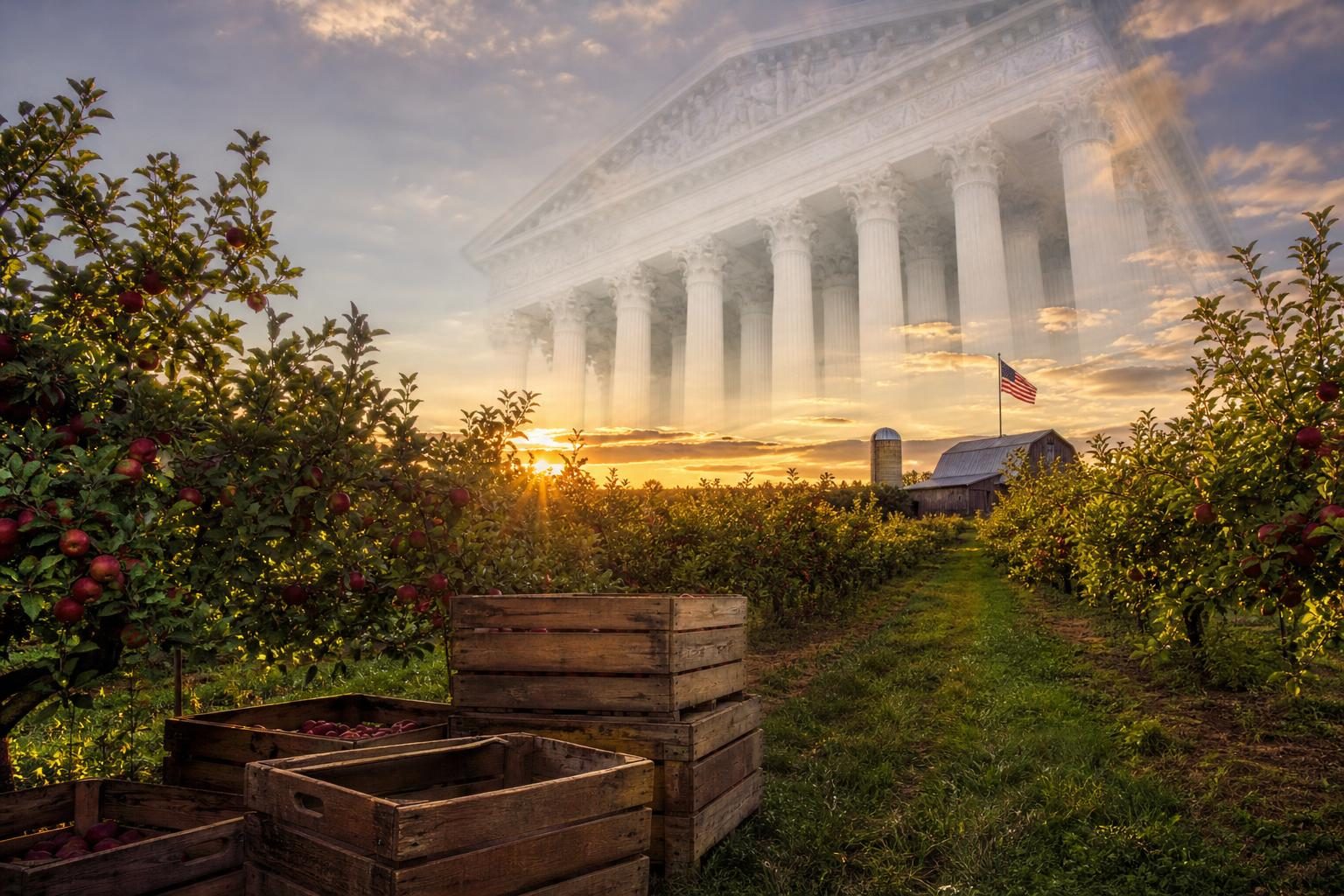
Illustration · Liberty Bell Report
Most Americans will never stand before an administrative law judge. But the question the Supreme Court took up this month, in a dispute that began on a New Jersey fruit farm more than a decade ago, goes to the heart of how the federal government exercises power over ordinary citizens and businesses: when Washington wants to punish you, does it have to prove its case in a real court?
The case is Department of Labor v. Sun Valley Orchards, No. 25-966. The justices heard oral argument on Nov. 10. At stake is whether the Constitution allows the Labor Department to use its own in-house adjudicators to impose money penalties on employers who break the rules of the H-2A guest-worker program, or whether those employers are entitled to have their cases decided by a federal judge, and potentially a jury.
How a farm ended up at the Supreme Court
The H-2A program lets American farms hire foreign workers for seasonal jobs when they cannot find enough domestic labor. In exchange, employers take on a long list of obligations designed to protect both the foreign workers and the American workers who might otherwise fill those jobs, including wage rules, housing standards and a guarantee of a minimum amount of work.
In 2015, Sun Valley Orchards brought in 96 H-2A workers, according to SCOTUSblog. The Labor Department later concluded that the farm had committed four violations of the program's rules, including problems with workers' access to a kitchen and with the guarantee that workers receive at least three-fourths of the hours promised in their contracts, according to an analysis by the employment law firm Fisher Phillips. The department ordered back wages for some violations and assessed civil penalties for all four.
The farm challenged the findings inside the department's own system. An administrative law judge, who works for the Labor Department, agreed that violations occurred but adjusted the amounts owed. The department's Administrative Review Board affirmed, and a federal district court in New Jersey upheld the result. Fisher Phillips reported that roughly $200,000 of the total was assessed as civil penalties, alongside a larger sum in back wages.
The appeals court's answer
The U.S. Court of Appeals for the Third Circuit saw it differently. In a unanimous decision, it held that the Labor Department's administrative judges cannot constitutionally impose civil penalties in H-2A cases, Fisher Phillips reported. The court stressed that the stakes, money penalties and damage to a business's reputation, look much more like the kind of private disputes that belong in a court of law than like routine government regulation.
That reasoning built directly on the Supreme Court's 2024 decision in SEC v. Jarkesy. In that case, the justices ruled 6-3 that when the Securities and Exchange Commission seeks civil penalties for securities fraud, the defendant has a Seventh Amendment right to a jury trial, and the agency cannot route the case through its own in-house tribunal instead. Chief Justice John Roberts wrote that the so-called public rights exception, which lets Congress assign certain matters to agencies, did not cover an action that so closely resembled a traditional fraud claim.
The Labor Department argues that immigration is different. In its view, the H-2A program is a creature of federal immigration law, an area where the government has always had broad authority, so penalties for breaking the program's conditions fall within the public rights exception and can be decided by agency adjudicators.
What the justices said
Reports from the argument suggest a court that is divided along familiar lines but seriously considering a significant limit on agency power. Bloomberg Law reported that the court's three liberal justices appeared to embrace the government's argument that the program imposes obligations on employers to protect domestic workers. Several of the Republican-appointed justices, meanwhile, seemed to doubt that the H-2A requirements fit within the public rights exception at all.
The farm's lawyer, Robert Johnson of the Institute for Justice, did not have an easy morning either. Justice Samuel Alito told him he was "outlining a hodgepodge decision" with his proposed way of sorting public from private rights in immigration cases, according to Bloomberg Law. The Western Journal highlighted that skeptical questioning, framing the farm's position as a defense of employers who undercut American workers.
SCOTUSblog's analysis concluded that the argument showed a court open to the possibility of a major limitation on agencies' ability to impose fines through internal processes, at least without ready review in court.
Two conservative instincts, one principle
This case is interesting precisely because it puts two conservative instincts side by side.
The first is protecting American workers. Many conservatives, especially in the America First movement, want guest-worker rules enforced vigorously so that farms cannot use foreign labor to undercut wages for Americans. The obligations Sun Valley was accused of breaking exist for that reason.
The second is the Constitution's separation of powers. The founders gave the judicial power of the United States to judges with life tenure and protected salaries, precisely so that the people who decide cases would be independent of the people who bring them. When an agency investigates a business, charges it, and then decides the case before a judge who works for the same agency, the citizen is playing an away game on the government's home field. The Seventh Amendment's jury guarantee was written to prevent that kind of concentration of power.
Those instincts do not actually conflict. Nobody in this case is arguing that H-2A rules should go unenforced. The question is who decides whether a business broke them and how much it must pay. A ruling for Sun Valley would not erase the program's protections; the Labor Department could still bring enforcement actions in federal court, where an independent judge, and possibly a jury, would hear the evidence.
Why it matters beyond the orchard
Federal agencies across the government rely on in-house judges to resolve enforcement cases, and Jarkesy has already prompted challenges to that system. Fisher Phillips noted that if the justices side with the farm, the Labor Department would likely lose its authority to use agency adjudication to impose civil penalties for at least some H-2A violations. Commentators expect employers in other parts of the country to cite the Third Circuit's decision in their own challenges to administrative rulings.
A broad ruling could reach well beyond agriculture, touching how agencies handle penalties in labor, workplace safety and other regulatory programs. A narrow ruling might simply decide that H-2A penalties look more like private claims than public ones, leaving bigger questions for another day. The justices' questions suggested they were weighing exactly that choice. For a family farm or a small business without a legal department, the difference matters enormously. An appeal inside an agency can drag on for years before a case ever reaches an independent judge, and many owners simply pay rather than fight. The right to a neutral court at the start, not the end, can decide whether justice is affordable at all.
What comes next
The court will issue its decision by the end of its term, typically by late June or early July. For family farms, for workers who depend on fair wages, and for every American who might someday face a federal penalty, the answer will help define a basic promise of self-government: that the people who accuse you do not also get to be your judge.
Sources
- Supreme Court of the United States: Dep't of Labor v. Sun Valley Orchards, LLC, No. 25-966, argument audio (link)
- SCOTUSblog: Justices see immigration contract dispute as raising the possibility of major limits on administrative adjudication (link)
- Bloomberg Law: Top US Court Wary of DOL In-House Immigration Penalty Power (link)
- Fisher Phillips: Farm Employers Score Major Win in H-2A Dispute (link)
- Supreme Court of the United States: SEC v. Jarkesy, opinion of the Court (2024) (link)
- The Western Journal: Supreme Court Justices Bash Lawyer Defending the Undercutting of American Jobs With Cheap Migrant Labor (link)
— 30 —