Pushback
Nine Has Served America Since 1869: Why Democrats' Plans to Remake the Supreme Court Don't Hold Up
With control of Congress coming in January, Democrats are reviving talk of term limits and adding justices. History, the Constitution and even Ruth Bader Ginsburg point the other way.
By LAUREN PIERCEStaff Correspondent · WASHINGTON · Nov 22, 6:39 PM · 3 min. read
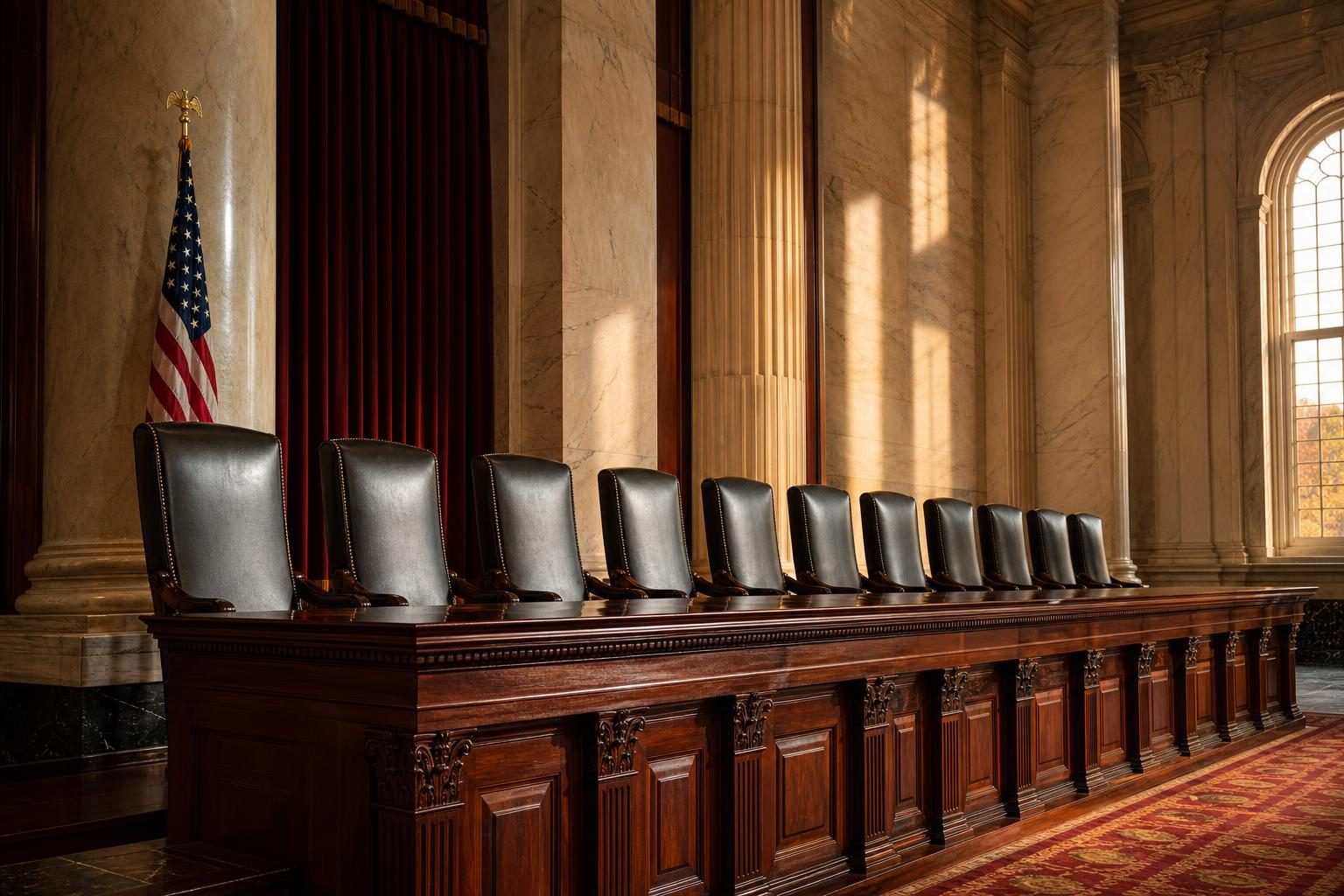
Illustration · Liberty Bell Report
Newly empowered Democrats could revive a package of Supreme Court bills that stalled under Republican control, including stricter ethics rules, 18-year term limits for justices and expanding the court beyond its nine seats, CBS News reported after the midterm elections, as carried by Yahoo News. Rep. Jamie Raskin of Maryland is expected to lead the effort from the House Judiciary Committee, and Rep. Al Green of Texas has filed a bill to grow the court from nine justices to 13.
The push is coming from the top. House Minority Leader Hakeem Jeffries, in line to become speaker, said on CBS's "Face the Nation" on Sunday that the effort to clean up Washington should reach the Supreme Court as well as Congress and the executive branch. Former Vice President Kamala Harris has urged her party to revisit expanding the court to 13 justices, the Deseret News reported, and former Attorney General Eric Holder has called for court expansion and term limits to be part of the Democrats' 2028 platform, Fox News reported.
That is a fair summary of what is being proposed. Here is why the proposals do not hold up.
Nine is not an accident of politics
The number of justices is set by Congress, and it changed several times in the republic's early decades. But it has been nine since the Judiciary Act of 1869, more than a century and a half of stability that has outlasted wars, depressions and bitter elections, the National Constitution Center notes in its history of the last serious attempt to change it.
That attempt came in 1937, when President Franklin Roosevelt, fresh off a landslide and with huge Democratic majorities in Congress, asked for the power to add justices after the court struck down parts of the New Deal. His own party stopped him. The Democratic-led Senate Judiciary Committee issued a blistering report urging that the plan be "so emphatically rejected" that no one would try it again, and the full Senate sent the bill back to committee in July 1937.
The lesson then was the lesson now: a court whose size changes whenever one party wins an election stops being a court and becomes an extension of the majority. The next majority would simply add its own seats, and the one after that would do the same.
The justice Democrats revered said the same
No one made that point more clearly than Justice Ruth Bader Ginsburg. Asked by NPR in 2019 about calls to add seats, she said "nine seems to be a good number" and warned that expanding the court would make it look partisan, adding that Roosevelt's plan had been a bad idea. Democrats who invoke her legacy on so many issues should take her at her word on this one.
Term limits and the Constitution
Term limits sound modest by comparison, but they run into the text of the Constitution itself. Article III provides that federal judges hold their offices "during good Behaviour," the framers' deliberate choice to protect judges from political pressure. A statute that pushes sitting justices off the bench after 18 years, including one version that would apply to the current justices, invites an immediate constitutional challenge. If Americans want term limits, the honest route is the one the framers provided in Article V: a constitutional amendment, ratified by the states.
Ethics rules deserve a serious, bipartisan conversation. But ethics should not be a pretext for a court remade to deliver different results. When the complaint about the court is mostly about how it rules, the remedy the Constitution offers is to win elections, nominate judges and confirm them.
Who is pushing back, and what comes next
The math is daunting for the reformers. Most Senate legislation needs 60 votes, Democrats are expected to hold only about 54 to 56 seats, and President Trump could veto anything that reaches his desk, CBS reported. Even within the Democratic Party, there is no agreement on how far to go.
Republican senators, conservative legal scholars and the long memory of 1937 stand in the way, and they should. Scripture tells us not to move the ancient boundary stones set by those who came before. Nine seats, life tenure during good behavior and confirmation by the Senate have served the country for generations. The burden is on those who would tear them up, and so far they have not met it.
Sources
- Yahoo News (CBS News): Newly empowered Democrats could revive plans for court reforms (link)
- CBS News: Full transcript of "Face the Nation with Margaret Brennan," Nov. 22, 2026 (link)
- Deseret News: Democrats are floating the idea to expand the Supreme Court amid conservative majority and Trump administration (link)
- NPR: Justice Ginsburg: 'I Am Very Much Alive' (transcript) (link)
- National Constitution Center: How FDR lost his brief war on the Supreme Court (link)
- Fox News: Eric Holder urges Democrats to make Supreme Court expansion part of 2028 platform (link)
— 30 —