Military & Defense
Iran Claims Strike on Oman's Hormuz Lighthouse Island as Tanker Attacks Mount
Iran's Revolutionary Guards claim they struck navigation gear on Oman's Didamar Island and say tankers on an 'unauthorized' route were hit by explosions, a test for a neutral mediator and the U.S. Navy.
By COLE BRENNANStaff Correspondent · WASHINGTON · Nov 12, 6:39 PM · 6 min. read
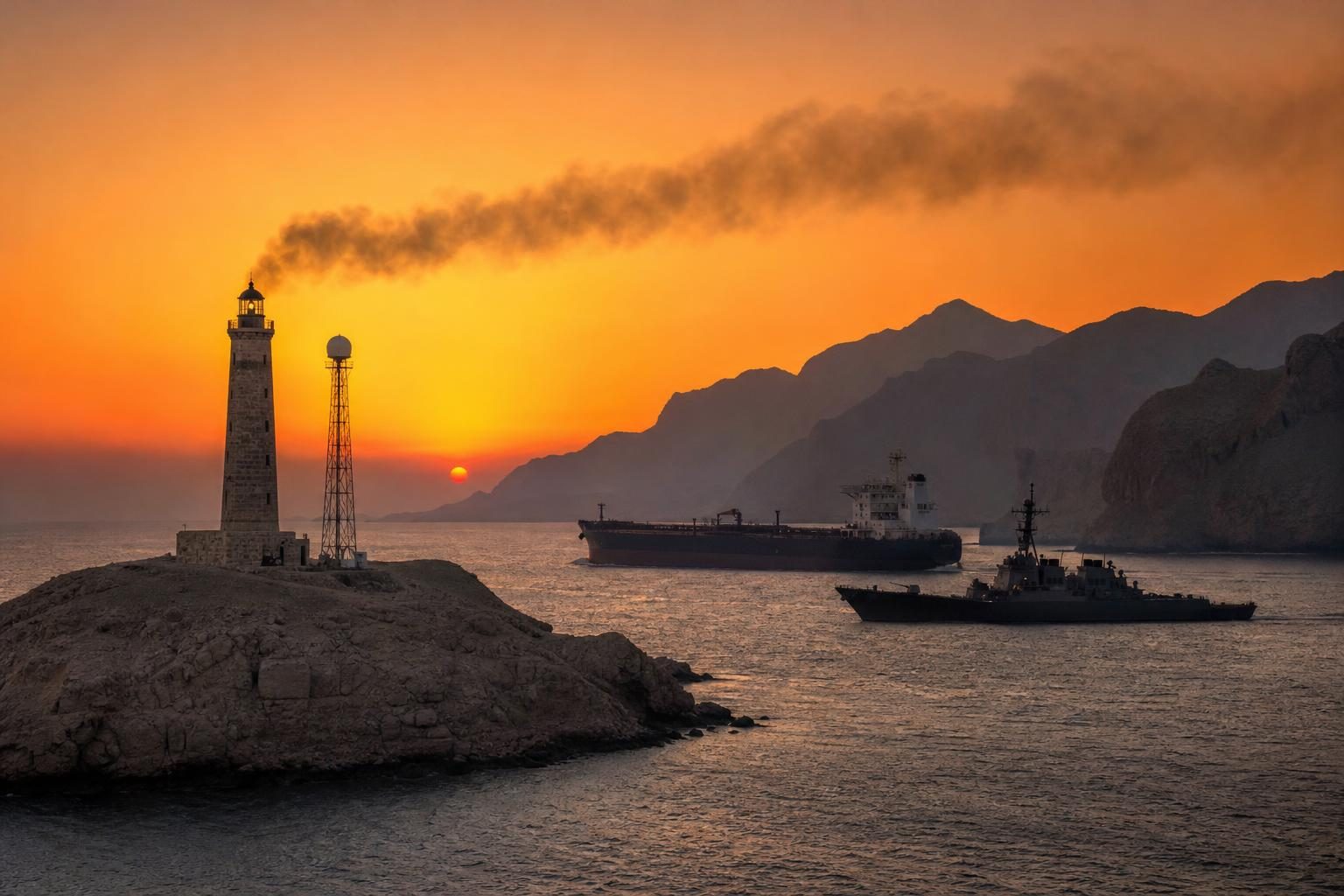
Illustration · Liberty Bell Report
Iran has turned its guns on a lighthouse. The Revolutionary Guards say they struck navigation and communications equipment on Didamar, a small Omani island near the mouth of the Persian Gulf, claiming a hit on "enemy navigation aid systems," Fox News reported. Just the News reported that Tehran went after the island because it allegedly helps the United States escort tankers through the Strait of Hormuz. Within days, Iranian forces were also claiming that tankers using a route Tehran has not approved had blown up on mines, Breitbart reported.
Oman is not a party to this war, and the aids on Didamar serve every captain who sails the strait. Firing on them is less a military operation than a message: Tehran wants to decide who may pass through one of the world's most vital waterways, and it will hit a neutral neighbor to make the point.
What Was Hit on Didamar
Didamar, also called Little Quoin Island, belongs to Oman and sits about 10 nautical miles north of the tip of Oman's Musandam Peninsula, close to a main shipping lane, Fox reported. It carries a lighthouse dating to 1914 and a marine radar on a tower of roughly 25 meters, and it is tied to the Hormuz Control Centre that coordinates traffic through the strait. Breitbart reported that the control center is staffed by Oman's Royal Navy.
Iranian state television claimed the island's personnel and equipment were assisting the enemy's oil smuggling, and the semiofficial Fars News Agency charged that the systems helped vessels cross the strait without Tehran's permission, according to Fox. By the enemy, Iranian outlets mean the United States, Breitbart reported.
The real picture is murkier. Fars dated the strike to Nov. 8, while Iran first claimed responsibility on Nov. 10, according to the Institute for the Study of War, which said the extent of the damage is unclear. Three sources told Reuters that Iran did attack the island's navigation and communications gear, and Sentinel-2 satellite imagery dated Nov. 8 shows what appear to be scorch marks near the radar and radio equipment, Fox reported. Oman confirmed that a loud explosion was detected at a base on the island, Just the News reported. Yet a senior Omani official told the Maritime Executive that the island had not been attacked and its facilities were undamaged, Breitbart reported, noting that smoke seen in video may have come from stricken tankers nearby. None of the reports described casualties.
Shipping-industry sources told Reuters any damage would likely have limited impact on commercial traffic because backup navigation aids are readily available, Breitbart reported.
Tankers in the Line of Fire
The Revolutionary Guards said two oil tankers exploded after hitting naval mines while using an unauthorized route, but they did not name the vessels and there was no independent confirmation, Breitbart reported. Britain's Maritime Trade Operations center did report several commercial vessels struck by unidentified projectiles in the strait this week, though none matched the mine damage the Guards described. By Thursday, Iran's military said four oil tankers had been hit by explosions after ignoring Iranian warnings, Reuters reported.
The toll on seafarers is heavy. The United Nations' International Maritime Organization has recorded at least 130 confirmed incidents in these waters since the war began, with at least 25 people killed, and analysts counted at least 28 incidents in October, the worst month yet, Just the News reported.
Washington's Response and the State of the War
U.S. Central Command has not published a damage estimate for Didamar. In a Wednesday social media post, CENTCOM said American forces are working around the clock "keeping the Strait of Hormuz open for commercial shipping" while enforcing the naval blockade of Iran, and said U.S. agencies are working to choke off Guards shipments of weapons and sanctioned goods over land and across the Caspian Sea, Breitbart reported. The southern route through Omani waters lies outside Tehran's direct military control and is overseen by CENTCOM, Fox reported, and the Institute for the Study of War said commercial ships kept using it after the Didamar strike.
On Thursday, Iran's state news agency IRNA said the town of Sirik in the southern province of Hormozgan had been hit by "an enemy" strike of a military nature, the Jerusalem Post reported, carrying a Reuters account. IRNA offered no details on damage or casualties and did not name the attacker.
The conflict is now more than eight months old. The United States and Israel launched it in February, Reuters reported, and Iran closed the strait that month. The Navy imposed a blockade of Iranian ports in April, lifted it in June after a temporary ceasefire, and reinstated it in July. Talks Vice President JD Vance led in Pakistan in April produced a June memorandum that paused the fighting, but it collapsed within weeks. U.S. strikes on Iran's Qeshm Island on Nov. 2 were described by officials as defensive action against surface-to-air missile threats, and Trump has called such raids minor.
The Wall Street Journal reported Wednesday that Vance was weighing a face-to-face meeting with a senior Iranian security official, a report Reuters had not confirmed. Trump, who has defended the war as necessary to keep Iran from a nuclear weapon, then posted, "We don't need a deal with Iran," adding that America holds Tehran's money and its strait, and he directed Vance to give his full attention to alleged crime and corruption in Democrat-run cities and states, Reuters reported. Secretary of State Marco Rubio, after meeting allies in Paris on Tuesday, dismissed Iran's demands, including war reparations, as absurd and said the president would not sign a bad deal. The administration signaled this week it believes the blockade and sanctions are working well enough that neither escalation nor diplomacy is required.
Oman, the Quiet Middleman
For more than a decade the sultanate was the go-to broker between Washington and Tehran, serving as the back channel before the 2015 nuclear deal and hosting several rounds of talks in President Trump's second term until strikes interrupted them in June 2025 and again this February, Al-Monitor reported. Long called the Switzerland of the Middle East, Oman has also hosted talks between Yemen's Houthis and Saudi Arabia.
That neutrality has cost Muscat in Washington. Once the war began, Pakistan, backed by Egypt, Turkey and Saudi Arabia, took the lead in negotiations, and Qatar has played a growing role; Just the News reported that Qatar has recently stepped up efforts to broker a nuclear agreement. A senior administration official accused Oman of being duplicitous and too close to Tehran, and Trump warned he would strike Oman if it tried to control the strait alongside Iran. Oman's foreign minister, Badr Albusaidi, had urged Washington to stop attacking Iran, saying "this is not your war".
Tehran has repaid that restraint by claiming a strike on Omani soil. Al-Monitor reported in June that Oman had been the Gulf country least touched by Iranian attacks during the war. As of Thursday, Oman had not publicly denounced the strike or any violation of its sovereignty, even though it had protested earlier Iranian attacks on its territory, Breitbart reported.
What It Means for Oil, Sailors and Home
Americans feel the Strait of Hormuz at the gas pump. Regional oil exports recovered to more than 80 percent of prewar levels in September and October, helped by CENTCOM operations, Saudi exports through the Red Sea, and tanker-to-tanker transfers near Oman and the United Arab Emirates, Fox reported, citing Reuters. Omani ports such as Sohar and Duqm have been emerging as strategic hubs for exporters seeking ways around the strait. If Iran can frighten captains away from the southern lanes, that hard-won recovery is at risk.
The American sailors carrying out the blockade and guarding those lanes serve in waters where Iran claims the right to decide who passes and boasts of mines that disable tankers. Their safety depends on deterrence that Tehran believes, which is why steady pressure matters. Tehran's choice of targets, a lighthouse on a neutral nation's island and unarmed merchant ships, tells the world plainly who is threatening freedom of the seas.
The test now is whether the nations that depend on Hormuz, not only America, will stand with Oman and insist that a lighthouse is not a target. Watch for an Omani statement, a CENTCOM damage assessment, and whether any Vance channel survives the president's post. Strength, not concession, has kept those lanes open. Americans of faith will keep the sailors on those decks, and the merchant crews beside them, in their prayers.
Sources
- Fox News: Iran escalates in Hormuz, claims strike on Omani island it says 'enemy' uses for US military ops (link)
- Just the News: Iran strikes Omani island that allegedly helps ships travel through Strait of Hormuz (link)
- Breitbart: Iran Escalates with Attacks on Ships and Omani Island (link)
- The Jerusalem Post (Reuters): Southern Iranian province Hormozgan hit by 'enemy' military strike, Iran claims (link)
- The Irish Times (Reuters): Trump says US does not need Iran deal and directs Vance to focus on domestic corruption (link)
- Al-Monitor: 'Duplicitous' or neutral? How Oman incurred Trump's wrath (link)
— 30 —