Faith & Religion
Two Ancient Cloths, One Head? New Spanish Study Revives the Shroud and Sudarium Debate
Researchers say the Sudarium of Oviedo, the cloth tradition links to Jesus' head, was bound with a bandage, and the lead author's early work points to the Shroud of Turin. Here is what the science shows, and what it does not.
By ETHAN CALLOWAYStaff Correspondent · WASHINGTON · Nov 23, 8:30 PM · 6 min. read
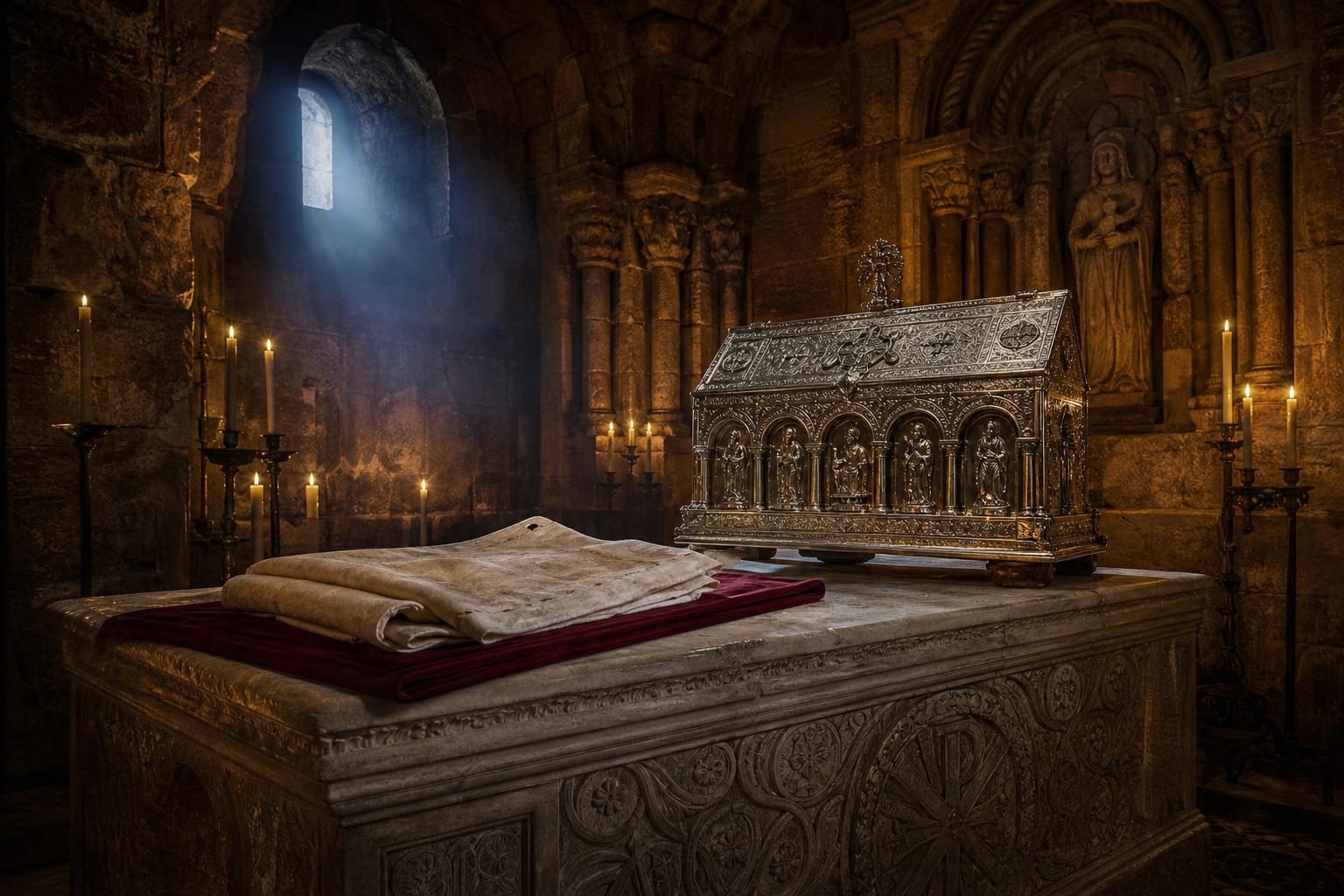
Illustration · Liberty Bell Report
For two thousand years, Christians have treasured a quiet detail in John's account of Easter morning. When Peter stepped into the empty tomb, he saw the linen burial wrappings lying there, and apart from them, rolled up in a place by itself, the cloth that had covered the Lord's head. Two cherished relics claim a link to that moment. One is the Shroud of Turin, the long linen sheet bearing the faint image of a crucified man. The other is the far less famous Sudarium of Oviedo, a stained face cloth kept in a cathedral in northern Spain and traditionally tied to the head covering described in John 20:6-7.
This week the smaller cloth is back in the news. A team of Spanish researchers has published a peer-reviewed study arguing that the Sudarium carries marks consistent with a bandage that once held it against a human head, and the study's lead author says his still-unpublished comparisons suggest its stains line up with wounds on the Shroud. Whatever the headlines say, these are the researchers' claims, and they deserve a careful reading.
What the Spanish team actually found
The paper, "Morphometric and experimental evidence for a cranial bandage hypothesis in the Sudarium of Oviedo," appears in volume 81 of the Journal of Cultural Heritage, according to Othonia, a site that follows Shroud research. Its authors are Pedro Peinado Rocamora, Juan Manuel Miñarro López, Silverio García Cortés and Fernando Sánchez Lasheras. Coverage of the findings described the project as led by the University of Oviedo, and YourNews reported that the study was published online in August.
Rather than cutting samples from the relic, the team worked from high-resolution scans of both sides of the cloth, using digital image processing to pick out faint variations in intensity that the naked eye struggles to see. The authors describe the approach as reproducible and free of destructive sampling, and they lay out three stages in how the marks came to be: generation, transfer and fixation.
Then they tested the idea with real linen. Their experiments produced straight-line pressure marks and small, concentrated pools of fluid that resemble patterns identified on the Sudarium, YourNews reported. Changing the position of the head changed where fluids gathered, which the team read as a sign that the angle of the head and the pressure of a binding shaped the stains. In the authors' view, the cloth's distinctive linear markings and clusters of blood-related material fit the pressure of a bandage wrapped around a person's head.
Peinado said the wrinkle patterns fit the idea that the cloth was held to the dead man's head by outside pressure, such as bandages or cords, and that differences among the stains could be explained by the body being moved while they formed.
The team was candid about the limits. Their experimental head model had no hair, and modern linen is not the same as an ancient textile. The paper does not claim to prove that a bandage was actually used. Nor does it, by itself, date the cloth, identify whose head it covered, or show any connection to the crucifixion or the Resurrection.
The lead author's bigger claim
The link to Turin that drew Monday's attention comes from a separate line of work. Peinado has been using computer comparisons to set marks on the Sudarium against wounds depicted on the Shroud, and his preliminary analysis, which has not been published or peer-reviewed, suggests stains on the Oviedo cloth correspond to wounds around the forehead and the back of the head seen on the Shroud. He has also sketched a sequence of events: the dead man was propped upright, then inclined while the Sudarium was bound to his head, and only afterward laid face-up beneath the shroud.
Supporters of both relics have argued along similar lines for years. The National Catholic Register has reported researchers' findings that the blood and lymph stains on the two cloths match and that both are type AB, and that blood from deep puncture wounds at the back of the head on the Sudarium resembles wounds on the Shroud. One researcher cited by the Register counted 70 points of correlation on the front of the Sudarium and 50 on the back.
Those are serious claims from people who have devoted years to the cloths, but they are claims, some published and some not yet tested by outside reviewers. The new peer-reviewed paper addresses how the Sudarium was fastened, not whether it touched the same body as the Shroud.
Two relics, two long journeys
The Shroud of Turin is a linen cloth about 4.4 meters long, roughly 14 and a half feet, bearing faint front and back images of a gaunt, sunken-eyed man with marks that correspond to the wounds of crucifixion and stains presumed to be blood, according to Encyclopaedia Britannica. Its documented history begins in 1354, when it was held by a French knight, Geoffroi de Charnay. His granddaughter Marguerite gave it to the House of Savoy in 1453; it was damaged by fire and water at Chambéry in 1532 and was moved to Turin in 1578, where it has been kept in the royal chapel of the Cathedral of San Giovanni Battista.
It nearly perished again in April 1997, when fire swept the cathedral's Guarini Chapel during restoration work and firefighters smashed through four layers of bulletproof glass to rescue it, Smithsonian Magazine recounted. Restoring that chapel took 21 years and close to $40 million.
The Sudarium is modest by comparison: roughly 2¾ feet by 1¾ feet, with no image at all, only stains. The Register traces its trail to the early seventh century. When Persian forces invaded in 614, the cloth was carried out of Palestine through North Africa, and in 840 King Alfonso II of Asturias built a chapel to protect it. It was kept in an ornate reliquary chest known as the Arca Santa, and today it is shown to the faithful in Oviedo three times a year: on Good Friday, on the Feast of the Triumph of the Cross on Sept. 14, and on Sept. 21, the close of that feast's octave. Its presence in Oviedo has been documented since at least 1075.
The dating problem that won't go away
The biggest objection to the Shroud has stood for nearly four decades. In 1988 the Vatican gave three laboratories in different countries postage-stamp-sized pieces of its linen, and radiocarbon tests placed the cloth's making at roughly 1260 to 1390. Britannica notes, however, that later chemical and other analyses have pointed to a much older date, possibly as early as the first century, and the Register describes the medieval carbon date as an unresolved problem for those who argue for an older origin.
This is where the Oviedo cloth matters. Monday's coverage noted that dating evidence cited for the Sudarium reaches back to around the eighth century, and the cloth was already being guarded in a royal Spanish chapel by 840, centuries before the Shroud's radiocarbon window opens. The logic runs in both directions. If the stains on the two cloths truly came from one man, a 14th-century origin for the Shroud becomes very hard to defend. If they did not, the Sudarium still stands on its own as an ancient and venerated relic. Settling it will take more evidence, reviewed in the open.
Why believers can welcome the question
It is worth remembering what the Church itself has said, and not said. Britannica notes that the Catholic Church has made no official pronouncement on whether the Shroud is truly a relic of Christ, and the Register points out that no Christian is compelled to believe in the Sudarium's authenticity. The Christian faith does not rest on linen. It rests on the testimony of those who saw the risen Lord and on the empty tomb that Peter and John found that first Easter morning.
Still, there is something fitting about the attention. The Gospel writer took the trouble to record where the head cloth lay, a small, concrete detail from an eyewitness. Careful, non-destructive study of a cloth that has been prayed before for more than a thousand years honors both faith and reason, and nothing about honest inquiry threatens the truth.
What comes next is clear enough. Peinado's comparison of the two cloths still has to be published and reviewed, and the bandage study's authors say their image methods can be reproduced by others. Until then, believers can follow the work with hope and with patience, knowing the Resurrection stands on far firmer ground than any laboratory report.
Sources
- Jingletree: Researchers uncover new evidence linking Shroud of Turin to ancient burial cloth believed to have covered Jesus’ head (link)
- YourNews: New Study Finds Evidence of Bandage on Ancient Cloth Believed to Have Covered Jesus’ Head (link)
- Othonia: New Study Tests How the Sudarium of Oviedo May Have Been Secured to the Head (link)
- National Catholic Register: The Sudarium of Oviedo: The “Other Shroud” of Jesus (link)
- Encyclopaedia Britannica: Shroud of Turin (link)
- Smithsonian Magazine: 21 Years After Fire, Shroud of Turin Chapel Restored to Former Glory (link)
— 30 —