Faith & Religion
States Rally to Kentucky Marian Grotto as Supreme Court Takes Up First Test of Church Land-Use Law
Kentucky's attorney general is leading states behind a small Virgin Mary prayer grotto in Park Hills, a neighborhood zoning fight the Supreme Court will hear on Jan. 20.
By MARGARET CALLAHANStaff Correspondent · WASHINGTON · Nov 23, 6:39 PM · 3 min. read
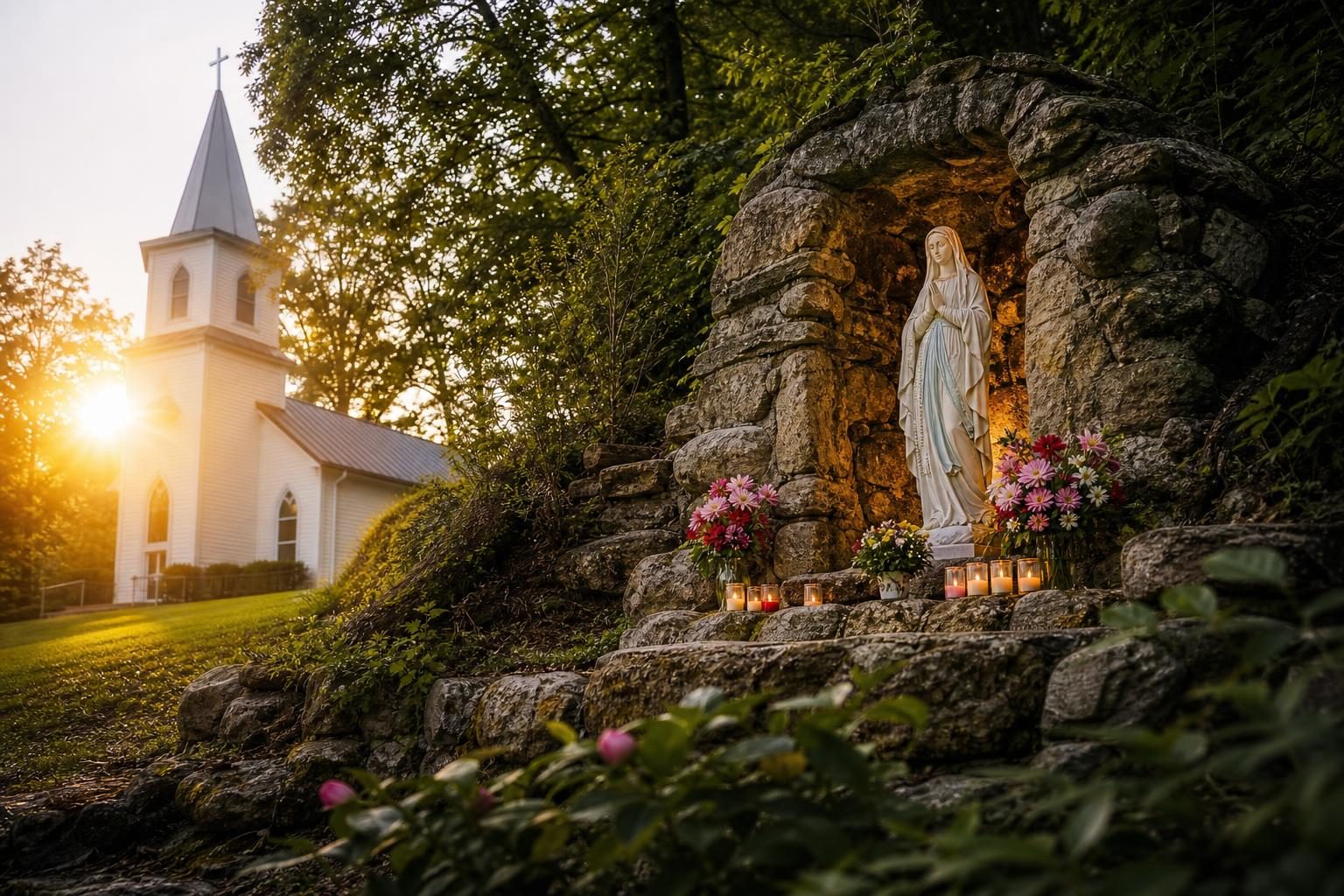
Illustration · Liberty Bell Report
A small outdoor prayer grotto honoring the Virgin Mary, planned beside a Catholic church in the Northern Kentucky town of Park Hills, has grown into a religious liberty case at the U.S. Supreme Court. Kentucky Attorney General Russell Coleman is now leading an 18-state coalition urging the justices to reverse the state ruling that blocked the roughly 600-square-foot shrine, Fox News reported.
The high court agreed on Oct. 1 to hear the case, Missionaries of Saint John the Baptist, Inc. v. Frederic, and has set oral argument for Wednesday, Jan. 20, 2027. According to Fox News, it will be the first time the justices weigh the land-use protections in the Religious Land Use and Institutionalized Persons Act, the federal law known as RLUIPA.
What the church wants is modest by any measure: a quiet outdoor place for meditation and prayer before and after Mass, as Coleman's office has described it. For many Catholics, a grotto honoring Our Lady is a natural expression of devotion, a place set apart for prayer. Whether a local zoning code can keep one off a church's own neighboring land is the question now before the nation's highest court.
A Neighborhood Dispute Climbs the Courts
The grotto would sit on a residential lot next to Our Lady of Lourdes Church in Park Hills, a suburb of Cincinnati. The land is owned by the Missionaries of Saint John the Baptist, Inc., a nonprofit formed by Roman Catholic priests, the Associated Press reported. Park Hills zoning officials approved the project in 2021, but a neighboring family, worried the shrine would add to traffic problems, challenged that approval in state court.
The church side won the first round in Kenton Circuit Court, LINK nky reported. A Kentucky Court of Appeals panel then reversed, finding the city board had no authority to grant the needed variance and rejecting the church's federal claim. In December 2025, the Kentucky Supreme Court upheld the result, reasoning that the ordinance did not substantially burden the church's faith because it could build a smaller shrine on the plot it already occupies.
That reasoning is the heart of the appeal. Under RLUIPA, governments in certain circumstances may not enforce land-use rules that impose a "substantial burden" on religious exercise. The church group argues the Kentucky decision misreads that law and clashes with U.S. Supreme Court precedent and with rulings from other appellate courts. The justices agreed to take up only that question: whether barring a religious institution from building a religious structure on its own property counts as a substantial burden under the statute.
States and Advocates Line Up
Coleman's support is not new. He defended the church's position before Kentucky's highest court and, in April, led a 20-state effort asking the U.S. Supreme Court to take the case. That coalition of Republican-led states argued the Kentucky court misread the federal land-use law and asked the justices to clear the way for the shrine. Now that the court has taken the case, his new filing asks the justices to reverse the Kentucky decision.
The church is represented by First Liberty Institute, the religious liberty law firm that petitioned the high court on the group's behalf. Ryan Gardner, a senior counsel at the firm, told Fox News the case could affect "every single zoning law" in the country. His point is a fair one for believers of every tradition. If a court may decide that a congregation can simply make do with a smaller or relocated place of prayer, few religious building projects anywhere would be safe from second-guessing by local boards.
What the Neighbors Say, and What Comes Next
The neighbors and their lawyers see the case very differently. They argue that Kentucky's courts read the Park Hills zoning rules correctly and that the church group never showed why it could not put the shrine on church land instead. Opponents also say the group knew the local ordinance barred the grotto on the residential tract when it acquired the property.
Those arguments deserve a respectful hearing. Homeowners have a legitimate interest in the character of their streets, and concerns about traffic are the ordinary stuff of zoning disputes in every American town. Yet religious liberty advocates warn that ordinary zoning decisions, made one case at a time, can squeeze houses of worship out of the space they need to practice their faith. In the church's view, the federal law asks whether a burden on religious exercise is substantial, not whether believers could make do with less.
The justices will hear the arguments on Jan. 20. Their answer will reach well beyond one church lot in Northern Kentucky, shaping how much room local governments have to tell churches, synagogues and other houses of worship what they may build on their own land. For the faithful in Park Hills, the hope is simpler: a quiet place to kneel before Our Lady, on property they already own.
Sources
- Fox News: States rally behind Catholic church in first-of-its-kind Supreme Court fight over prayer shrine (link)
- PBS News (Associated Press): Supreme Court intervenes in dispute over Kentucky church's plan to build shrine on residential land (link)
- Kentucky Lantern: Kentucky attorney general asks U.S. Supreme Court to allow Catholic church to build shrine (link)
- LINK nky: U.S. Supreme Court sets date for oral arguments in Park Hills grotto case (link)
- SCOTUSblog: Court will hear arguments in January on six-person juries, religious zoning dispute (link)
- Fox News: EXCLUSIVE: Supreme Court prayer grotto case could impact 'every single zoning law' in America, attorney says (link)
— 30 —