Faith & Religion
Faith in the Public Square Goes Before Canada's Highest Court: What Next Week's Bill 21 Ruling Means for Teachers, Police and Religious Liberty
On Nov. 27 the Supreme Court of Canada will decide whether Quebec can keep barring teachers, police officers and judges from wearing religious symbols on the job, and how far a legislature can go in shielding a law from the courts. Here is the case, the history and why Americans who cherish the First Amendment should pay attention.
By MARGARET CALLAHANStaff Correspondent · WASHINGTON · Nov 21, 2:03 AM · 5 min. read
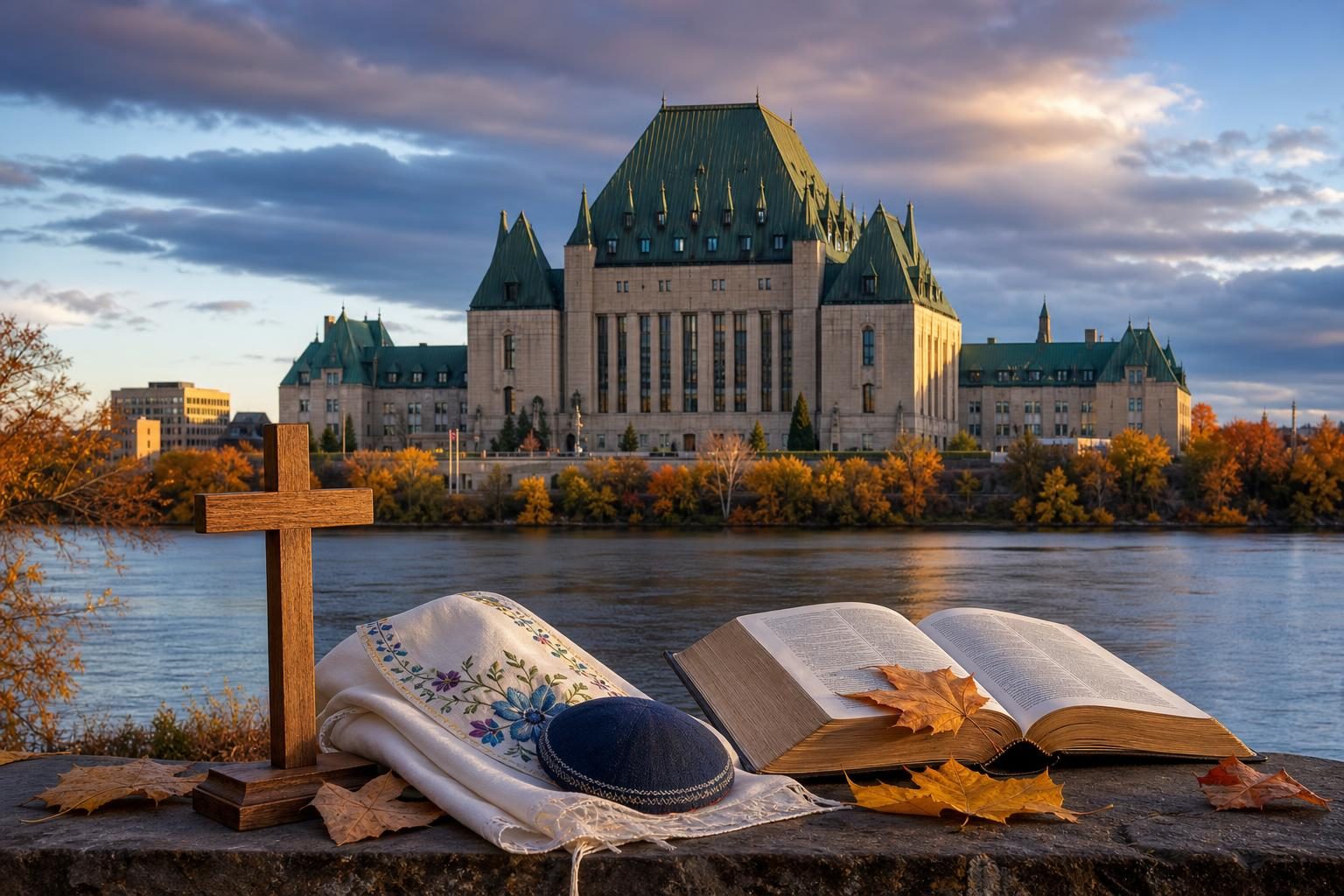
Illustration · Liberty Bell Report
Canada's highest court will decide next week whether a teacher in Quebec may wear a cross, a head scarf, a turban or a kippah while doing her job, and in the process it may redraw the line between elected legislatures and the judges who review their laws.
The Supreme Court of Canada announced on Friday that it will release its decision on Quebec's secularism law, known as Bill 21, on Friday, Nov. 27, at 9:45 a.m. Eastern, CBC News reported. The Globe and Mail described the coming ruling as landmark, noting that the court is expected to decide not only the fate of the religious symbols ban but also whether there are limits on how governments use the Charter's notwithstanding clause.
For believers of every faith, and for anyone who cares about how free societies protect conscience, it is one of the most important religious liberty cases in the Western world this year.
What Bill 21 Does
Quebec adopted Bill 21 in 2019. The law prohibits public sector workers in positions of authority, including teachers, police officers, prison guards and judges, from wearing religious symbols while on the job, CTV News reported. Its supporters in Quebec describe it as a defense of the state's religious neutrality, a principle with deep roots in the province's history.
The law applies to symbols of any faith. In practice, critics say, its heaviest weight has fallen on Muslim women who wear the hijab, and on Sikh and Jewish believers whose faith calls for head coverings. Intervenors who appeared before the Supreme Court drew the justices' attention to the concrete harm the law has caused, particularly for Muslim women, the Canadian Civil Liberties Association said in its summary of the hearing.
From the start, Quebec shielded the law with Section 33 of the Canadian Charter of Rights and Freedoms, better known as the notwithstanding clause. That provision allows a legislature to declare that a law will operate even if it would otherwise violate certain Charter rights, including freedom of religion and equality rights.
How the Case Reached Ottawa
The legal fight has been long. In a unanimous decision on Feb. 29, 2024, the Quebec Court of Appeal upheld almost every part of the law, CTV News reported. The appeals court agreed with the trial judge that Quebec's use of the notwithstanding clause shields Bill 21 from challenges based on discrimination.
The appeals court went further than the trial court in one important respect. It struck down an exemption that a lower court judge had carved out for English-language school boards, extending the law's reach to those schools, too. The only part of the law the appeals court found unconstitutional was its ban on face coverings for members of the provincial legislature.
Opponents, including school boards and civil liberties groups, then took the case to the Supreme Court of Canada, which heard four days of arguments in March. Seven of the court's nine justices are hearing the case.
The Bigger Question: Who Has the Last Word?
What makes the case so significant is that it is no longer only about head coverings and crosses. It is about who gets the final say in a democracy.
The federal government in Ottawa urged the justices to set new limits on the notwithstanding clause, The Globe and Mail reported. Lawyers for the Attorney General of Canada argued that the clause is meant to be temporary and cannot be used in a way that does lasting harm to Charter rights, and that courts must keep the power to decide whether a government's use of it amounts to an unconstitutional change to the Constitution. Ottawa also asked the court to allow judges to declare that a law shielded by the clause violates the Charter, even while the law itself remains in force.
Several provinces pushed hard the other way. Alberta, Ontario and Saskatchewan argued that letting courts review a government's use of the notwithstanding clause, or the laws it protects, would undermine parliamentary supremacy, according to The Globe and Mail. Counsel for 27 intervenor groups addressed the court on the final day, and many focused on whether the justices may formally declare that Bill 21 violates Charter rights, Canadian Lawyer reported.
That sets up an unusual alignment. The provinces defending the clause include conservative governments that have used it themselves to protect their own laws. Many religious liberty advocates, meanwhile, are hoping the court gives judges a stronger hand. Conservatives who believe both in limited judicial power and in robust protection for faith will find themselves weighing two principles they hold dear.
What the Court Could Do
The court does not signal its outcome in advance. Broadly, the justices could uphold the law and leave the notwithstanding clause as it has long been understood. They could uphold the law while laying down new conditions on how the clause may be used, or allow courts to issue declarations that a protected law breaches the Charter. Or they could strike down parts of the law, such as its application to English school boards, which the appeals court extended.
Any of those paths would ripple far beyond Quebec. Other provinces have reached for the notwithstanding clause in recent years on matters ranging from labor disputes to language and school policy, and the ruling will shape how freely they can do so in the future.
Why Americans Should Care
The United States settled this question differently. Our First Amendment protects the free exercise of religion as a right no legislature can simply set aside, and the Constitution has no notwithstanding clause. In recent years, American courts have repeatedly affirmed that public employees and citizens do not shed their faith at the schoolhouse door or the courthouse steps. A public school teacher in Ohio or Texas may wear a cross necklace or a head scarf to class without fear of losing her job.
That is not an accident. The Founders understood that a government strong enough to strip religious expression from its own employees is strong enough to push faith out of public life altogether. Neutrality, rightly understood, means the state does not take sides among faiths. It does not mean the state demands that believers hide their faith to serve their neighbors.
Quebec's leaders sincerely see Bill 21 as protecting the public from any hint of state-sponsored religion, and their history gives them reasons for that concern. But a teacher's crucifix or a police officer's turban is not the government establishing a church. It is a person of faith showing up for work.
What Comes Next
The ruling will be released at 9:45 a.m. Eastern on Nov. 27. Whatever the justices decide, the reaction will be swift in Quebec City, in Ottawa and in provincial capitals from Edmonton to Toronto.
Liberty Bell Report will bring readers the decision, what it means for the public workers covered by the law, and what it signals for religious liberty across the democratic world. In the meantime, Christians of every tradition can pray for wisdom for the justices and for a just outcome that honors the conscience of every believer.
Sources
- CBC News: Supreme Court ruling on Quebec's secularism law coming on Nov. 27 (link)
- The Globe and Mail: Supreme Court to issue landmark ruling on Quebec's Bill 21 next week (link)
- CTV News: Quebec Appeal Court rules secularism law is constitutional, English schools rebuffed (link)
- The Globe and Mail: Supreme Court wraps up four-day hearing on Quebec's Bill 21 (link)
- Canadian Lawyer: SCC hears intervenors, closing arguments in Bill 21 case (link)
- Canadian Civil Liberties Association: Bill 21 at the SCC: Day 4 (link)
— 30 —