Faith & Religion
Before the Turkey, the Prayer: How Thanksgiving Began as a Day of Gratitude to God, From Plymouth to Washington to Lincoln
As families prepare for Thursday, the record left by Pilgrims, presidents and a determined magazine editor shows a holiday rooted in faith, offered in hard times, and meant for the whole nation.
By ETHAN CALLOWAYStaff Correspondent · WASHINGTON · Nov 22, 3:00 AM · 6 min. read
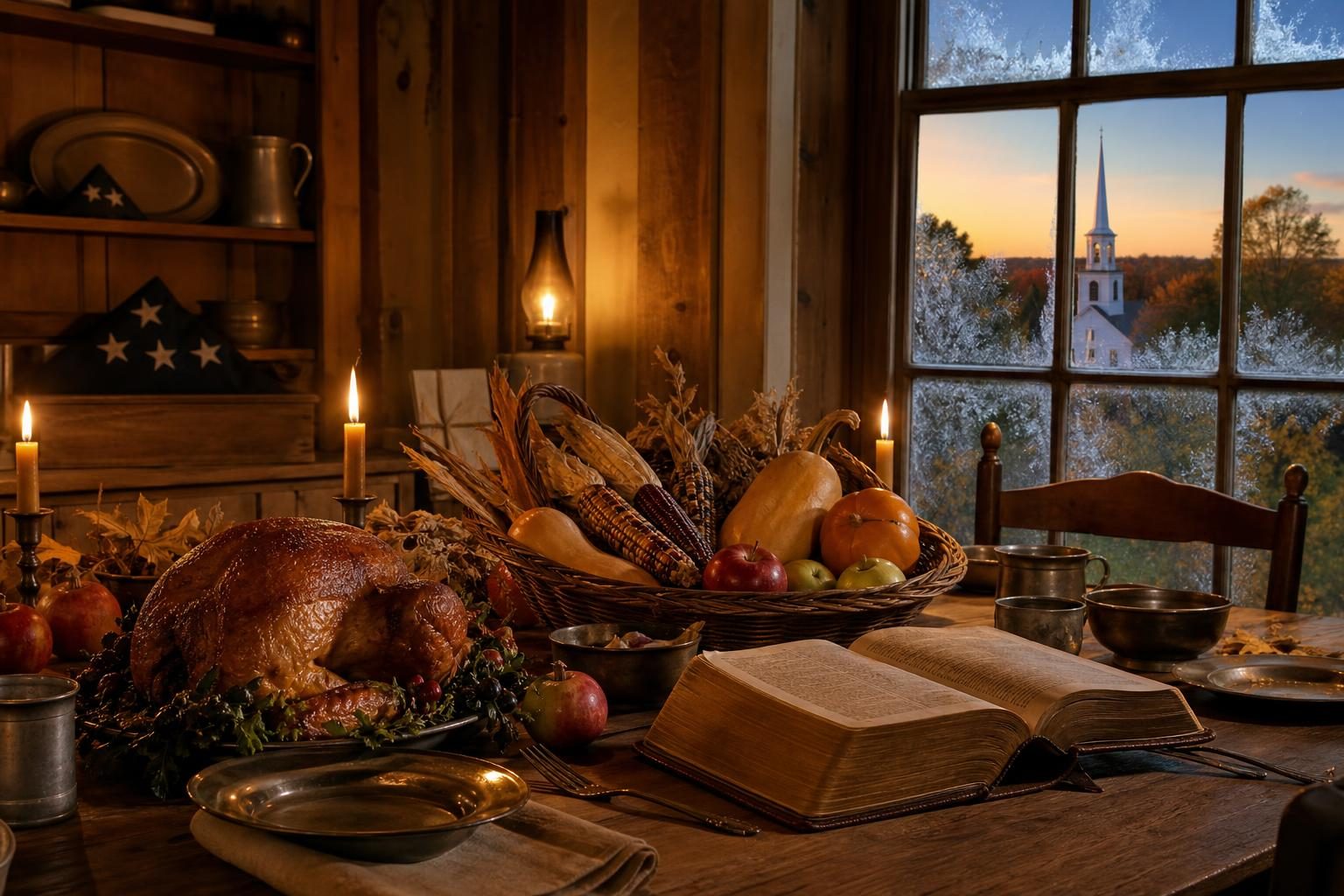
Illustration · Liberty Bell Report
This week, tens of millions of Americans will crowd highways and airports, stretch the dining table with a borrowed leaf and argue cheerfully over the last slice of pie. It is easy to forget, amid the parades and the football, what the day was meant to be. The historical record is not shy about it. From its earliest roots, Thanksgiving was a day set apart to thank God.
That conviction is not limited to Americans. In a column published by The Christian Post on Saturday, a writer recalled asking a Chinese pastor's wife whether she knew what Thanksgiving was. Her family had celebrated it every year in China, she answered, not because it is American but because it is Christian. It is a striking reminder, from believers who know what it costs to worship freely, of where this holiday's heart has always been.
The Harvest at Plymouth
The story Americans learn in grade school begins in the autumn of 1621, after the Pilgrims' first harvest at Plymouth. The best eyewitness account comes from a letter by the colonist Edward Winslow, dated December 11, 1621, which describes the settlers celebrating their first good crop of corn and barley, grown with generous help from their Wampanoag neighbors, according to historians at Pilgrim Hall Museum. Winslow wrote that the governor sent men out fowling so that the colony might "after a special manner rejoice together".
The Wampanoag leader Massasoit arrived with a large company of his men, and the two peoples shared food and fellowship over several days, the account records. Historians are careful to note what the letter does not say. Winslow never used the word "Thanksgiving," and the settlers did not set out to found an annual holiday.
That distinction matters, because to the Pilgrims a true "day of thanksgiving" was something more solemn than a feast. It was a religious observance, a day of prayer and worship called in response to a specific mercy from God, and it could just as easily follow a day of fasting in hard times. The Plymouth harvest gathering of 1621 was joyful; the tradition it came to symbolize was devout.
A Nation Born in Prayer
The habit of public thanksgiving traveled with the colonists and grew with the country. Colonial governments and, later, the Continental Congress issued proclamations calling Americans to days of prayer and thanks during the struggles of the Revolution, as the Library of Congress's collection of Thanksgiving documents shows.
When the new republic began under the Constitution, its first president continued the practice. On October 3, 1789, George Washington issued a proclamation, at the request of Congress, setting aside Thursday, November 26, as a day of public thanksgiving and prayer, according to the National Archives' Founders Online. Its opening line declared it the duty of all nations "to acknowledge the providence of Almighty God". Washington asked Americans to give humble thanks for God's care through the war and for the peaceable establishment of a constitutional government. This year, Thanksgiving falls on November 26 once again, the same date Washington chose.
It is worth pausing on that. In the very first year of government under the Constitution, with the First Amendment newly drafted and on its way to the states, the nation's founders saw no contradiction in asking the whole country to give thanks to God. They did not establish a church; they simply acknowledged, as a people, a debt of gratitude. Washington's proclamation was a national day, though not yet an annual one.
The Editor Who Would Not Quit
For decades after Washington, Thanksgiving remained a patchwork. Some presidents issued proclamations; others did not. States set their own days, many of them in New England, where the tradition ran deepest.
The woman who changed that was Sarah Josepha Hale, the editor of Godey's Lady's Book, one of the most widely read magazines of her era. Beginning in the 1840s, Hale campaigned year after year for a national, annual Thanksgiving, writing editorials and letters to governors and presidents, according to the National Park Service. In September 1863, she wrote to President Abraham Lincoln asking him to make the day a fixed national festival.
Her timing could not have been more poignant. The country was tearing itself apart. Only months earlier, the Union had won at Gettysburg at a cost in lives that still staggers the imagination.
Lincoln's Proclamation in a Time of War
On October 3, 1863, Lincoln issued a proclamation inviting Americans to observe the last Thursday of November as a day of thanksgiving and praise, the National Park Service reports. Secretary of State William Seward drafted the text.
The proclamation is remarkable for what it chose to see in the middle of a civil war. It listed the blessings the nation still enjoyed, from fruitful fields to growing population, and called them "the gracious gifts of the Most High God". It did not pretend the war was not happening. Instead, it asked Americans to offer thanks while also humbly seeking forgiveness for the nation's sins, and to commend to God's care the widows, orphans, mourners and sufferers of the war.
That pairing of gratitude and humility, in the darkest of years, is the heart of the American Thanksgiving. Lincoln's proclamation began an unbroken line of annual national observances that has continued ever since, as presidents from Lincoln forward kept the tradition going, Smithsonian Magazine has noted.
The date itself had one more twist. In 1939, with the last Thursday of November falling late in the month, President Franklin D. Roosevelt moved the holiday up a week, hoping a longer holiday shopping season would help an economy still recovering from the Great Depression, Smithsonian Magazine recounts. The change caused widespread confusion, with states splitting over which Thursday to observe. Congress settled the matter in 1941 by fixing Thanksgiving on the fourth Thursday of November, where it remains.
The squabble over dates never changed the substance. Every president since Lincoln has issued a Thanksgiving proclamation, and those documents, read together, form a long and unbroken public record of national gratitude to God.
Why It Still Matters
There is a temptation to treat Thanksgiving as a secular harvest festival with a religious past. The record suggests the reverse: it is a religious holiday that has gathered secular customs around it. The Pilgrims rejoiced after a hard first year. Washington called a young nation to acknowledge Providence. Lincoln asked a bleeding country to count its blessings and confess its sins.
For Christian families, that history is an invitation. The meal is a blessing in itself, but the older tradition asks for something more: a pause before eating to name what God has given, including the gifts that came wrapped in hardship. Many families still go around the table and share one thing they are thankful for. Others read a psalm, sing a hymn or read aloud from Washington's or Lincoln's proclamation, both of which are short enough to share before the turkey is carved.
And for all Americans, believers or not, the history offers a lesson in civic humility. The men who wrote these proclamations were not naive about suffering. Washington had just led a long, grinding war. Lincoln was presiding over the bloodiest conflict in the nation's history. Yet both believed that a people who stop to give thanks are better able to bear burdens, forgive one another and face what comes next.
What Comes Next
Thanksgiving falls this Thursday, Nov. 26. Somewhere this week, a family in a small apartment, perhaps far from home and perhaps having paid a price for their faith, will bow their heads before a simple meal, just as that pastor's family in China did every year. Millions of other Americans will do the same around fuller tables.
The words they use will vary. The impulse, as the record of nearly four centuries shows, is the same one that moved Pilgrims at Plymouth, a general in New York and a wartime president in Washington: before anything else, give thanks.
Sources
- Pilgrim Hall Museum: Evolution of an American Holiday (link)
- Founders Online (National Archives): Thanksgiving Proclamation, 3 October 1789 (link)
- National Park Service: Lincoln and Thanksgiving (link)
- Smithsonian Magazine: Presidents From Lincoln to FDR Kept the Thanksgiving Tradition Going (link)
- The Christian Post: Thanksgiving: What a persecuted Chinese Christian reminded me about the holiday (link)
- Library of Congress: Thanksgiving: Primary Source Set (link)
— 30 —