
 Yesterday on Command Post with Dan Whitaker
Warned and Then Stopped: U.S. Strike Halts a Cargo Ship Trying to Run the Iran Blockade
CENTCOM says a Palau-flagged bulk carrier leaving Bandar Abbas ignored repeated warnings before a U.S. aircraft knocked out its propulsion. No crew were hurt.
Filed November 27, 2026 · 📍 Hartford, CT 06103
Were you there? Share your story
Story tracker
Our anchors are following this story. New details will appear here as they come in.
Key points
- CENTCOM says a U.S. aircraft disabled the Palau-flagged bulk carrier Pacific Archer in the Gulf of Oman on Thanksgiving.
- The ship had left Iran's Bandar Abbas and ignored repeated warnings; its civilian crew was unharmed.
- U.S. forces have redirected 158 ships and disabled six since the blockade was reimposed.
- The blockade returned after a framework deal with Iran collapsed in July.
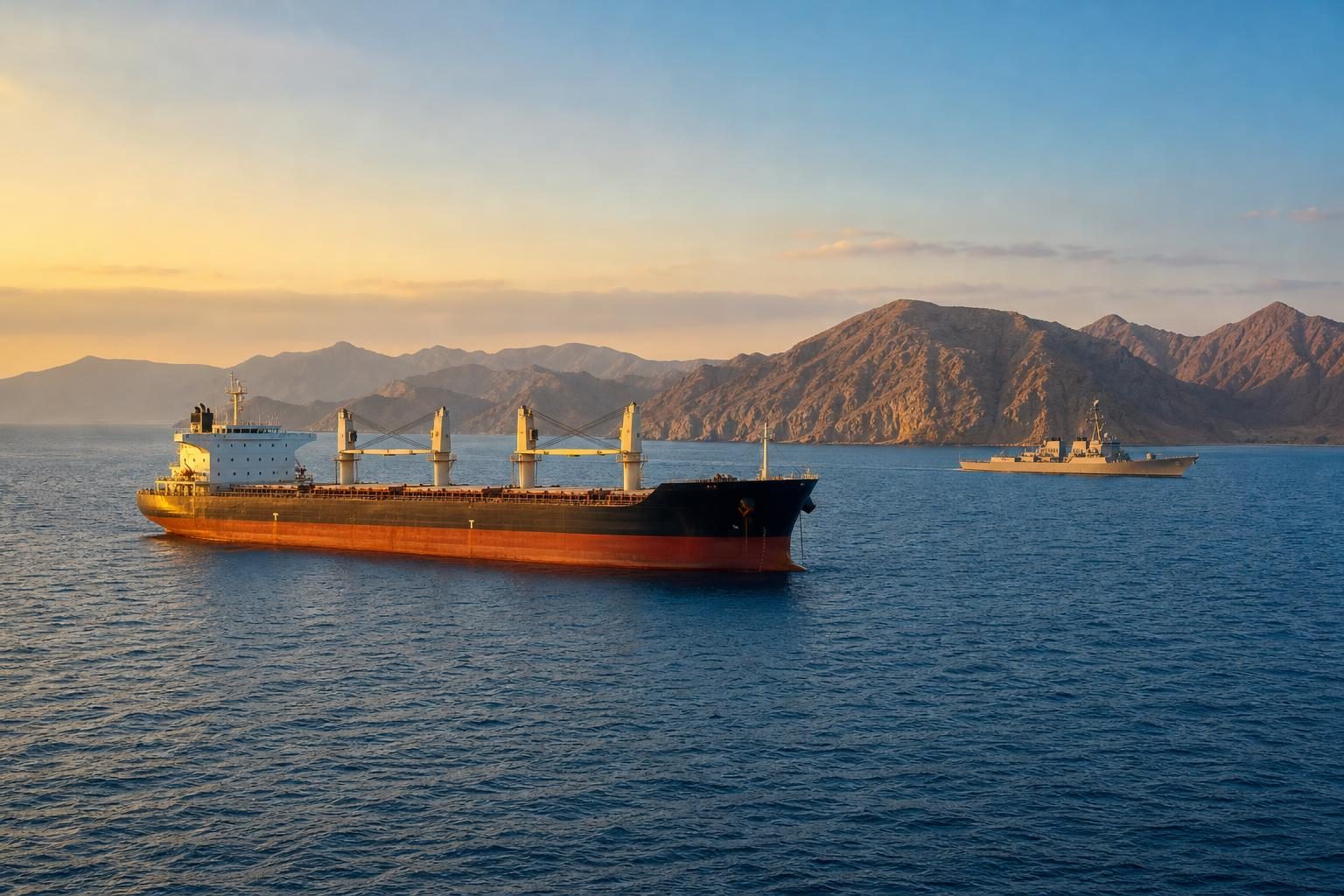
U.S. forces disabled a commercial cargo ship in the Gulf of Oman on Thanksgiving Day after its crew tried to slip past the American naval blockade of Iranian ports, U.S. Central Command said [1][2].
CENTCOM identified the vessel as the M/V Pacific Archer, a Palau-flagged bulk carrier that had left the Iranian port of Bandar Abbas, Stars and Stripes reported [1]. After the crew ignored repeated warnings, a U.S. military aircraft fired precision munitions that struck the ship's stern, the command said [1]. The strike knocked out the ship's propulsion, and the civilian crew was not hurt, ABC News reported [3].
Fox News, which described the ship as a tanker, reported that CENTCOM released video of the strike [2]. The command's own statement calls it a bulk carrier [1]. PBS NewsHour and MS NOW both reported it as the latest in a series of ships the military says tried to breach the blockade [4][5].
The Blockade by the Numbers
Since the blockade was reimposed, U.S. forces have redirected 158 commercial vessels that obeyed orders and disabled six that refused, CENTCOM said, according to Stars and Stripes [1]. The United States reinstated its blockade of ships entering or leaving Iranian ports after a framework agreement with Tehran collapsed in July, the outlet reported [1].
Those numbers tell the story. For every ship that had to be stopped by force, more than 25 turned around when told to. Force has been the last resort, not the first.
As reported, the command's statement did not identify the aircraft involved or say what cargo the Pacific Archer was carrying [1]. Iranian officials had not publicly responded in the coverage as of Friday afternoon.
A Familiar Pattern, and a Familiar Debate
The Pacific Archer is not the first blockade runner stopped in these waters. In October, U.S. forces disabled another commercial cargo ship in the Gulf of Oman after its crew ignored repeated warnings, Al Jazeera reported [6]. That strike drew a public challenge from Sen. Chris Murphy, a Connecticut Democrat, who questioned why taxpayers were paying billions to hit commercial ships [6].
The answer lies in what the blockade is for: cutting off the trade that keeps Iran's war effort supplied. A blockade that ships can ignore without consequence is no blockade at all. The approach CENTCOM describes, warnings first and then a disabling shot at the stern rather than a strike meant to sink, is built to stop the ship while sparing the sailors aboard. In this case, by the command's account, no one aboard was hurt [1][3].
Where the War Stands
The strike comes as the Trump administration weighs its options in the long-running conflict with Iran, MS NOW reported [5]. The two sides have kept trading strikes, though not at the intensity of the war's opening stages, ABC News noted [3].
What to watch next: whether CENTCOM says what the Pacific Archer was carrying and where it was headed, any response from Tehran or from Palau, the country whose flag the ship flies, and whether more ships test the blockade in the days ahead.
Sources
- [1]Stars and StripesUS disables commercial ship in Gulf of Oman, CENTCOM saysOpens in a new tab ↗
- [2]Fox NewsUS military disables tanker ship attempting to slip through Iran blockade on Thanksgiving DayOpens in a new tab ↗
- [3]Opens in a new tab ↗
- [4]PBS NewsU.S. military says it disabled another ship that tried to breach naval blockade on Iranian portsOpens in a new tab ↗
- [5]Opens in a new tab ↗
- [6]Opens in a new tab ↗
Should U.S. military aid to Israel end early?
- Yes, Israel can afford its own weapons
- Phase it out slowly
- No, keep it while Iran is a threat
More in Military & Defense
CENTCOM Calls Iran's Tanker Raid Story a 'Fabricated Lie'
Today on Command Post with Dan Whitaker
Putin's Zircon Sub Joins the Fleet as U.S. Sub Building Lags
Today on Command Post with Dan Whitaker
U.S. Forces Downed Drones Over an English Air Base; Iran Suspected
Overnight on Command Post with Dan Whitaker
Were you there?
If you were at the scene, or this story touched your life, tell us what you saw and what it was like.
Discussion 0
Sign in or create a free account to join the discussion.
No comments yet. Start the discussion.