
 This morning on Command Post with Dan Whitaker
Car Bomb Kills Russian Air Force Colonel Outside St. Petersburg, the Latest in a String of Attacks on Moscow's Officers
The blast on a highway in Shushary is the second of its kind in the same area in under three months, and it came the morning after U.S.-mediated peace talks ended without a breakthrough.
Filed November 12, 2026 · 📍 Washington, DC 20001
Were you there? Share your story
Key points
- A remotely detonated bomb killed a Russian Air Force colonel near St. Petersburg Thursday morning, Russian media report.
- Russia's Investigative Committee opened a murder case; no one has claimed responsibility.
- It is the second car bombing in the same area since August, after a string of attacks on senior officers.
- The blast came as U.S. envoys arrived in Moscow to meet Vladimir Putin.
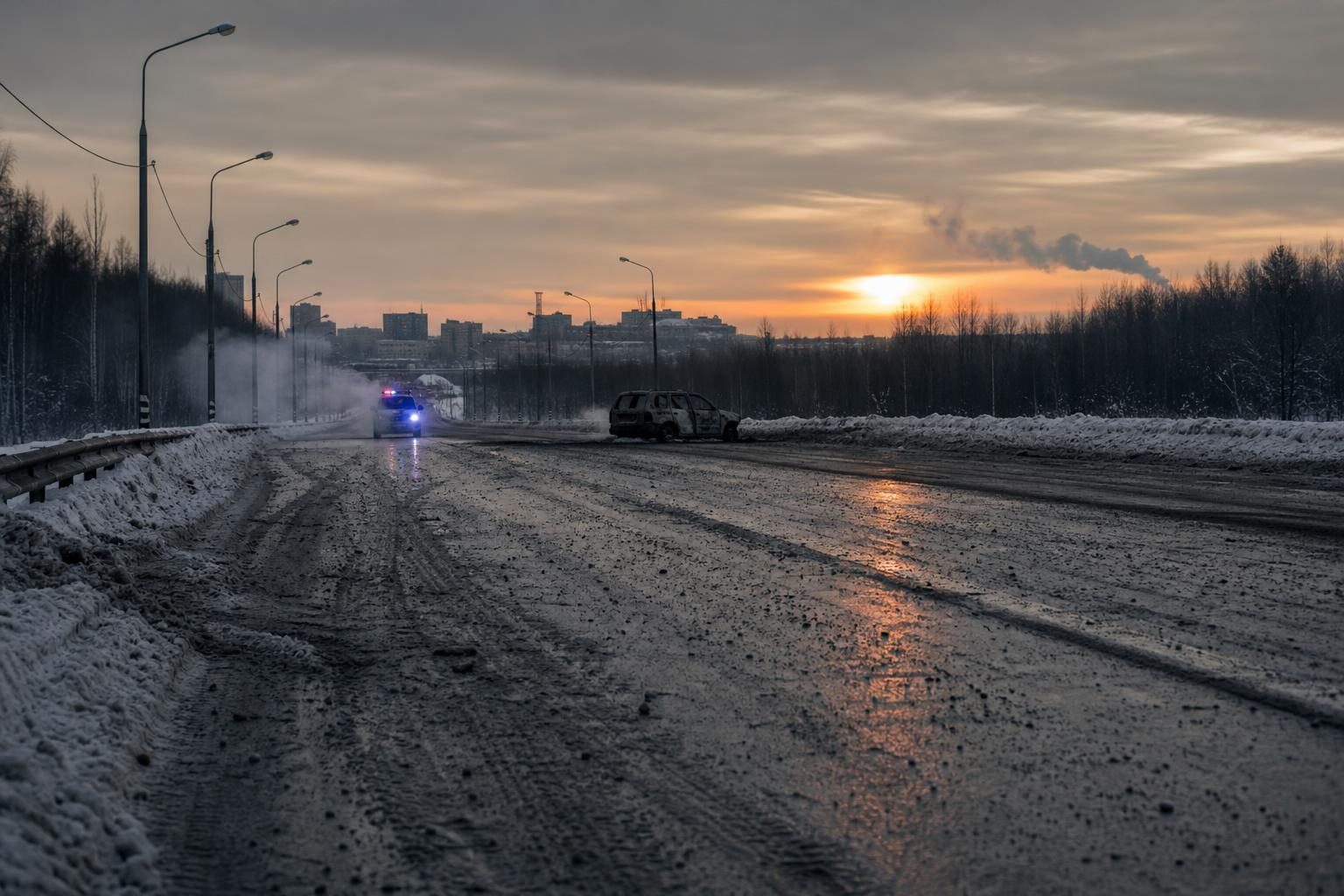
A bomb tore through an SUV on a highway outside St. Petersburg early Thursday, killing a Russian Air Force colonel in what Russian investigators are treating as murder and what looks like the latest in a long run of targeted attacks on the men running Moscow's war in Ukraine [1][2].
The explosion happened at about 7 a.m. local time in Shushary, on the Kolpinskoye Highway near a supermarket and a gas station, according to the St. Petersburg outlet Fontanka, as reported by the Kyiv Independent [1]. Russian media say the officer was driving alone and that the device was set off remotely as he pulled out of a residential courtyard; he died at the scene, and a building intercom camera recorded the blast [2].
What We Know About the Victim
Russian authorities have not released the officer's name [2][3]. Fontanka reported that he was an Air Force colonel, and Euronews noted that Russian media describe him that way, though his rank has not been officially confirmed [1][2]. A St. Petersburg television channel and other Russian outlets reported that he served as chief navigator of the 6th Air and Air Defence Army [3][2].
Fontanka also reported that the bomb was a remote-controlled device fixed to the underside of the vehicle [3]. Russia's Investigative Committee, in a statement on Telegram, described the incident as a car explosion in St. Petersburg's Pushkinsky district, said the cause had not yet been established, and announced that it had opened a murder case, with investigators, forensic experts and operational officers at the scene [2][1].
No one has claimed responsibility, and Ukraine has not commented [1][2]. Euronews observed that Kyiv rarely claims such attacks on Russian troops, though Ukrainian forces have used similar blasts in the past to show that Russia's security services are vulnerable [2].
A Pattern Close to Home
The Kyiv Independent noted that this is the second such killing in the same area in less than three months [1]. On Aug. 27, a bomb exploded near a supermarket in Shushary, killing a lieutenant colonel whom the independent Russian outlet Agentstvo identified as Sergei Sechkov, 43, according to The Moscow Times [5]. His wife was critically injured; Euronews reported that she lost her legs [5][2]. Russia's Investigative Committee initially called that incident a vehicle fire [5]. Fontanka later reported that a suspect, a 24-year-old woman allegedly recruited online by Ukrainian handlers, had fled to Turkey and then Moldova, a claim that has not been independently verified [5].
The St. Petersburg killings fit a much larger picture. The most prominent case came in December 2024, when Lt. Gen. Igor Kirillov, the head of the Russian military's nuclear, biological and chemical protection forces, was killed along with an assistant by a bomb hidden on an electric scooter outside his Moscow apartment building [4]. Ukraine's security service claimed that attack, and an Uzbek man was charged; Vladimir Putin called it a major blunder by Russia's security agencies [4].
In April 2025, Lt. Gen. Yaroslav Moskalik, a deputy head of the General Staff's main operational department, was killed by a bomb in a car parked near his home in Balashikha, just outside Moscow, and a suspect was quickly arrested [4]. In December 2025, Lt. Gen. Fanil Sarvarov, who led the General Staff's operational training directorate, was killed when a bomb went off under his car in southern Moscow [4]. A spokeswoman for the Investigative Committee said then that Ukrainian intelligence was one line of inquiry [4].
A Shadow War Inside Russia
The list keeps growing. Euronews' tally of recent attacks includes the February shooting of a senior military intelligence general in Moscow, an April blast that killed a battalion commander at a garrison in the Khabarovsk region through a device hidden in a mailbox, and an Aug. 1 explosion at a Moscow restaurant in which the head of Russia's Aerospace Forces was reportedly the target [2]. Newsweek reported that a defense ministry official who handled missile and artillery shipments to the front, Damir Davydov, was killed in June when a bomb destroyed his BMW near a residential building in the Moscow area [3].
Moscow has blamed Ukrainian secret services for the string of car bombings [3]. Kyiv has claimed some attacks and stayed silent on others [2]. Whoever is responsible, the effect is the same: officers who plan and direct the war can no longer assume they are safe at home, hundreds of miles from the front, and Russia's vaunted security apparatus has been unable to stop it.
For Americans, the lesson is an old one. Wars are not only fought on the front lines, and a conflict that drags on spreads into cities, highways and apartment courtyards far from the trenches. Every one of these killings also hands the Kremlin a talking point to use against any deal it does not like.
Why Washington Should Pay Attention
There are three reasons American policymakers should watch this campaign closely.
The first is escalation. These attacks have landed on officers near the top of Russia's chain of command: the general in charge of nuclear, biological and chemical protection troops, a deputy chief of operations, the head of operational training and now, reportedly, the chief navigator of a major air army [4][3]. Moscow's response to past attacks has been to point at Kyiv and press on with the war [3][4]. A government that feels humiliated at home is rarely in the mood to compromise abroad.
The second is the peace effort the United States now leads. President Trump has put real political capital into ending this war through his envoys, and each bombing on Russian soil gives hard-liners in Moscow a ready excuse to stall. A settlement that ignores this shadow front, and the intelligence services fighting it, would be fragile from its first day.
The third is closer to home. The men killed in these attacks were found where they live: outside apartment buildings, in residential courtyards, near the neighborhood supermarket [1][2][4][5]. That is a reminder that the security of senior officers and their families does not end at the gate of a base, a lesson every Western military, including our own, takes seriously.
The Timing and the Talks
The timing is hard to miss. The bombing came the morning after U.S.-mediated talks between Russia and Ukraine in Abu Dhabi ended without a breakthrough, and as President Trump's envoys, Steve Witkoff and Jared Kushner, arrived in Moscow to meet Mr. Putin [6]. Russian state media reported their arrival early Thursday, and the two are expected to travel on to Dublin to brief Ukraine's President Volodymyr Zelensky [6].
None of the reports on the bombing has drawn a direct link to the diplomacy, and no official Russian statement blaming Ukraine for this attack had been reported by Thursday morning [1][2]. But the pattern of past cases suggests what is coming. After earlier killings, Moscow pointed at Kyiv, while Ukraine either claimed the attack, denied involvement or said nothing [3][2][4].
What comes next is a murder investigation that Russia's security services will be under pressure to close quickly, a likely official claim of Ukrainian involvement, and another test of whether the peace effort can survive the war's shadow side. For the U.S. envoys sitting down in the Kremlin, it is a reminder that a ceasefire on paper will mean little unless it reaches the highways of St. Petersburg as well as the trenches of the Donbas.
Sources
- [1]Opens in a new tab ↗
- [2]Opens in a new tab ↗
- [3]Opens in a new tab ↗
- [4]Opens in a new tab ↗
- [5]The Moscow TimesCar Bomb Kills Military Officer in St. PetersburgOpens in a new tab ↗
- [6]Kyiv IndependentWitkoff, Kushner arrive in Moscow following Ukraine peace talks, Russian state media reportsOpens in a new tab ↗
Should U.S. military aid to Israel end early?
- Yes, Israel can afford its own weapons
- Phase it out slowly
- No, keep it while Iran is a threat
More in Military & Defense

Donnie Dunagan, the Voice of Young Bambi Who Became a Decorated Marine Drill Instructor, Dies at 92
This morning on Command Post with Dan Whitaker

House Passes Sweeping Veterans Package on Veterans Day to Boost Pay for Combat-Wounded Retirees
Overnight on Command Post with Dan Whitaker

Recruits Are Lining Up Again: Hegseth's Record for the Troops on Veterans Day
Yesterday on Command Post with Dan Whitaker
Were you there?
If you were at the scene, or this story touched your life, tell us what you saw and what it was like.
Discussion 0
Sign in or create a free account to join the discussion.
No comments yet. Start the discussion.