
 Last night on The Bottom Line with Douglas Park
Voters Said Yes to Tax Relief. DeSantis Wants Guardrails Before Anyone Tries to Take It Back
Amendment 3 passed with 62% and takes effect Jan. 1. The governor wants a special session to stop new fees and help rural counties. Lawmakers would rather wait until March.
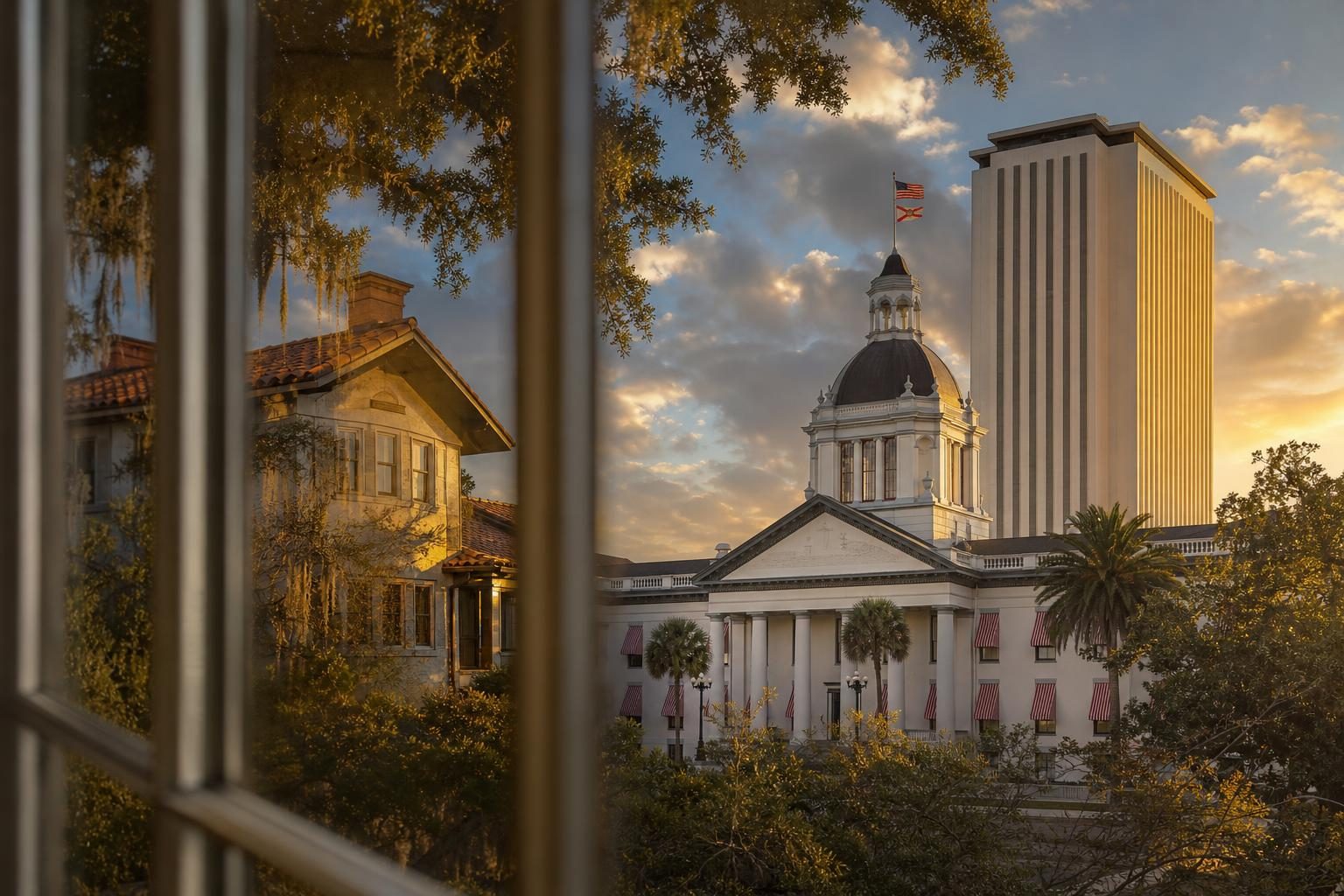
Filed November 27, 2026 · 📍 Tallahassee, FL 32301
Were you there? Share your story
Part of our continuing coverage: Deltona Cancels Its Christmas Parade, Citing Amendment 3, as Supporters Say Cities Can Cut Elsewhere
Key points
- Amendment 3 raises the non-school homestead exemption to $150,000 in 2027 and $250,000 in 2028.
- DeSantis wants a special session before Jan. 5 to bar offsetting tax and fee hikes and help rural counties.
- Senate President Jim Boyd and House Speaker Sam Garrison expect to handle it in the March regular session.
- Flagler's sheriff is planning for a possible $15.5 million loss but says the voters are the bosses.
Florida voters sent a clear message on Nov. 3. Amendment 3, the property tax relief measure, passed with about 62% of the vote, comfortably above the 60% the state constitution requires [2]. Now, with the new law weeks from taking effect, Gov. Ron DeSantis is pressing the Legislature to come back to Tallahassee and make sure that message is not quietly undone at the local level [3].
What Voters Approved
The amendment raises the homestead exemption on non-school property taxes from $50,000 to $150,000 in 2027 and to $250,000 in 2028, according to NBC Miami [1]. School taxes are not affected [1]. It also lowers the yearly cap on assessment increases for non-homestead property, such as rentals, second homes and commercial buildings, from 10% to 5% [1].
The bigger exemption goes to people who were Florida residents by Dec. 31, 2026. Newcomers start with the current exemption and move up to the larger one in their fifth year [1]. The changes take effect Jan. 1, and the first tax bills reflecting the larger exemption will arrive in November 2027 [1]. The amendment also directs counties and cities to use property tax revenue for core purposes, including public safety, education and infrastructure [1].
For a family with a paid-down home in Ocala or Port St. Lucie, that is real money. For retirees on fixed incomes who have watched their bills climb with every reassessment, it is the difference between staying in the home they raised their children in and being taxed out of it.
The Governor's Ask
DeSantis wants a special session before his term ends on Jan. 5 to set what he calls parameters around the amendment, WLRN reported [3]. His main goal is to stop local governments from raising other taxes or fees to make up the lost revenue. He also wants the state to send money to rural counties with small tax bases and to fast-growing "bedroom communities," so they can keep paying for essential services such as law enforcement [3].
He has also criticized local governments that are already talking about cutting services in response to the vote [3].
That is a sensible request. A tax cut that voters approve by a supermajority should not be clawed back through new fees and surcharges dreamed up after the fact. And the governor's plan answers the most serious objection to Amendment 3 head-on: small, rural counties really do have less room to absorb the change, and the state can help them without asking homeowners to pay twice.
Lawmakers Want to Wait
Incoming legislative leaders are not rushing. Senate President Jim Boyd and House Speaker Sam Garrison have not ruled out a special session, but they expect to handle questions about Amendment 3 in the regular session that begins March 2, WLRN reported [3]. Boyd has noted that the amendment takes effect on its own on Jan. 1 [3].
There is a fair argument for patience. The regular session allows full committee hearings, and the first bills under the new exemption are nearly a year away [1][3]. But waiting carries its own risk. Local officials are already drawing up plans for leaner budgets, as the next section shows, and the choices they make before March will shape what residents see [5].
The Sheriffs' Warning, and a Better Answer
Before the vote, the Florida Sheriffs Association's leadership warned that the measure could amount to a hidden form of defunding the police, WUSF reported [4]. Not every sheriff agreed. Miami-Dade Sheriff Rosie Cordero-Stutz publicly backed the amendment [6].
Since the vote, some local officials have begun planning for leaner budgets. Flagler County Sheriff Rick Staly said his office is weighing cuts as it prepares for a possible $15.5 million revenue loss in fiscal 2028, WFTV reported [5]. Staly, who had opposed the measure, also said voters have spoken and that they are the bosses [5]. That is the right attitude, and it points to the right answer.
The amendment itself puts public safety at the top of the list of what property taxes should pay for [1]. If a city has to choose between deputies and a new public art budget, the voters have already told it which comes first. The job now is to protect the police and fire budgets, trim what is not essential, and keep the promise the voters made to themselves.
What Comes Next
DeSantis has said he is not giving up on a special session before he leaves office [3]. If lawmakers hold off, the guardrails will be debated in the spring, under a new governor. Either way, Florida's homeowners will be watching to see whether the relief they voted for reaches their mailboxes in full.
Sources
Should Florida ban new data centers until it studies power and water use?
- Yes
- No, bring the jobs
- Only near neighborhoods
More in Florida & Southeast News

Pink Wings Over Florida Bay: Flamingos Return as Everglades Water Flows South Again
Today on Launch Pad with Hannah Lindgren

Donalds Bets on the Atom: Florida's Next Governor Wants Nuclear Power Back in the Mix
Today on Sunshine State Report with Tomás Ortega

Where America Launches, Let America Learn: Florida Makes Its Case for the U.S. Space Academy
Overnight on Launch Pad with Hannah Lindgren
Were you there?
If you were at the scene, or this story touched your life, tell us what you saw and what it was like.
Discussion 0
Sign in or create a free account to join the discussion.
No comments yet. Start the discussion.