
 Overnight on Sunshine State Report with Tomás Ortega
St. Johns River Breaks Another Record as DeSantis Readies a Second Disaster Request
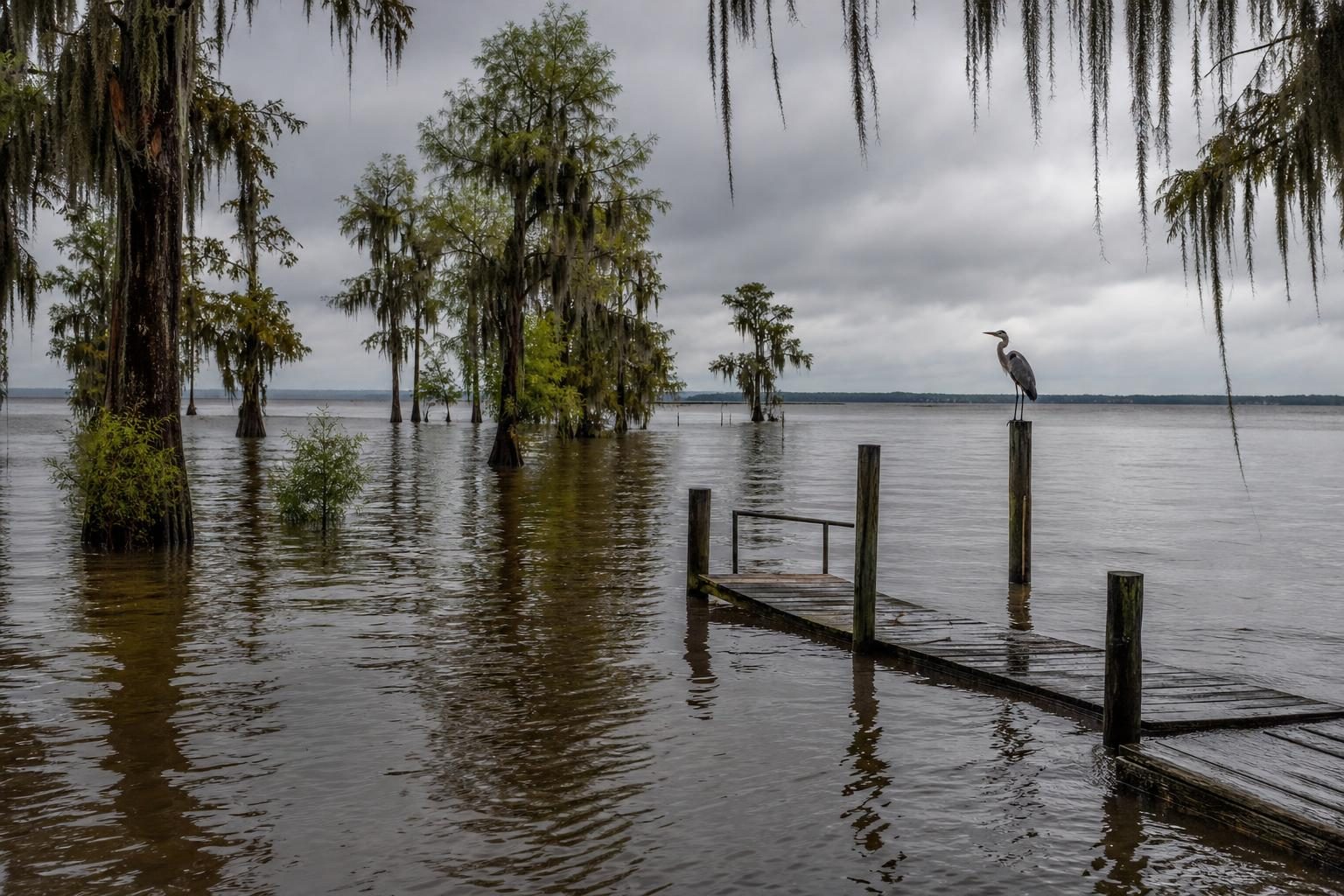
With Lake Harney past its historic flood mark and more rain due before Thanksgiving, Florida is gathering damage data for a broader federal disaster declaration while river communities from Brevard to Volusia brace for weeks of high water.
Filed November 24, 2026 · 📍 Tallahassee, FL 32301
Were you there? Share your story
Part of our continuing coverage: Still Rising Before Thanksgiving: The St. Johns River Breaks Records From Cocoa to Lake Harney as Volusia Braces for Its Turn
Key points
- Seminole County says the St. Johns at Lake Harney near Geneva has exceeded its historical flood records; Volusia warns of major to record flooding from Astor to DeLand.
- DeSantis says Florida is preparing a broader major disaster declaration request on top of the one filed earlier this month.
- Up to 4 inches of rain is forecast for the Space Coast midweek, with Brevard under a Flood Watch.
- State resource centers are open in Palm Bay and West Melbourne; officials say high water could last into December.
The St. Johns River has broken another flood record, and Gov. Ron DeSantis says Florida will ask Washington for more help. Newsweek reported that the river set a new mark as the governor moved to seek a fresh disaster declaration for communities hit by the second round of November flooding [1].
The newest record came on the river's middle stretch. Seminole County emergency management director Alan Harris said the St. Johns at Lake Harney, near Geneva, has climbed past its historical flood records, Central Florida Public Media reported [2]. Harris said the eastern and northern parts of the county are taking the worst of it, especially along the river and around Lake Jessup [2].
Downstream in Volusia County, officials warned Monday of major to record flooding, WKMG News 6 reported [3]. The river has already reached major flood stage at Astor, with more water on the way, and has hit record flood stage near Lake Harney, with additional rises forecast [3]. The county named Astor, DeLand, Hontoon Island, Enterprise, Stone Island and Lake Harney Woods as the areas of greatest concern [3].
Upstream in Brevard County, the river near Cocoa pushed past a high-water record that had stood since 1953, and rising water is threatening low-lying yards, docks and major roads from Cocoa to Astor [4]. DeSantis said Monday the river remains at record-breaking levels and warned that more flooding is expected [5].
Why the water is slow to leave
The St. Johns flows north, so runoff from rain that fell farther south keeps moving through the river system toward Volusia County long after the local rain has stopped [3]. Volusia officials said high water and flooding impacts could last several weeks or longer [3]. Seminole officials told Central Florida Public Media that flooding could linger well into December, and that, based on projections assuming no more rain, the water may not begin to recede until sometime next month [2].
A second disaster request
At a Monday news conference in Melbourne, DeSantis said the state is preparing to request another major disaster declaration, WESH reported [6]. If approved, it would bring federal aid to eligible residents and to government agencies [6]. The new request follows an earlier one the state filed after the historic flooding earlier this month, which struck some of the same neighborhoods [6]. DeSantis said this one will be broader because more communities were affected, and officials expected to have enough coastal damage data by Monday or Tuesday [6].
The Florida Division of Emergency Management said the state is gathering damage assessments for a supplemental request covering more counties and communities [5]. The governor's emergency order, first issued for a handful of counties, was expanded last week as conditions worsened [5].
Tallahassee has not waited on Washington. State agencies have carried out nearly 500 floodwater rescues [5]. Nearly 160 Florida State Guard members have been mobilized, the Florida Fish and Wildlife Conservation Commission has deployed 173 law enforcement officers, and State Guard teams have helped muck out and gut more than 250 flood-damaged properties in Brevard and Okeechobee counties [5].
Rain returns for Thanksgiving week
More rain is on the way. FOX 35 forecast 1 to 4 inches for the Space Coast and roughly a half inch to an inch for Orlando and Daytona Beach, and Brevard County is under a Flood Watch because the ground is already saturated [4]. A few showers could linger into Thanksgiving Day before drier air arrives for Black Friday [4]. Seminole County officials said they are preparing for the additional rainfall later this week [2].
Why it matters
For families along the river, this Thanksgiving may be spent moving furniture to higher ground, bailing out garages or sharing a table with relatives because home is underwater. Seasons like this test a community, and they are when neighbors, congregations and first responders matter most. The state's response has been fast and visible. The federal side now needs to keep pace, because a presidential declaration is what opens the door to help for families whose losses run far beyond what they can carry alone [6].
Where to get help
The state has opened four Multi-Agency Resource Centers across three counties to connect residents with state agencies and recovery assistance [5]. Two are in Brevard County: the Tony Rosa Community Center in Palm Bay and the West Melbourne Veterans Memorial Complex on Minton Road [5]. Residents should confirm hours before going, particularly around the holiday, and follow county emergency management offices and the National Weather Service for conditions on their stretch of the river.
What comes next
The state expects to file its broader request once the coastal damage data is in, even as its first request still waits on a federal decision [6][5]. Forecasters and county officials will be watching how Wednesday's rain affects a river already running at or near record levels from Cocoa to Astor [2][3][4].
Sources
- [1]Opens in a new tab ↗
- [2]Central Florida Public MediaSt. Johns River levels climb in Seminole County, with more rain expectedOpens in a new tab ↗
- [3]WKMG News 6 (ClickOrlando)St. Johns River flooding: Volusia County warns of major to record levelsOpens in a new tab ↗
- [4]FOX 35 OrlandoOrlando weather: Major flooding continues along St. Johns River ahead of Thanksgiving rainOpens in a new tab ↗
- [5]Florida Division of Emergency ManagementICYMI: Governor Ron DeSantis Issues Updates on State Response and Recovery Efforts for November Fall FloodingOpens in a new tab ↗
- [6]Opens in a new tab ↗
Should Florida ban new data centers until it studies power and water use?
- Yes
- No, bring the jobs
- Only near neighborhoods
More in Florida & Southeast News
Six Arrested as Florida Shuts Orlando Slaughterhouse Over Alleged Animal Cruelty; AG Says Four Are in U.S. Illegally
Last night on Sunshine State Report with Tomás Ortega
Florida Commissioner's Son, 19, Killed by Gunfire in His Tent
Last night on Sunshine State Report with Tomás Ortega
No Charges After Grandmother Killed in Panama City Beach Publix Lot; Family Demands Answers
Last night on Sunshine State Report with Tomás Ortega
Were you there?
If you were at the scene, or this story touched your life, tell us what you saw and what it was like.
Discussion 0
Sign in or create a free account to join the discussion.
No comments yet. Start the discussion.