
 Today on The Power Grid with Priya Desai
Ukraine's Drones Knock Out Nearly a Third of Russia's Refining Capacity as Peace Talks Resume
Ukrainian drone strikes have disrupted nine major Russian refineries in a week and targeted the country's two largest, straining Moscow's fuel supply as U.S. envoys press Vladimir Putin for peace.
Filed November 12, 2026 · 📍 Washington, DC 20001
Were you there? Share your story
Key points
- Reuters, citing two industry sources, reports Ukrainian strikes since late October have cut Russia's refining capacity by about 30 percent, with nine of 35 major refineries disrupted in a week.
- Drones hit Kirishi, Russia's second-largest refinery, on Nov. 9 and attacked Omsk, its largest, on Nov. 11 in an assault lasting more than eight hours.
- Rosneft capped fuel sales at 30 liters in cities and 50 on highways in several regions as Moscow juggles domestic shortages and diesel exports.
- Witkoff and Kushner met Putin in Moscow after Abu Dhabi talks; Witkoff said progress was made and a new round with Europeans is set.
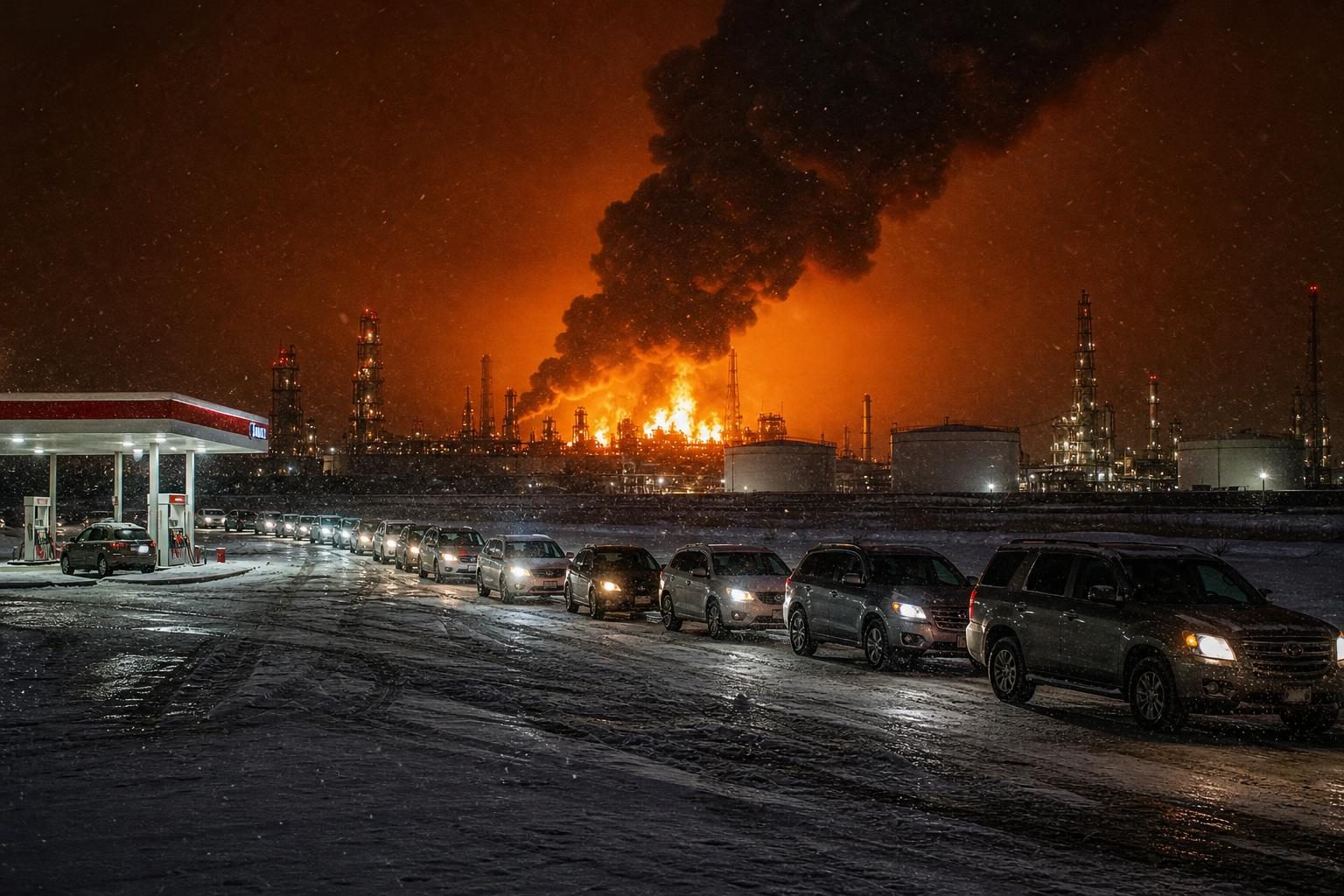
Ukraine's long-range drones have taken a large bite out of Russia's ability to turn crude oil into fuel. Strikes since late October have cut Russia's refining capacity by roughly 30 percent, Reuters reported Tuesday, citing two industry sources [1]. In the past week alone, attacks disrupted operations or caused emergencies at nine of the country's 35 major refineries, the news agency said [1].
The damaged plants have a combined nameplate capacity of about 300,000 metric tons a day, or 2.2 million barrels, out of roughly 930,000 tons of total primary capacity [1]. Russian refineries were processing about 700,000 tons a day at the end of October, and the sources estimated the actual cut in crude runs could reach 200,000 tons a day [1]. Hot Air calculated that this likely erased about 28 percent of Russia's real output in under two weeks [2].
Russia's Two Biggest Plants in the Crosshairs
Overnight into Monday, Nov. 9, drones struck the Kirishi refinery in Leningrad Oblast, about 500 miles north of Ukraine, the Kyiv Independent reported [3]. Kirishi is Russia's second-largest refinery, handling 20 million metric tons a year and producing more than 6 percent of the country's refined oil, including military fuel [3]. Governor Aleksandr Drozdenko said a fire on the grounds had been put out and that drone debris killed a woman in an apartment building in Vsevolozhsk [3]. The plant was also hit on May 5, when three of its four crude distillation units were damaged, and again on Aug. 30 [3].
Reuters also named refineries in Ryazan, Yaroslavl and the Volga region among those affected [1]. Then on Wednesday the drones reached Omsk in Siberia, about 1,550 miles from Ukraine's eastern border and home to Russia's largest refinery, a Gazprom-owned plant that can process more than 21 million tons of crude a year and supplies about one in six liters of Russian gasoline and diesel, the Kyiv Independent reported [4]. Sirens sounded for more than eight hours, and residents reported a fire near the refinery [4]. Governor Vitaly Khotsenko said crews were sent to sites hit by "falling drone debris" but did not name them, and the extent of the damage was not yet clear [4]. The 30 percent estimate predates that attack [1][4].
Fuel Caps in Russia, Relief at American Pumps
Rosneft capped gasoline and diesel sales at its stations on Monday in Karelia, Buryatia, Zabaykalsky Krai and the Novosibirsk, Arkhangelsk and Penza regions, limiting drivers to 30 liters per purchase in cities and 50 on highways, according to Russian media reports cited by Hot Air [2]. Reuters reported that Moscow is struggling to cover domestic shortages even as it ships diesel abroad under an export arrangement with President Donald Trump [1].
In Moscow, Foreign Minister Sergei Lavrov used a Kommersant article on Tuesday to accuse Kyiv of disregarding Trump's appeals to leave Russian energy sites alone [1]. Kyiv stepped up its attacks after a Trump-announced ceasefire on energy facilities failed to hold at the end of October, Reuters reported [1]. President Volodymyr Zelenskiy has said the strikes answer Russian attacks on Ukrainian power plants, heating and water systems, and that Moscow "refused the de-escalation steps that our partners talked about" [1]. Those Russian attacks continue; a drone struck a Kyiv high-rise on Thursday, killing at least one person, Radio Free Europe/Radio Liberty reported [5].
Here at home, the news at the pump has improved. AAA put the national average for regular gasoline at $4.10 on Nov. 5, down 12 cents in a week, as crude slid into the high $80s and low $90s [6]. Its daily tracker showed the average under $4 by midweek. Even so, the Nov. 5 figure stood more than a dollar above a year earlier, and before 2026 the national average had never topped $4 in November [6].
Talks Move From Abu Dhabi to the Kremlin
Russian, Ukrainian and American negotiators met in Abu Dhabi on Nov. 10 and 11, the first such session since February, with the White House saying security guarantees would be the focus [2]. The talks advanced a large prisoner exchange but produced no breakthrough, RFE/RL reported [5]. Envoys Steve Witkoff and Jared Kushner then met Putin in Moscow on Thursday for about two and a half hours [5]. "I think progress was made," Witkoff told CNN, adding that a new round is set and that European partners will join it [5]. Putin called any foreign troop presence in Ukraine unacceptable, and the Kremlin offered no concessions on demands that include full control of Donetsk [5]. The envoys were expected next in Dublin to meet Zelenskiy [5].
The administration has also eased some sanctions and struck the diesel deal with Moscow while pressing Kyiv to spare Russian refineries, RFE/RL noted [5]. Wanting lower fuel prices for American families is the right instinct. But the surest path to cheaper, steadier fuel runs through American oil fields and refineries, not Russian ones. A fuel system that drones can throttle overnight is no supplier to count on, and every barrel produced and refined at home is one less that depends on Putin's goodwill. Ukraine's drones, meanwhile, have handed its negotiators real leverage. A just and lasting peace, the kind Christians pray for, grows likelier when the aggressor feels the full cost of continuing the war.
Sources
- [1]Reuters (via gCaptain)Recent Ukrainian Attacks Have Reduced Russia's Oil Processing Capacity By 30%, Sources SayOpens in a new tab ↗
- [2]Opens in a new tab ↗
- [3]The Kyiv IndependentUkraine strikes Russia's second-largest oil refinery in overnight drone attack, Russian governor saysOpens in a new tab ↗
- [4]The Kyiv IndependentRussia's largest oil refinery slammed by drones in 8-hour attack 2,500 km from UkraineOpens in a new tab ↗
- [5]Radio Free Europe/Radio LibertyUS Envoy Says Europe To Join Next Peace Talks After Putin MeetingOpens in a new tab ↗
- [6]Opens in a new tab ↗
Should Congress speed up permits for pipelines and power plants?
- Yes, build more American energy
- Yes, but respect tribal and local input
- No, keep environmental reviews
More in Energy & Environment

Gas Heads Toward $3.60 for Thanksgiving as Saudi Output Surges, but Burning Tankers and a Siberian Refinery Strike Keep Oil on Edge
This morning on The Power Grid with Priya Desai

Trump's Interior Plan Would Let States, Tribes and Towns Buy Federal Land, Reviving an Old Western Fight
Last night on Hollister Tonight with Jack Hollister
Inside the Senate's Permitting Deal: What the Bipartisan Energy Bill Would Change, and Why the Clock Is Ticking
Last night on The Sterling Report with Ava Sterling
Were you there?
If you were at the scene, or this story touched your life, tell us what you saw and what it was like.
Discussion 0
Sign in or create a free account to join the discussion.
No comments yet. Start the discussion.