
 This morning on Campaign Trail with Sophia Reyes
California's 'Election Month' Is a Choice: Why the Biggest State Still Counts for Weeks, and How Florida Does It Faster
Universal mail ballots, a seven-day window for late arrivals and a cure period that runs to Thanksgiving keep California counting long after the rest of the country. Trust is paying the price.
Filed November 13, 2026 · 📍 Los Angeles, CA 90012
Were you there? Share your story
Key points
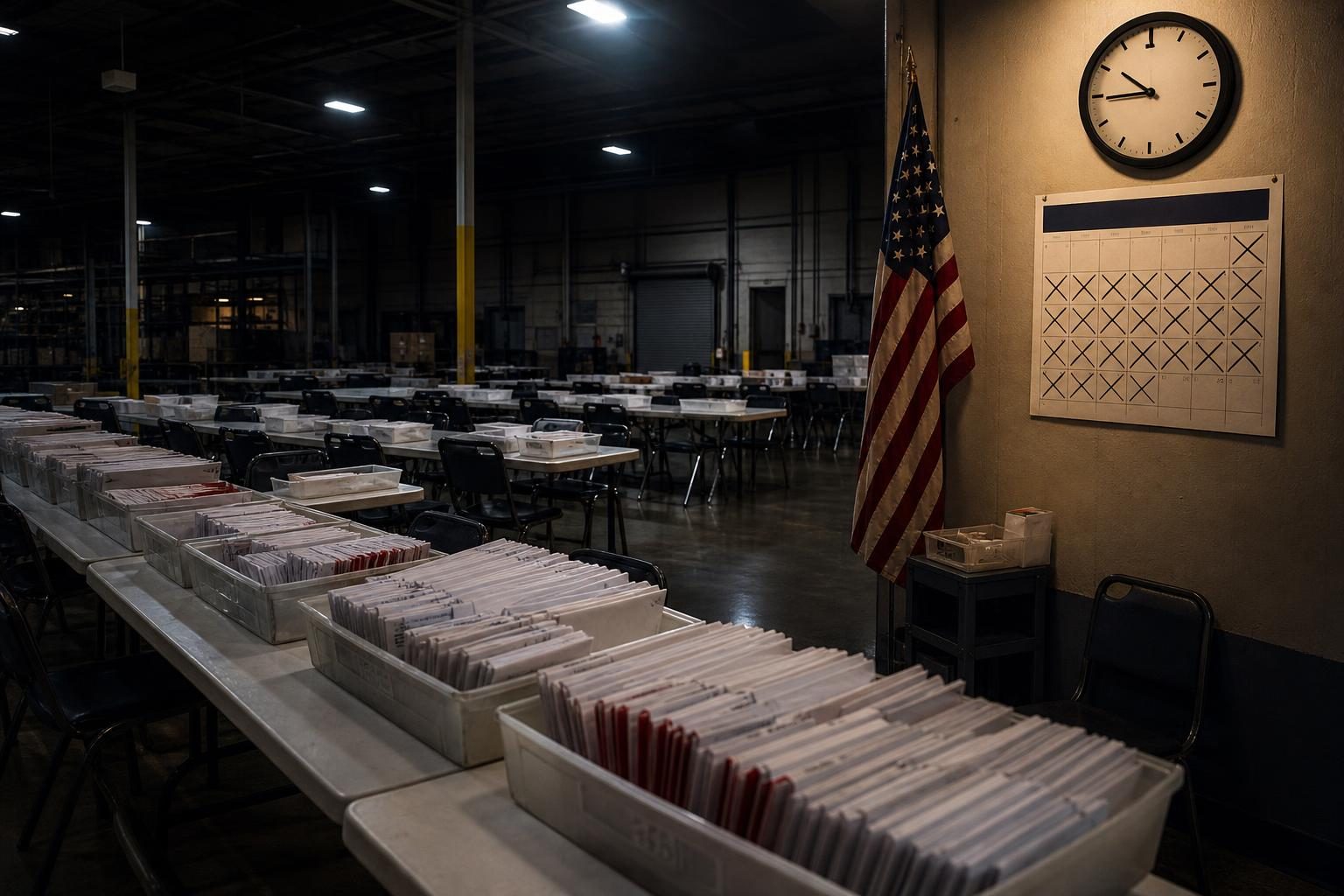
- California mails ballots to about 23 million voters and counts those postmarked by Election Day that arrive up to seven days later.
- Voters have until the day before Thanksgiving to fix signature problems; counties have 30 days to certify.
- The share counted within two days fell from about 80% two decades ago to 66% in 2024.
- Florida processes mail ballots early and requires most to arrive by Election Day.
Florida, one election-integrity expert argued this year, proves that secure elections do not have to take a month [2]. California routinely needs weeks. As the nation waits again on the country's biggest state to finish counting the 2026 midterm vote, it is worth asking a simple question: is California's slow count a law of nature, or a choice its leaders have made?
The record points to a choice. That is not a claim that California's elections are rigged; the evidence does not show that. It is a claim about design, and about what slow counts do to public trust.
How California Votes
California mails a ballot to every one of its roughly 23 million registered voters, a system adopted during the pandemic, CalMatters reported [1]. Gov. Gavin Newsom signed AB 37 in 2021 to make universal vote-by-mail permanent, according to a column in The Blaze by Josh Findlay of the Texas Public Policy Foundation [2]. Los Angeles County alone has nearly 6 million registered voters [1].
Then come the rules that stretch the count. Ballots postmarked by Election Day are counted if they arrive within seven days afterward [1][4]. Voters whose signatures do not match get a chance to fix, or cure, their ballots, and this year they have until the day before Thanksgiving to do it, according to Kim Alexander of the California Voter Foundation, as quoted by CalMatters [1]. Counties must count at least six hours a day but do not have to count on weekends or holidays, and they have 30 days to certify results [1].
Hans von Spakovsky of Advancing American Freedom summed it up for Fox News in June: mass mail voting, a seven-day window for late-arriving ballots, a long cure period and a high volume of provisional ballots [3]. "There are four reasons why California takes so long," he said [3]. He noted that in 2024, 13 million of California's 16 million votes were cast by mail [3].
California is not alone in mailing every voter a ballot, but it is by far the biggest state to do it. It is one of eight states, plus the District of Columbia, with universal mail voting, according to Fox News and Votebeat [3][5]. With about 23 million registered voters, it has millions more than Texas, the next largest at about 18.7 million, Votebeat reported [5]. Nearly 90% of Californians voted by mail in last year's special election, according to state data cited by Votebeat [5]. Alexander calls the late flood of mail ballots the "pig in the python" problem [5].
Some details invite doubt even among careful observers. When a postmark is missing or unreadable, officials can rely on the date the voter wrote on the envelope, von Spakovsky told Fox News [3]. Even Newsom sent counties a letter in May urging them to tabulate quickly, Fox reported [3].
It Is Getting Slower, Not Faster
According to an analysis by the California Voter Foundation reported by Votebeat, California counted about 80% of its ballots within two days of the election two decades ago, but only about 50% in 2022 and 66% in November 2024 [5]. In 2024, the state took 38 days to certify its results, according to The Blaze [2].
The delays have real consequences. Twenty-two days after the 2024 election, California still had about 265,000 ballots left to count, and one Central Valley House race was separated by 182 votes with 99% counted, Straight Arrow News reported at the time [6]. The Associated Press, in a story published by ABC7, noted that one California House race in 2024 was not called until December [4].
After the June 2026 primary, Secretary of State Shirley Weber's office said the count could continue for up to 30 days, and a week after that election the state was still processing 1.4 million ballots, according to The Blaze [2]. Weber's message to voters was simple. "Accuracy comes before speed," she said, as quoted in that column [2].
What Florida Does Differently
Accuracy and speed are not opposites. Florida lets election officials begin processing mail ballots before Election Day, requires most mail ballots to arrive by the time polls close, and gives voters a much shorter window to cure signature problems, according to Findlay's column [2]. The result, Findlay argues, is a count that wraps up quickly without sacrificing security [2].
California's own experts acknowledge the trade-off. Jesse Salinas, the Yolo County registrar who leads the state association of election officials, told Votebeat that faster counting would mean fewer votes counted [5]. That is an argument for California's late-arrival and long-cure rules, but it is also an admission that the state has chosen a slower system on purpose.
Why Trust Matters
Slow counts do not prove fraud, and Republicans should be careful not to claim otherwise. Experts quoted by CalMatters and the AP explained that late-counted mail ballots in California tend to lean Democratic because Republicans are more likely to vote early or in person [1][4]. In 2018, four Republican House candidates led on election night and then lost, CalMatters reported [1]. In the June 2026 Los Angeles mayoral primary, Republican Spencer Pratt led early before Nithya Raman pulled ahead [1].
But voters can be forgiven for losing patience. Votebeat reported that the share of voters who trust their votes will be counted accurately fell from 77% in 2024 to 60% in 2026, and that studies found trust drops when people hear about unexplained delays [5]. Alexander, who supports California's system, put it bluntly. "It is undermining voter confidence," she told CalMatters [1].
President Trump has called California's results rigged, the AP and CalMatters reported [1][4]. California Democrats push back hard. After the June primary, Assemblymember Marc Berman, the author of a recent counting law, called the president's claims a lie, and Newsom's office said, "we wish the votes were counted faster, too" [4]. UCLA law professor Rick Hasen told the AP that Democrats holding on to their ballots made the count slower, and that the Legislature needs to spend much more to speed it up [4].
Small Steps, Big Gaps
California has taken some steps. Newsom signed a law last year requiring counties to finish most counting within 13 days instead of 30, though counties can get extensions, the AP and Votebeat reported [4][5]. Lawmakers also gave counties $29 million for machines and staff, CalMatters reported [1]. Local officials told Votebeat the state still does not give them enough money to count faster [5].
None of that changes the core design. As long as ballots can arrive a week late and signature fixes can run to Thanksgiving, California will keep counting long after the rest of the country has moved on.
The Common-Sense Fix
There is a better way, and other states are already using it. Require mail ballots to arrive by Election Day, the way Florida does [2]. Let counties start processing ballots before Election Day so the count is ready when polls close [2]. Shorten the cure period to days, not weeks, and pay for enough staff to count every day until the job is done, weekends included [1][2]. Those are not partisan ideas; they are the habits of states that count quickly and well.
Self-government depends on the consent of the governed, and consent depends on confidence. A free people should not have to wait a month to learn who represents them. California has the money and the talent to count faster. What it needs is the will.
What Comes Next
California's counties have 30 days from Election Day to certify, and this year's cure deadline falls the day before Thanksgiving [1]. Expect several close races to stay unsettled until then, and expect the debate over the state's rules to come back when the new Legislature meets.
Sources
- [1]Opens in a new tab ↗
- [2]Opens in a new tab ↗
- [3]Opens in a new tab ↗
- [4]ABC7 News (Associated Press)California's slow ballot count makes it a target for critics. It doesn't mean elections are riggedOpens in a new tab ↗
- [5]Opens in a new tab ↗
- [6]Straight Arrow NewsCalifornia is still counting ballots. What's taking so long?Opens in a new tab ↗
Who should lead the Republican ticket in 2028?
- JD Vance
- A governor from outside Washington
- A fresh face
- Too early to say
More in Elections
Fetterman Holds His Ground on Israel as the Far Left Lines Up 2028 Challengers Against Him
This morning on Trending Tonight with Maya Thompson
Paul LePage Wins Maine's 2nd District, Flipping a Democratic Seat in a Tough Year for the GOP
Overnight on Campaign Trail with Sophia Reyes
Boebert Holds Off on Concession as Colorado Finishes Counting in Tight 4th District Race
Yesterday on Campaign Trail with Sophia Reyes
Were you there?
If you were at the scene, or this story touched your life, tell us what you saw and what it was like.
Discussion 0
Sign in or create a free account to join the discussion.
No comments yet. Start the discussion.