
 Overnight on Order in the Court with Harold Whitmore
A Plane for a Six-Pack? An Alaska Bush Pilot Brings the Eighth Amendment's Forgotten Clause to the Supreme Court
On Tuesday the justices hear Ken Jouppi's fight to get back the Cessna Alaska seized over a passenger's beer. The answer will shape how far the government can go when it takes property as punishment.
Filed November 29, 2026 · 📍 Supreme Court, DC 20543
Were you there? Share your story
Key points
- The Supreme Court hears Jouppi v. Alaska on Tuesday, Dec. 1.
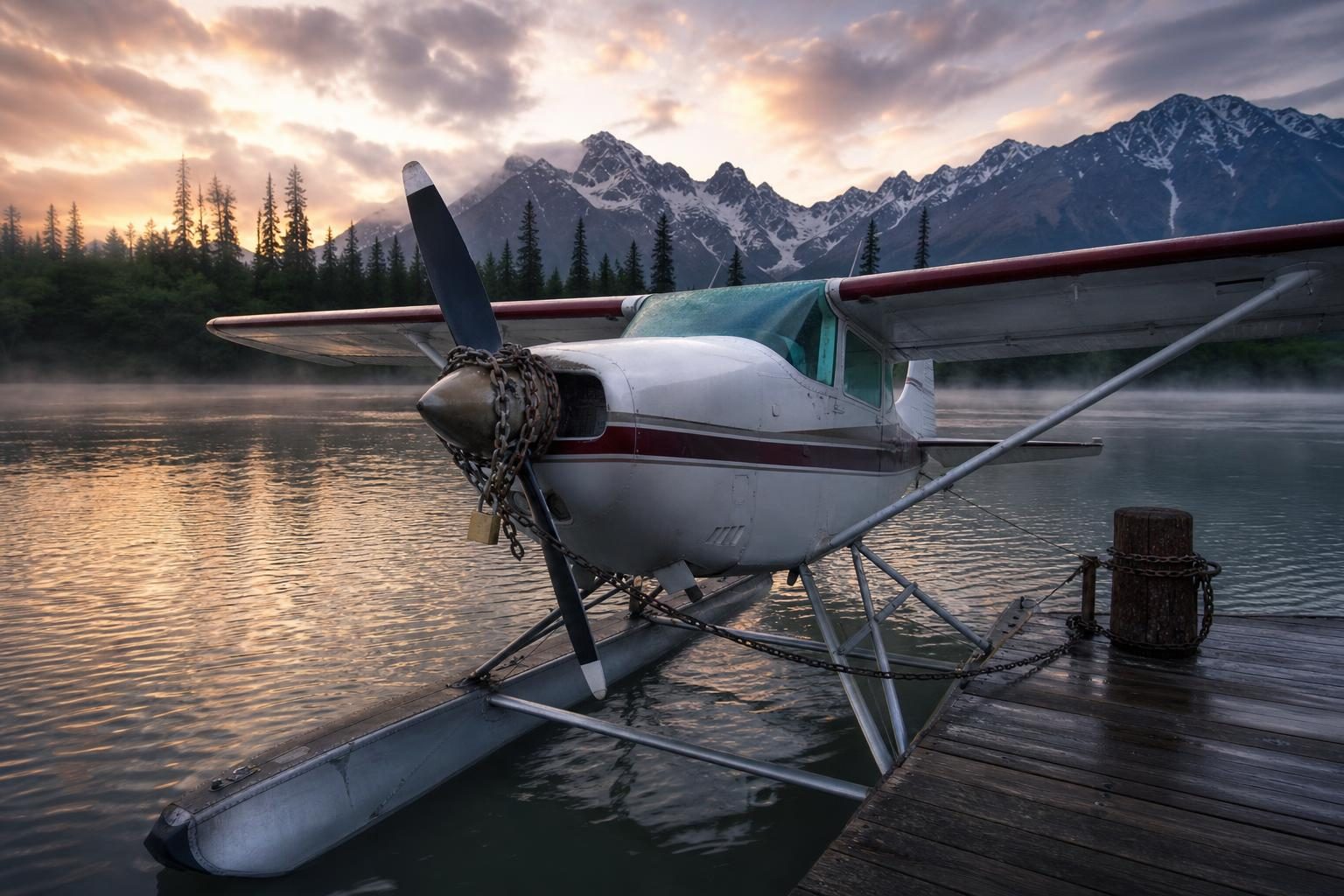
- Alaska seized pilot Ken Jouppi's 1969 Cessna after a passenger hid beer bound for a village that bans alcohol.
- The question is how courts should judge whether a forfeiture is an unconstitutionally excessive fine.
- The Justice Department backs Alaska; the U.S. Chamber of Commerce warns the state's approach would weaken the clause in most civil penalty cases.
On Tuesday, the U.S. Supreme Court will hear the case of Ken Jouppi, an Alaska bush pilot who lost his airplane to the state over beer a passenger carried aboard [4]. The question sounds small. It is not. The justices will decide how courts should judge whether a penalty the government imposes by taking someone's property is so far out of proportion to the offense that the Constitution forbids it [4].
Jouppi has put the stakes simply. "This case isn't just about me," he said, as CBS News reported [2].
What happened in Beaver
In April 2012, according to the Institute for Justice, the public-interest law firm representing Jouppi, a passenger on his plane hid several packs of beer meant as a gift for her husband, the postmaster in Beaver, a small Alaska village [1]. Beaver had voted in 2004 to prohibit alcohol [1].
The state seized Jouppi's plane, a 1969 Cessna U206D [1]. A lower court valued it at about $95,000, while Jouppi puts its value today closer to $150,000, CP24 reported [3]. In a state where many villages can be reached only by air, a plane like that is not a toy. For a bush pilot, it is the business.
Alaska's courts sided with the state. In April 2025, the Alaska Supreme Court rejected Jouppi's argument that losing the plane was an unconstitutionally excessive fine, reasoning that "the illegal importation of even a six-pack of beer causes grave societal harm," as the Institute for Justice quotes the ruling [1]. The U.S. Supreme Court agreed in July to take the case [5].
The question before the justices
The Eighth Amendment is best known for its ban on cruel and unusual punishment, but the same sentence also forbids excessive fines. In 2019, in Timbs v. Indiana, the Supreme Court held unanimously that the Excessive Fines Clause applies to the states, not only to the federal government, in a case over an Indiana man's forfeited Land Rover [6]. Writing for the Court, Justice Ruth Bader Ginsburg traced the protection back through centuries of English law to Magna Carta [6]. The Institute for Justice describes Jouppi's case as a chance to build on that ruling [1].
Jouppi's lawyers argue that Alaska's courts judged his conduct in the abstract, weighing the general harm alcohol causes in dry villages instead of what this pilot actually did on this flight, CP24 reported [3]. Alaska answers that Jouppi has not shown that forfeiting the plane is grossly disproportional to the gravity of his offense [3].
The case has drawn unusual alignments. The U.S. Justice Department has filed in support of Alaska's position, SCOTUSblog reported, while the U.S. Chamber of Commerce warned the justices that the Alaska ruling would weaken the clause's protections in most civil penalty cases [4].
Why it matters
Two good principles meet in this case, and both deserve respect.
The first is self-government. Beaver's residents chose to keep alcohol out of their community [1], a decision many rural villages have made to protect families from the damage drinking can do. Enforcing that choice is a legitimate interest, and nothing in Jouppi's appeal asks the justices to strike down the village's ban.
The second is proportion. The Founders wrote the Excessive Fines Clause because they knew the power to fine and to seize can be used to ruin people, not merely to punish them; the Court in Timbs recounted how that abuse ran through English history [6]. A government that can take a man's livelihood over a few cans of beer someone else hid in his cargo holds a power the Constitution was written to limit. That is not a soft-on-crime idea. It is the same respect for private property and limited government that conservatives defend in every other setting, from eminent domain to civil asset forfeiture.
The Chamber of Commerce's warning points to the wider stakes [4]. If courts may measure a penalty against the general harm a law targets, rather than against the individual's own conduct, almost any fine or forfeiture can be justified. Small business owners, farmers, truckers and pilots would feel that first.
What comes next
The justices hear arguments Tuesday, Dec. 1 [4]. A decision is expected before the term ends next summer. Whatever the Court decides about Ken Jouppi's Cessna will shape how much protection the Eighth Amendment gives every American whose property the government wants to keep.
Sources
- [1]Institute for JusticeJouppi v. AlaskaOpens in a new tab ↗
- [2]Opens in a new tab ↗
- [3]Opens in a new tab ↗
- [4]Opens in a new tab ↗
- [5]NBC NewsAlaska wants to seize a pilot's plane over a 6-pack of beer. The Supreme Court will hear his case.Opens in a new tab ↗
- [6]Cornell Law School Legal Information InstituteTimbs v. Indiana (2019)Opens in a new tab ↗
Should the death penalty stay on the books for the worst crimes?
- Yes, for the worst murders
- Only with absolute proof like DNA
- No, life without parole is enough
More in Crime & Justice
One Killed, Two Wounded in Daylight Gunfire on a Busy Queens Street; 18-Year-Old Detained
Last night on Breaking Now with Nathan Brooks
Hopkins Uber Driver Dies Two Weeks After Attack on the Job
Last night on Street Watch with Elijah Carter
Justice Department Urges Judge to Keep Hasan's Dec. 3 Execution on Track
Yesterday on Rule of Law with Lauren Pierce
Were you there?
If you were at the scene, or this story touched your life, tell us what you saw and what it was like.
Discussion 0
Sign in or create a free account to join the discussion.
No comments yet. Start the discussion.