
 Overnight on Main Street Money with Marcus Hale
SpaceX and Tesla Edge Toward a Record Merger: What a Combined Musk Giant Would Mean for Investors and American Industry
Bloomberg reports the talks are advancing, and an announcement could come as soon as December. Here is what is known, what still has to happen and why it matters far beyond Wall Street.
Filed November 13, 2026 · 📍 Wall Street, NY 10005
Were you there? Share your story
Key points
- Bloomberg reports SpaceX-Tesla talks on a record merger have progressed
- Electrek says an announcement could come as soon as December
- Both companies formed special committees in October to weigh a deal
- SpaceX plans $74 billion in Texas and Arizona data centers and tries a Starship double catch Friday
Two of the most consequential American companies of this century may be about to become one. Talks between SpaceX and Tesla on what would be a record-setting merger have progressed, Bloomberg reported Thursday, citing people familiar with the discussions [1]. Electrek, summarizing that report, described the potential combination as a $1.5 trillion Tesla merger and said an announcement could come as soon as December [2].
Neither company had announced a signed agreement as of Thursday, and talks of this size can stall or change shape late in the process. But the direction is clear, and it has been building for weeks. For investors, for the workers who build rockets and cars in this country, and for a nation locked in a technology race with China, the outcome deserves close attention.
How We Got Here
The idea did not come out of nowhere. In October, while SpaceX was reporting its third-quarter results as a publicly traded company, Elon Musk said Tesla and SpaceX had each formed special committees to discuss a merger [3]. Committees like these are the standard tool when a deal involves the same leader on both sides of the table. They exist so that directors without a personal stake can weigh the terms on behalf of ordinary shareholders.
The move also fits a pattern. Earlier this year SpaceX combined with xAI, Musk's artificial intelligence company, a step that led market commentators to ask openly whether Tesla would be next [4]. Thursday's report suggests that question is now being worked out in the boardrooms [1].
What remains unknown is just as important as what has been reported. The public reporting so far has not laid out a final price, an exchange ratio for shares, a closing timeline or the makeup of a combined board. Those details will decide whether a deal is good for the people who own the stock, and they deserve hard scrutiny when they arrive.
What a Combined Company Would Hold
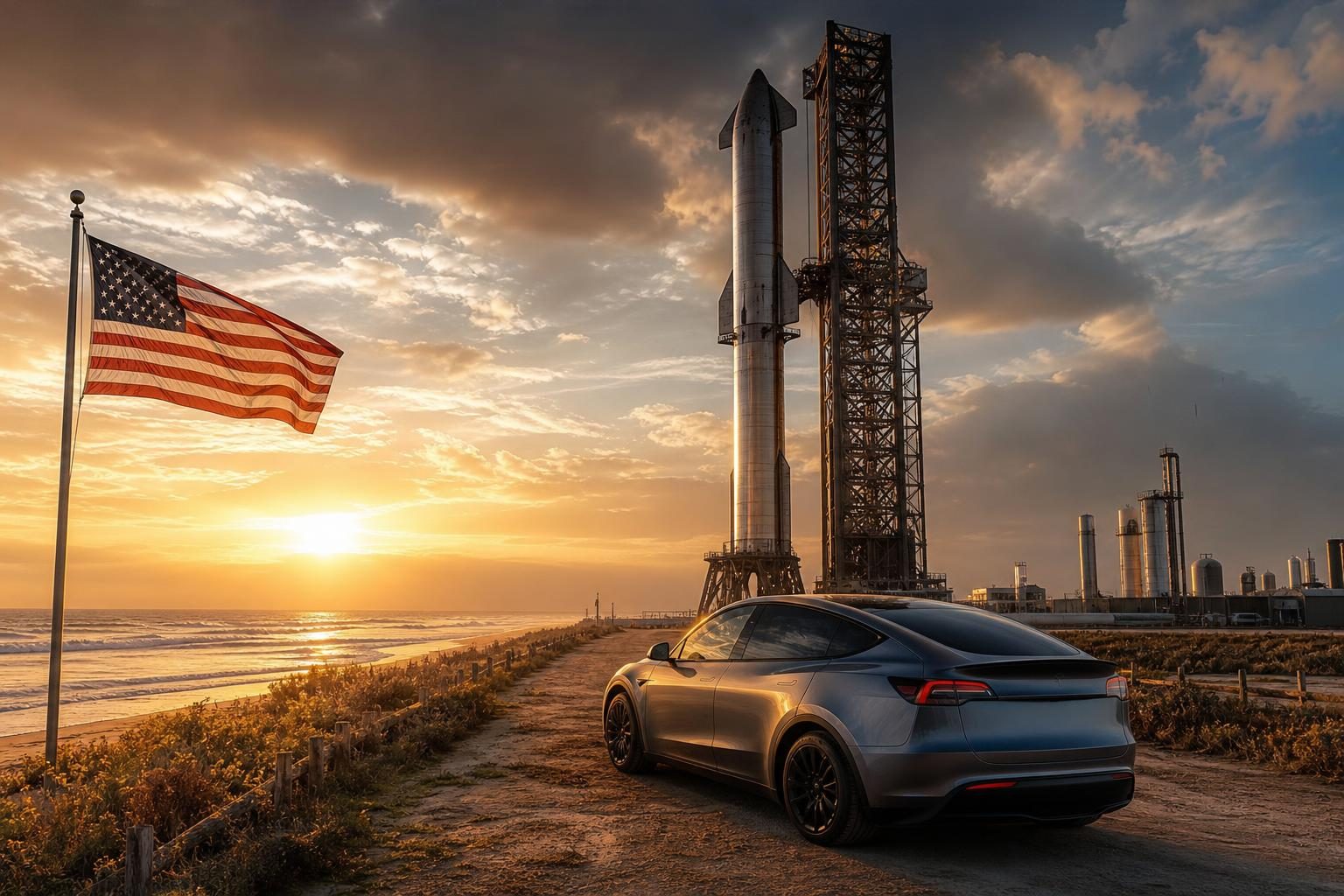
A merged company would gather an unusual collection of businesses under one roof. On one side sits Tesla, the electric-car maker with its factories, batteries and self-driving software. On the other sits SpaceX, which now reaches well beyond rockets.
This week alone shows how wide that reach has become. On Thursday SpaceX announced plans to invest more than $74 billion in two data center projects in Texas and Arizona, pitching them as a boost for local communities at a time when such facilities face a broad backlash [5]. The company said the investments would "expand local tax bases" in the communities that host them [5].
On Friday SpaceX is set to attempt something no one has done: catching both halves of its giant Starship rocket after a flight, including the upper stage itself. CNN described the ship catch as an audacious grab for the "holy grail" of rocketry and walked through the risks of trying it [6]. Rockets that can be caught, refueled and flown again would sharply cut the cost of reaching orbit, and that cost advantage is the engine behind nearly everything else SpaceX hopes to do.
Put those pieces next to Tesla's manufacturing and software work, and the logic Musk's supporters see is easy to follow: one American company that writes its own software, trains its own systems in its own computing campuses, builds vehicles on the ground and launches hardware into space.
The Hurdles: One Leader, Two Sets of Owners
The same feature that makes the combination exciting to fans makes it delicate for shareholders. When one person leads both companies, every term of the deal, from the price to the share swap, carries a potential conflict of interest. That is exactly why the special committees were formed [3], and their independence will be the first thing serious investors examine.
Tesla's owners will want to know whether they are paying a fair price for a fast-growing but capital-hungry space and computing business. SpaceX's owners will ask the reverse: whether folding in a carmaker dilutes what they bought. Both groups will want to see the math, the projections and the outside opinions that usually accompany a transaction of this size. They will also want to know who would run each business day to day, because a rocket company and a car company answer to very different customers, regulators and production schedules.
There is also a concentration question. A combined company would tie a large share of America's private space, satellite, electric-vehicle and artificial intelligence capacity to a single leadership team. Supporters say that is a strength, because decisions get made fast and money flows to the best ideas. Skeptics say it magnifies the damage if something goes wrong at the top. Both arguments have merit, and investors should weigh them honestly instead of treating the deal as a sure thing.
Then there is the public. SpaceX is already making its case for data centers in the middle of a backlash against such projects [5], and a merger of this scale would draw a hard look from regulators and lawmakers, even though the two companies mostly operate in different markets.
What It Means for Investors
For everyday Americans who hold Tesla in a brokerage account or a retirement fund, the practical effect could be large. A merger would turn a car-and-software stock into a stake in rockets, satellites and computing infrastructure as well. That could mean more growth potential. It could also mean more volatility, because the value of a launch business can swing on a single test flight, and a data center plan can swing on a single permit fight.
The wise course is the old-fashioned one: wait for the actual terms, read what the independent committees conclude, and avoid trading on rumor. If an agreement is reached, the owners of both companies would expect to have their say, and those votes are where ordinary shareholders hold real power over the outcome. The reported December window [2] gives shareholders time to do their homework, and they should use it.
What It Means for American Industry
There is a bigger picture, too, and conservatives should welcome it even while asking tough questions. The United States is in a long contest with China over who will lead in space, advanced manufacturing and artificial intelligence. A company that can fly reusable rockets, power its own computing campuses and produce vehicles at scale on American soil is the kind of industrial muscle that contest demands.
The new projects are planned for Texas and Arizona [5], not overseas. They promise construction work, technical jobs and a larger local tax base, which is what many small towns and rural counties have needed for decades. At the same time, the communities asked to host these sites deserve a real voice, honest numbers on power and water, and companies that keep their promises. Good stewardship of the land and of a neighbor's trust is not an obstacle to progress. It is how progress lasts.
Scripture teaches that work done well is a calling, and that building something that serves others is a worthy goal. The test for this merger, if it comes, is whether it serves the people who own it, work for it and live next to it, and not only the ambitions of the people who run it.
What Comes Next
Three things are worth watching. First, Friday's Starship flight [6]: a successful double catch would strengthen the case that SpaceX's core technology is ready for routine reuse, while a failure would be a reminder of how hard the work is. Second, any formal word from the two companies or their special committees [3]. Third, the possible December announcement [2], which would put real numbers on the table for the first time.
Until then, the honest summary is this: the talks are real and advancing [1], the strategic logic is serious, and the details still matter. American investors deserve both the ambition and the accountability.
Sources
Should towns welcome AI data centers?
- Yes, they bring jobs and tax money
- Only if they pay their own power costs
- No, they strain water and the grid
More in Business & Economy

Kalshi and Donald Trump Jr. Part Ways Over His Firm's Bet on Rival Polymarket
Last night on Code & Coin with Kendall Price
Honda Commits $3 Billion to New Ohio Plant, Lifting U.S. Output to 1.3 Million Vehicles
Last night on Main Street Money with Marcus Hale

Jobless Claims Edge Up to 200,000 as Layoffs Stay Rare and Inflation Takes Center Stage
Last night on The Hart of the Economy with Evelyn Hart
Were you there?
If you were at the scene, or this story touched your life, tell us what you saw and what it was like.
Discussion 0
Sign in or create a free account to join the discussion.
No comments yet. Start the discussion.