
 Tonight on Open Road with Frank Kowalski
Grounded Nation: What Failed, Who Is Investigating and What Stranded Travelers Can Do
Officials call it a telecommunications outage with no sign of an attack, and the FBI is reportedly examining a software update. Here is the latest, your refund rights and the long history behind the nationwide ground stop.
Filed November 13, 2026 · 📍 Washington, DC 20001
Were you there? Share your story
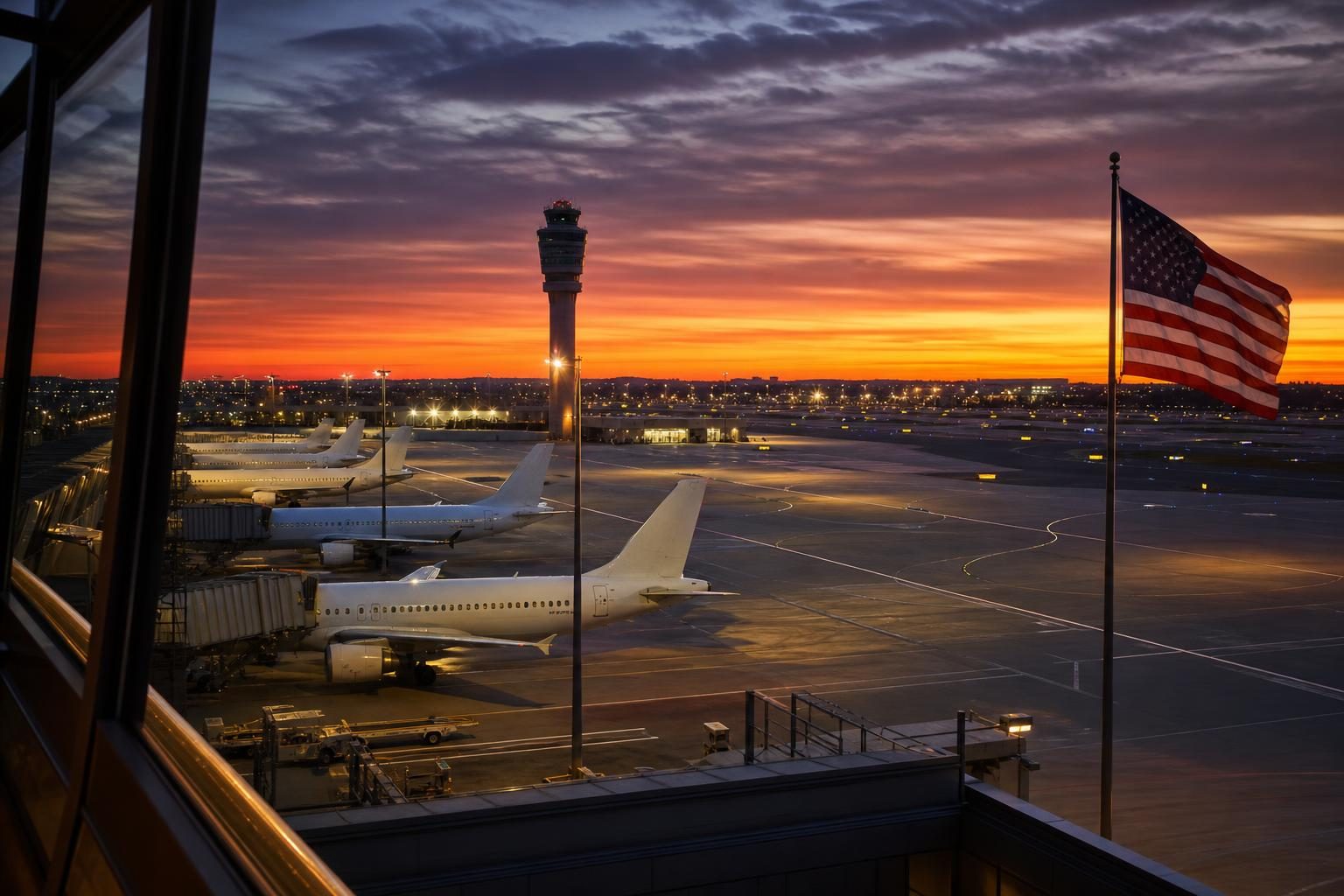
Part of our continuing coverage: FAA Grounds Every Departing Flight Nationwide After Communication Failure at Air Traffic Control Centers
Story tracker
Key points
- Departing flights nationwide remained grounded into Friday evening, with nearly 7,000 flights delayed or canceled, per FlightAware figures cited by Reuters.
- DHS Secretary Markwayne Mullin called it a telecom outage with no indication of an attack; Bloomberg reports the FBI is examining a possible software update.
- Federal rules require automatic cash refunds when airlines cancel or significantly change flights and passengers decline the alternative.
- The failure came hours after the White House asked Congress for $30.1 billion to modernize air traffic control and airports.
The nation's airports stayed frozen into Friday evening. The Federal Aviation Administration's order holding every departing flight on the ground remained in effect until further notice, Reuters reported, and the flight-tracking service FlightAware counted nearly 7,000 flights delayed or canceled as the backlog grew [1]. By early Friday evening, the FAA had not announced when departures would resume.
What has changed since the order came down late Friday afternoon is the official account of what went wrong, or at least of what officials say did not. The FAA now describes the problem as a temporary telecommunications outage, according to Reuters [1]. Homeland Security Secretary Markwayne Mullin told reporters there was no indication of a nefarious attack and stressed that Americans flying Friday were safe, The Hill reported [2]. And Bloomberg reported that the FBI is examining whether a software update set off the failure [3].
Here is what is known, what is not, and what travelers caught in the middle should do next.
What Officials Are Saying About the Cause
Mullin's briefing for reporters was the most detailed public account so far. He called the event "a telecommunication outage throughout FAA" and said his department would keep working to find its root cause, according to The Hill [2]. Pressed by reporters, he stopped short of ruling out a cyberattack entirely [2].
Bloomberg, citing a person familiar with the matter, reported that the FBI does not believe the breakdown was the result of a cyberattack or criminal activity [3]. One line of inquiry, that person said, is whether a software update caused the outage [3]. The FAA has not publicly confirmed that theory, and no official has said which piece of equipment or software failed.
Transportation Secretary Sean Duffy's first statement said the problem affected all of the Air Route Traffic Control Centers, Reuters reported [1]. Those are the large regional facilities that guide airliners once they climb away from an airport and hand them along as they cross the country. When controllers there cannot count on reaching pilots by radio, the system cannot safely accept new departures anywhere, which is why the order covered the whole country instead of a single airport. Planes already in the air were allowed to continue to their destinations, and inbound international flights were being handled case by case, according to Reuters [1].
The honest answer tonight is that the cause is not yet known. Travelers and families should be wary of confident claims racing across social media until investigators and the FAA say more. A careful, fact-based answer matters more than a fast one.
What Stranded Travelers Should Do
Start with the simplest step: check the airline's app or website before leaving for the airport, and keep checking. Even after departures resume, airplanes and crews will be out of position, so plan for delays to linger well beyond the moment the order is lifted.
Know your refund rights. Under federal rules adopted in 2024, an airline that cancels a flight to, from or within the United States, or significantly changes it, owes the passenger a cash refund if the passenger turns down the alternative offered, according to the Department of Transportation [4]. The refund is supposed to be automatic, and airlines may not substitute vouchers or travel credits unless the traveler chooses to accept them [4]. Refunds are due within seven business days for credit card purchases and within 20 days for other forms of payment [4]. The department counts a domestic departure or arrival moved by more than three hours, or an international one moved by more than six hours, as a significant change [4].
That gives a traveler whose flight is canceled a real choice: accept the airline's rebooking, or decline it and get the money back. The refund right applies when the passenger rejects the alternative, so anyone who takes a rebooked flight should understand they are generally keeping the trip, not the cash [4].
If you need to rebook, move quickly. Get in the counter line and work the airline's app or phone line at the same time, because open seats on later flights will go fast on a Friday night less than two weeks before Thanksgiving. Ask the airline plainly what it will cover for meals or a hotel if you are stuck overnight, and keep every receipt. Because this failure sits inside the government's system rather than the airline's own operation, carriers may not be obliged to pay those costs, but it never hurts to ask courteously.
And a word about courtesy itself. The gate agents, pilots and flight attendants standing in front of frustrated crowds tonight did not cause this. Patience and kindness toward the people trying to get everyone home is a small way to live out the Golden Rule on a hard travel night.
A Pattern of Breakdowns
Friday's order is only the second nationwide halt to departures since the Sept. 11, 2001, attacks, Reuters reported, with the other coming in January 2023, when the system that sends safety notices to pilots failed [1].
The warning signs have kept coming since. In April 2025, air traffic controllers handling flights into Newark Liberty International Airport lost radar and radio contact with the planes they were guiding for more than a minute, Fox Business reported, an episode that threw one of the country's busiest airports into chaos [5]. The FAA blamed that episode on a telecommunications outage [5]. Newark's troubles that spring became part of the backdrop for the rebuilding effort that followed.
Reuters called Friday's disruption the newest sign of stress on an air traffic system already strained by faulty equipment, communication breakdowns and too few controllers [1]. Each incident has been different in its details, but the lesson keeps repeating: when the links that connect controllers to pilots fail, the whole system has to stop.
The Push to Modernize Air Traffic Control
The timing was striking. Earlier on Friday, before the ground stop, the Trump administration asked Congress for $30.1 billion for air traffic control and airports, Reuters reported [6]. Budget Director Russell Vought and Duffy laid out the request in a letter to lawmakers and urged the Republican-led Congress to approve it before the end of the year [6].
About $10.1 billion of the request would go to modernizing air traffic control itself, including $7.2 billion for a common automation platform and new controller workstations and $2 billion for cloud computing, according to Reuters [6]. Another $2 billion would replace and upgrade FAA control towers, and $18 billion would go to airport projects [6]. The money would come on top of the $12.5 billion Congress approved in July 2025 to begin rebuilding the system, and the major airlines have voiced support [6].
Friday's failure will strengthen the administration's argument that patching decades-old equipment is not a plan. It should also sharpen the questions taxpayers are entitled to ask. Why could a single communications problem reach every en route center at once? What backup was supposed to keep controllers talking to pilots, and why did it not prevent a national stop? Investigators owe the public clear answers before Congress writes the next check, and the money that is spent should go first to the radios, networks and backup systems that failed today.
What Comes Next
The immediate task is getting airplanes moving again, and then untangling the backlog through the weekend. After that comes the accounting. The Department of Homeland Security says it will keep pursuing the root cause [2], and the FBI's review of the possible software update will help determine whether this was a technical mistake, an equipment fault or something else [3].
On Capitol Hill, the $30.1 billion request now arrives with a vivid illustration attached [6]. Safe skies should never be a partisan issue. Friday gave lawmakers of both parties every reason to act, while insisting on accountability for how the money is spent.
For travelers still sitting in terminals tonight, the advice is simple: watch your airline's updates, know your refund rights, and be kind to the people working the counters. Liberty Bell Report will keep following the investigation and the effort to make sure a single failure never stops a nation's flights again.
Sources
- [1]Opens in a new tab ↗
- [2]The HillMullin: No indication of 'nefarious attack' on FAA as DHS investigates root cause of telecom outageOpens in a new tab ↗
- [3]Opens in a new tab ↗
- [4]U.S. Department of TransportationFinal Rule Requiring Automatic Refunds of Airline Tickets and Ancillary Service FeesOpens in a new tab ↗
- [5]Opens in a new tab ↗
- [6]Opens in a new tab ↗
Would you buy an electric vehicle?
- Yes
- Maybe a hybrid
- No
- Only if prices come way down
More in Autos & Transportation
Building the Skies America Deserves: Why the Duffy Overhaul Is the Real Answer to Friday's Ground Stop
Tonight on Open Road with Frank Kowalski

Inside Ford's New Vault: 125 Legends, From the 1966 Le Mans Sweep to Hollywood Mustangs and a 1938 Ambulance
Today on Open Road with Frank Kowalski
White House Asks Congress for $30.1 Billion to Finish Fixing Air Traffic Control
Today on Open Road with Frank Kowalski
Were you there?
If you were at the scene, or this story touched your life, tell us what you saw and what it was like.
Discussion 0
Sign in or create a free account to join the discussion.
No comments yet. Start the discussion.