
 On Monday on Open Road with Frank Kowalski
A $345 Million Hit for Airlines, and Duffy Tells Congress He Has No Money for a New Network
Analysts tally what Friday's ground stop cost the biggest carriers as Duffy presses a lame-duck Congress for $50 billion before the Thanksgiving rush.
Filed November 16, 2026 · 📍 Washington, DC 20001
Were you there? Share your story
Part of our continuing coverage: Duffy Traces Friday's Ground Stop to a Contractor's Router Swap and Vows Accountability as Flights Return to Full Operations
Key points
- Bernstein estimates a $345 million pretax hit to American, Delta, United and Southwest.
- More than 18,500 flights were canceled by Monday morning, a Reuters count shows.
- Duffy says the $12.5 billion already approved cannot pay for a new telecom network.
- Speaker Johnson wants the money in a year-end package; Democrats question the extra $20 billion.
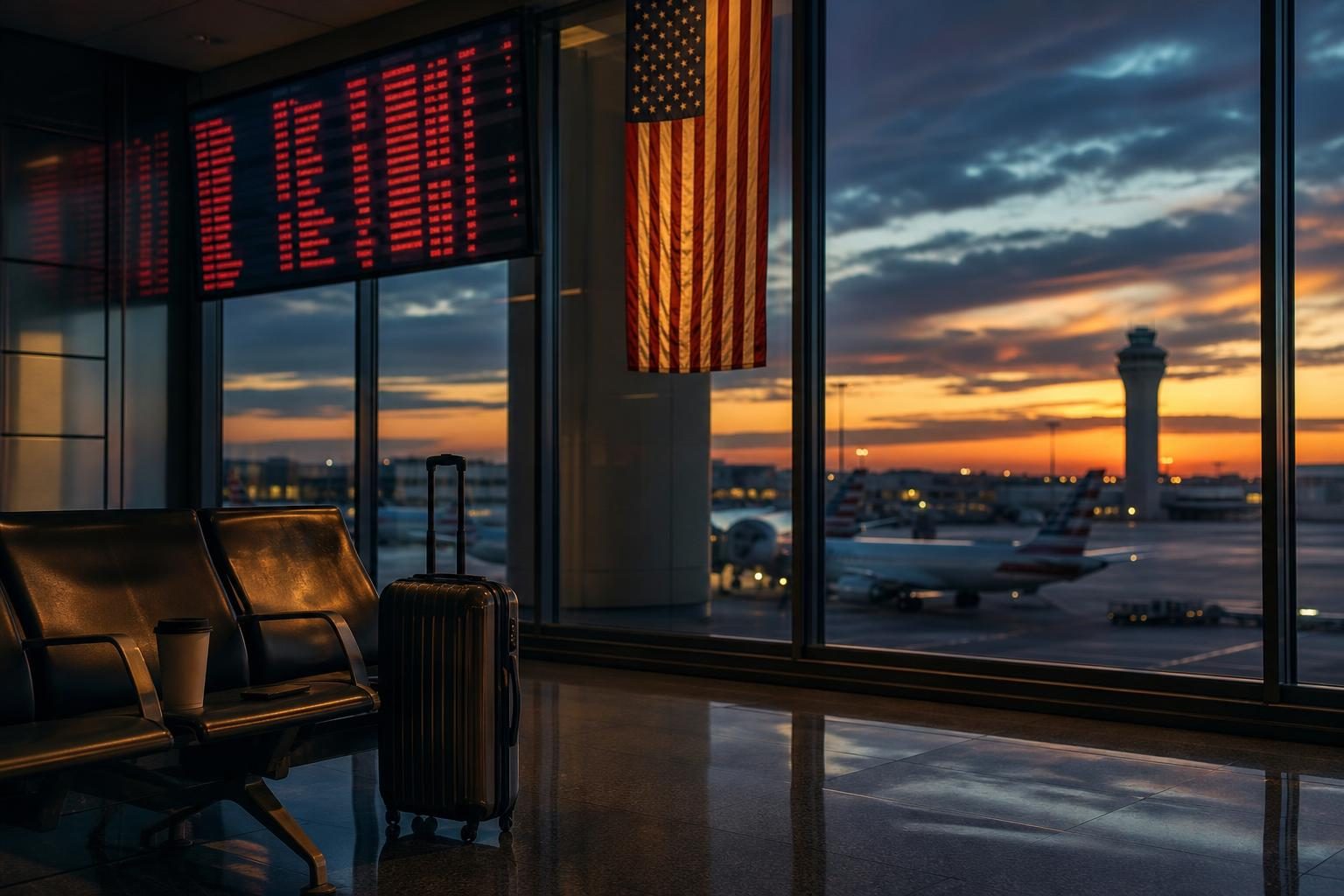
Last Friday's nationwide ground stop now comes with a price tag. The brokerage Bernstein estimates that the four largest U.S. airlines, American, Delta, United and Southwest, will give up about $345 million in combined pretax earnings to the shutdown and the days of disruption that followed it, Reuters reported Monday [1]. Bernstein put the likely range at roughly $270 million to $430 million [1].
The scale of the weekend explains the number. More than 18,500 flights within, into or out of the United States had been canceled as of Monday morning, according to a Reuters count based on FlightAware data [1]. Some carriers bounced back faster than others. Bank of America analysts said American canceled 22% of its Sunday schedule and JetBlue 28%, while Delta, United and Southwest each canceled 5% or less [1].
Transportation Secretary Sean Duffy put the wider damage to the economy higher still. He told CNBC on Monday that the cost of the disruptions would run into the billions of dollars, Reuters reported [2]. The good news is that the system has largely healed: Monday's cancellations fell to about 300, down from more than 2,300 on Sunday [2].
What Travelers Are Owed
Behind those numbers are travelers who missed reunions, business meetings and weekends at home. Federal rules give them at least one firm protection. Under the Transportation Department's automatic refund rule, when an airline cancels a flight and the passenger declines a rebooking or other alternative, the carrier owes a cash refund, due within seven business days for credit card purchases and 20 calendar days for other payment methods [6]. Airlines may not swap that refund for a voucher or travel credit unless the passenger chooses to accept one [6]. Anyone still waiting on money from the weekend should hold the airlines to that standard.
Duffy's Plea: No Money for a New Network
Duffy's message to Congress is that the real fix costs money he does not have. In a television interview, he warned that the Federal Aviation Administration still relies on technology from the 1980s and said, "I have no money for a new network," Breitbart reported [3]. On Monday he urged lawmakers to move quickly on billions of dollars to replace the aging telecommunications systems that carry air traffic data, according to Reuters [2]. The administration's request now stands at $50 billion, up from the $30 billion it sought before Friday [2].
Democrats have answered with a question that sounds reasonable: why ask for more when most of the last round has not been spent? They say the administration has spent only about $1 billion of the $12.5 billion Congress approved last year for air traffic control, and they want hearings into what caused the communications failure, Reuters reported [2]. Duffy's reply is that the $12.5 billion, approved in the One Big Beautiful Bill, came with specific instructions and cannot be used to build a new telecom architecture [2].
That distinction matters more than the talking points on either side. If Duffy is right that the money was fenced off for other uses, it cannot buy the network that buckled on Friday [2]. Taxpayers deserve a full accounting of every dollar already approved, and the administration should provide one. But the answer to decades-old equipment is not another year of argument while that same equipment keeps carrying the country's air traffic.
The Thanksgiving Crunch and What Congress Does Next
The timing could hardly be tighter. Thanksgiving is 10 days away, and millions of Americans are preparing to travel [5]. Experts cited by The New York Times said flight schedules should be back to normal before the holiday [5]. Even so, the weekend showed how thin the margin is when one failure on the network can strand travelers from coast to coast.
On Capitol Hill, Speaker Mike Johnson has said Congress will take up the request for up to $50 billion during the lame-duck session, folding it into a broader year-end package, Roll Call reported [4]. Democrats have signaled a fight over the extra $20 billion the administration added to its request after Friday [4].
The clock is political, too. Duffy and Republicans want action in the final weeks before the current Congress wraps up and Democrats take over in January, Reuters reported [2]. If the request slides into a divided government, the likeliest result is more delay, and more holidays spent on equipment that should have been replaced long ago.
Our view: Duffy is right that the air traffic system needs a new backbone, and Republicans are right to push for it now, before another holiday rush. The way to win the votes is to show the work, with a clear plan for every new dollar, a public account of the old ones and real accountability for the contractors who install the gear. Families flying home for Thanksgiving should not be one failed router away from a national shutdown.
Sources
- [1]Reuters (via Investing.com)Top four US airlines face $345 million hit from FAA ground stop, Bernstein estimatesOpens in a new tab ↗
- [2]Reuters (via Yahoo News)US transport chief urges Congress to quickly pass air traffic telecom fundingOpens in a new tab ↗
- [3]Opens in a new tab ↗
- [4]Opens in a new tab ↗
- [5]Opens in a new tab ↗
- [6]U.S. Department of TransportationWhat Airline Passengers Need to Know About DOT's Automatic Refund RuleOpens in a new tab ↗
Would you buy an electric vehicle?
- Yes
- Maybe a hybrid
- No
- Only if prices come way down
More in Autos & Transportation
California Pulls Waymo's Robotaxis Off Every State Freeway, Calling Them an 'Imminent Hazard' After Work-Zone and Police Incidents
Last night on Hollister Tonight with Jack Hollister
FAA Pulls the New Routers Tied to Friday's Ground Stop as Mullin Assures Americans the Week's Outages Were Not an Attack
Last night on Open Road with Frank Kowalski
United Airlines Hit by a Widespread System Outage as Planes Wait for Takeoff Data, Three Days After the Nationwide Ground Stop
Monday night on Open Road with Frank Kowalski
Were you there?
If you were at the scene, or this story touched your life, tell us what you saw and what it was like.
Discussion 0
Sign in or create a free account to join the discussion.
No comments yet. Start the discussion.