
 Last night on On Scene with Beau Thibodeaux
Four Years Underground, One Eruption Overhead: What Blew Out of Chiquita Canyon Landfill, and What Its Neighbors Are Owed
A drilling crew hit pressurized methane at the troubled Castaic landfill, sending trash skyward and six workers to hospitals; Los Angeles County has ordered the operator to pay for families to escape the fumes.
Filed November 17, 2026 · 📍 Los Angeles, CA 90012
Were you there? Share your story
Key points
- Drillers hit a pressurized methane pocket Monday at Chiquita Canyon Landfill; six workers had minor injuries.
- Los Angeles County declared a public health emergency and ordered the operator to fund hotel stays and air purifiers.
- A smoldering reaction has burned inside the landfill since about May 2022, according to the EPA.
- Federal and state orders require a bigger cover and an underground barrier to stop the reaction's spread.
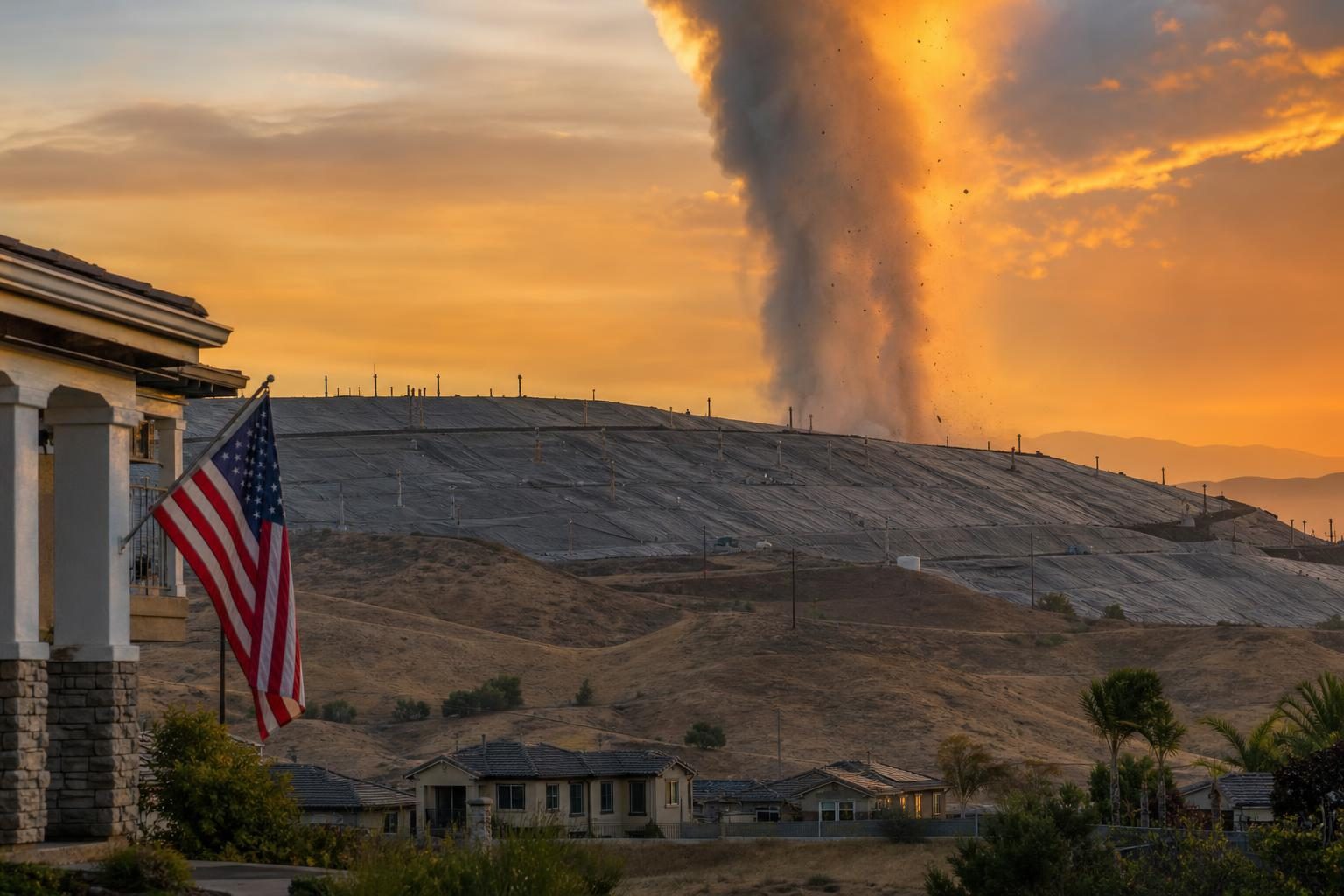
A drilling crew working on Monday at the Chiquita Canyon Landfill in Castaic, in northern Los Angeles County, punched into a pocket of pressurized methane, and the landfill blew a plume of gas and rotting trash into the sky. Six workers were taken to hospitals, and fire officials described their injuries as minor [1]. By Monday night, Los Angeles County health officials had declared a public health emergency and ordered the landfill's operator to pay for nearby families to get out of the smell [2].
The Independent reported the column of trash and gas reached about 500 feet [4]. For the neighborhoods that sit below the canyon, it was the most dramatic moment yet in a crisis that has been building underground for more than four years.
What Happened on Monday
Crews were drilling at the site when they struck the gas pocket, and material shot out of the opening, KTLA reported [1]. Early reports put the number of injured workers at four; the count later rose to six, all landfill employees who were taken to hospitals to be checked and treated for minor injuries [1].
In a directive issued late Monday, the county Department of Public Health said the release had caused noxious odors in Val Verde, Hasley Hills, Industry, Cambridge and Hillcrest, the communities closest to the landfill [2][3]. The county ordered the operator to provide temporary hotel stays, filtered-air refuge centers and air purifiers for affected residents, among other steps [2][3].
Fire officials said the drilling posed no health risk to the public, but Spectrum News found residents who did not feel reassured, and some said they were afraid to go back to their homes [3]. Los Angeles County Supervisor Kathryn Barger, who represents the area, condemned the eruption and the plume [1][3].
A Fire That Has Burned Beneath the Ground Since 2022
To understand Monday's eruption, you have to go back to the spring of 2022. Since about May of that year, the landfill has been gripped by what the Environmental Protection Agency calls a subsurface elevated temperature event, a reaction deep inside the buried waste that has grown in size and impact over time [5].
EPA says the exact cause is not known. The agency describes this kind of event as a reaction that may involve precombustion, smoldering or pyrolysis, the breakdown of material under intense heat, inside the mass of trash [5]. The reaction is also forcing out unusually large amounts of leachate, the contaminated liquid that collects in landfills, which has to be pumped out of the reaction area [5].
The size of the problem has been disputed. In April 2025, California's environmental protection agency said the reaction had grown to about 90 acres, more than three times larger than the 28 acres the landfill's operators had claimed [6].
Chiquita Canyon is a 639-acre landfill that opened in 1972 and stopped accepting new waste on January 1, 2025 [6]. The site is run by Chiquita Canyon LLC, a subsidiary of the waste company Waste Connections [5].
Years of Orders, and the Families Still Waiting
Regulators at every level have stepped in. In June 2024, EPA found the landfill in violation of the Clean Air Act and later issued an order requiring corrective work [5]. In July 2025, EPA required the operator to cover at least another 100 acres with a tougher, less permeable geomembrane, a heavy plastic liner meant to trap gases and keep rain out, and in March 2026 the agency sent two more letters demanding additional work under that order [5].
The state's Department of Toxic Substances Control issued its own imminent and substantial endangerment order in April 2025. It required the operator to move a tank farm that holds leachate, expand the protective cover over the entire main canyon of waste, build an underground barrier on the south side of the landfill to keep the reaction from spreading, and keep up monitoring and reporting [6]. CalEPA said at the time that residents of Val Verde and Castaic had suffered as the crisis worsened [6].
Even before that, regional air regulators had ordered the operator in September 2023 to investigate and control the odors and the spread of the reaction [5].
For the families nearby, though, orders on paper have not always meant relief at home. Monday's directive puts temporary housing and clean-air refuges back at the center of the response, paid for by the operator [2][3].
What Methane Is, and Why Drilling Matters
Methane is the main gas produced when buried food scraps, yard waste and paper break down without oxygen. It is invisible, it is flammable, and inside a landfill it can collect under pressure. Landfills drill wells to pull that gas out in a controlled way, either to burn it off or to use it for energy.
That work is part of the fix, and it carries risk. Monday's eruption happened during exactly that kind of drilling, when crews hit gas that was under more pressure than the opening could handle [1]. The trash that came out with it is what turned a gas release into a scene that looked to many residents like a geyser [2][4].
The odor that followed is what reached homes. The county's emergency directive was driven by those odors and the complaints from neighborhoods downwind [2][3]. The county's response, hotel rooms and filtered-air centers, is designed to get vulnerable people, especially children, the elderly and those with breathing problems, away from the fumes while the site is brought under control [2].
Who Answers for It
There is a basic principle at stake here that conservatives and liberals alike should be able to agree on: the company that runs a facility is responsible for the harm it causes its neighbors. That is not a new regulation; it is the old common-law idea of nuisance, and it is why the county's order puts the bill for hotel rooms and air purifiers on the operator rather than on taxpayers [2].
It is also fair to say that this crisis has been studied, ordered and litigated for years while families in Val Verde waited. Federal and state orders have piled up since 2023, and the reaction still had enough force on Monday to send six workers to the hospital [1][5][6]. Residents are entitled to ask whether the agencies involved have been moving with the urgency the situation demands.
None of this changes the most important fact about Monday: no one was seriously hurt [1]. The six workers who were checked out at hospitals were doing the hard, necessary job of bringing a dangerous site under control, and they deserve thanks along with answers about what went wrong.
What Comes Next
The county's public health order requires the operator to keep providing temporary housing, refuge centers and air filtration while the odors persist [2][3]. Investigators will want to know how the crew hit a pressurized pocket during drilling and whether the drilling plan needs to change before work resumes [1]. EPA's existing order, and the state's endangerment order, still require the operator to finish expanding the landfill's cover and to build the barrier meant to stop the reaction from spreading [5][6].
For residents, the practical advice is simple: follow county public health notices, take advantage of the hotel and refuge-center help the operator has been ordered to provide, and keep children and anyone with asthma or heart and lung problems indoors with windows closed when the odor is strong. For the companies and agencies responsible, the message from these neighborhoods is just as simple. Four years is long enough. Finish the job.
Sources
- [1]Opens in a new tab ↗
- [2]Opens in a new tab ↗
- [3]Opens in a new tab ↗
- [4]The IndependentGeyser of trash and methane spews 500 feet into the air at California landfill and sparks health concernsOpens in a new tab ↗
- [5]U.S. Environmental Protection AgencyChiquita Canyon Landfill, Castaic, CAOpens in a new tab ↗
- [6]Opens in a new tab ↗
Is America headed in the right direction?
- Right direction
- Wrong direction
- Mixed
- Too soon to tell after the midterms
More in U.S. News
Explosion and Fire Hit Clean Harbors Waste Incineration Plant Near Houston; One Hurt as Air Readings Show No Hazard
Overnight on Breaking Now with Nathan Brooks
Wyoming Gov.-Elect Barlow Taps Veteran Energy Lawyer and Lifelong Democrat Walter Eggers for Attorney General as Conservatives Urge Senate to Say No
Yesterday on Hollister Tonight with Jack Hollister

Nationwide Emergency Alert Test Hits TV and Radio Today at 2:20 p.m.: What Families Need to Know
Yesterday on On Scene with Beau Thibodeaux
Were you there?
If you were at the scene, or this story touched your life, tell us what you saw and what it was like.
Discussion 0
Sign in or create a free account to join the discussion.
No comments yet. Start the discussion.