
 Last night on The Sterling Report with Ava Sterling
Republicans Take the Lead on Nvidia Oversight: Chip-Export Curbs Gain Ground as Huang and Lutnick Are Called to Answer
Speaker Mike Johnson says a consensus is forming to limit China's access to advanced chips. GOP chairmen in both chambers want Jensen Huang before them soon, and Sen. Tim Scott wants Commerce Secretary Howard Lutnick too.
Filed November 12, 2026 · 📍 Lansing, MI 48933
Were you there? Share your story
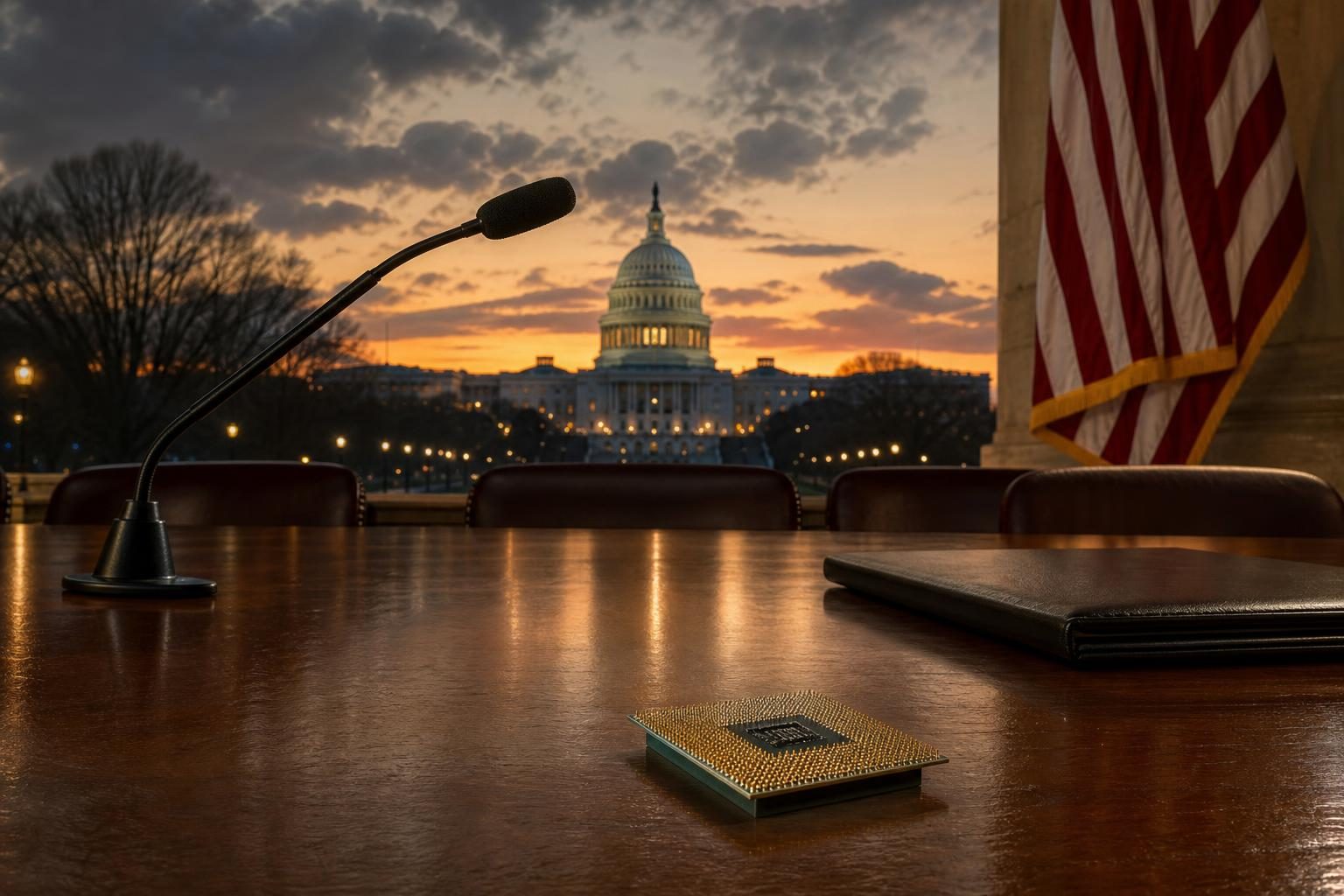
Part of our continuing coverage: Jensen Huang Steps Down at Nvidia as the Spy Scandal Ends a 33-Year Run; CFO Colette Kress Takes the Helm
Key points
- Speaker Johnson says a consensus is developing in Congress to limit China's access to advanced AI chips.
- At least four chip-export bills are in play, and Republicans want restrictions attached to the defense bill, Reuters reports.
- Former Nvidia CEO Jensen Huang has signaled he will appear before House committees, possibly before Thanksgiving.
- Senate Banking Chairman Tim Scott asked both Huang and Commerce Secretary Howard Lutnick to testify.
House and Senate Republicans are moving quickly to put guardrails around America's most valuable technology after the Nvidia spy scandal, and they are not waiting for the new Democratic Congress to do it.
Speaker Mike Johnson told reporters at the Capitol on Thursday that he favors limiting China's access to advanced chips and that support is building. "I think there's a developing consensus in Congress," Johnson said, according to Reuters [1]. At the same time, Republican committee chairmen in both chambers pressed former Nvidia chief executive Jensen Huang to appear soon, and one of them asked Commerce Secretary Howard Lutnick to answer questions as well [2][3].
The Scandal Behind the Push
Nvidia announced Thursday that Huang had stepped down, CBS News reported, after revelations about his relationship with Alice Huang, a former executive at Megaspeed [3]. Megaspeed is a Singapore-based data center company that gained access to highly prized chips banned from export to China and is under investigation in the United States and Singapore for allegedly smuggling them into China, according to CBS [3]. Reuters described Megaspeed as an Nvidia partner that U.S. officials suspect of helping China obtain restricted chips [1].
Beijing denies that Alice Huang is a spy [1][2]. Attorney General Todd Blanche said Thursday that the Justice Department has not reached a conclusion on that question, Reuters reported [2]. That caution matters. The facts are still coming in, and the right response is careful oversight, not a rush to judgment.
Four Bills on the Table
Lawmakers are pressing colleagues to pass at least four chip-export bills, according to Reuters [1]. The AI Overwatch Act would give Congress more power over exports of advanced AI chips. The Chip Security Act would require companies to track the location of advanced AI processors to prevent smuggling. The Match Act would pressure U.S. allies to restrict sales and servicing of advanced chipmaking equipment bound for China. The Remote Access Security Act would give the Commerce Department tools to stop Chinese firms from renting overseas data centers to reach Nvidia chips [1].
A Senate aide told Reuters that Republicans want the new export restrictions attached to the annual defense authorization bill [1], one of the few must-pass measures left before the current Congress ends. That would put the chip curbs on the fastest track available in the lame-duck session.
Each of those bills targets a real gap. Export rules mean little if chips can be smuggled through third countries, rented remotely through foreign data centers or built with equipment sold by allies. The Megaspeed allegations, if proven, show exactly how those gaps can be exploited [3].
Huang Is Coming to the Hill
Rep. John Moolenaar of Michigan, who chairs the House Select Committee on China, said negotiations over a date are underway. "Our goal is to get him in as soon as possible," Moolenaar said, according to CBS [3]. He said Huang's resignation changes the dynamic and warned that if Huang does not appear, all three committee chairmen involved are prepared to use their subpoena power [3].
Moolenaar, House Foreign Affairs Chairman Brian Mast of Florida and House Intelligence Chairman Rick Crawford of Arkansas sent Huang a letter Nov. 4 asking him to brief them on security protocols against foreign espionage and his interactions with a publicly reported Chinese intelligence asset, CBS reported [3]. Mast told reporters Thursday that committee staff had spoken with Nvidia the night before about a date and location [1][2]. Just the News reported that Huang agreed to brief the lawmakers, citing Mast [4], and Bloomberg reported that Huang agreed to testify soon [5]. CBS described the talks as still being negotiated, with no date set [3]. Reuters reported he is expected to appear before Thanksgiving [1].
The appearance is expected to be a closed-door briefing for the three House committees, according to CBS [3]. The Nov. 4 letter had set a deadline of Wednesday, and Mast and Moolenaar said Thursday that they had received a response [3]. Closed-door sessions are standard when lawmakers expect to discuss classified intelligence, and a briefing does not rule out a public hearing later.
The Senate Wants Answers From Lutnick Too
In the Senate, Banking Committee Chairman Tim Scott of South Carolina sent letters Thursday asking both Huang and Lutnick to testify, and said he would consider subpoenaing Huang if he does not come voluntarily, according to Reuters [2]. "The American people deserve answers," Scott said [2].
Lawmakers, including Scott, have criticized Lutnick over the administration's refusal to add dozens of Chinese companies to a key U.S. trade blacklist, and they are questioning whether the government properly oversaw Nvidia's exports to China, Reuters reported [1][2]. The Financial Times reported that legislators want Lutnick to explain why chip sales were allowed to a company linked to the alleged spy [6]. Two people familiar with the matter told Reuters that senior White House officials have discussed whether Lutnick should be pushed out [1][2], though no one has said so on the record. Spokespeople for Huang and Lutnick could not immediately be reached for comment [2]. Lutnick deserves the chance to answer before anyone writes his political obituary, and a hearing is the right place for him to do it.
Senate Majority Leader John Thune said he expects interest in oversight and that testimony from Huang would make sense, CBS reported, and Sen. Kevin Cramer of North Dakota said he would support a subpoena [3]. Senate Democratic leader Chuck Schumer said Congress must demand answers from Huang and Nvidia and that the administration must explain its actions after learning of the relationship [3].
Where the President Stands
President Trump, a friend of Huang, has defended him, saying he has done a fantastic job, according to CBS [3]. After Huang stepped down, Trump suggested Apple's Tim Cook as the man to replace him [3].
There is no contradiction between admiring what Huang built and insisting on answers about how secrets and chips may have leaked. Nvidia's chips are the backbone of America's lead in artificial intelligence. Protecting that lead is a national security priority, and Republicans in Congress are treating it like one.
Why It Matters to Our Readers
For years, conservatives have warned that the Chinese Communist Party treats American technology as a prize to be taken by any means: theft, smuggling, front companies and influence. This scandal, whatever the final facts show, is a test of whether Washington has learned that lesson. It also shows that oversight is not only a Democratic tool. Republican chairmen are the ones issuing letters, setting deadlines and talking about subpoenas [2][3].
Getting the policy right means closing smuggling routes, tightening oversight of remote access and keeping allies in step, without punishing American companies that play by the rules. The four bills now circulating are a serious start [1]. Moving them before the current Congress ends would also show that Republicans can deliver results, not just hearings, in the final weeks of their majority.
What Comes Next
Watch three things. First, whether the chip curbs ride on the defense authorization bill before the year ends [1]. Second, the date and format of Huang's appearance, which lawmakers want before Thanksgiving [1][3]. Third, whether Lutnick accepts Scott's invitation, and whether the White House stands by him [2]. The answers will tell Americans how seriously Washington takes the race with Beijing.
Sources
- [1]Reuters via Yahoo NewsChina's access to Nvidia chips in doubt as curbs gain traction in US CongressOpens in a new tab ↗
- [2]Reuters via Yahoo NewsUS Senate Banking Committee chair calls on Jensen Huang, Lutnick to testifyOpens in a new tab ↗
- [3]Opens in a new tab ↗
- [4]Just the NewsHuang, Nvidia CEO who resigned, agrees to brief Congress on relationship with alleged spy: lawmakerOpens in a new tab ↗
- [5]Opens in a new tab ↗
- [6]Opens in a new tab ↗
With Democrats taking Congress, what should Republicans focus on first?
- Blocking bad bills
- Working on prices and costs
- Winning back the House in 2028
- Confirming judges before January
More in Politics
Stephen Miller's First Week as Chief of Staff: A Freer Cabinet, Fewer CEO Favors and a West Wing Built to Fight
Last night on The Briefing Room with Claire Donovan

Holscher Edges Masterson by Less Than a Point to Win Kansas Governor's Race; Masterson Calls to Congratulate Her
Last night on Hollister Tonight with Jack Hollister
Trump Backs Tim Cook to Run Nvidia: 'A Legend Replaces a Legend'
Yesterday on Free Speech Frontline with Ryan Mercer
Were you there?
If you were at the scene, or this story touched your life, tell us what you saw and what it was like.
Discussion 0
Sign in or create a free account to join the discussion.
No comments yet. Start the discussion.