World News
Putin Vows a 'Far More Painful' Answer, Rules Out Cease-Fire Talks After Third Kerch Bridge Strike
Speaking in Shenzhen after meeting Trump and Xi, Putin said Russia will not negotiate partial truces with Ukraine after three strikes in four days on the bridge to Crimea.
By DAN WHITAKERStaff Correspondent · WASHINGTON · Nov 19, 2:15 PM · 3 min. read
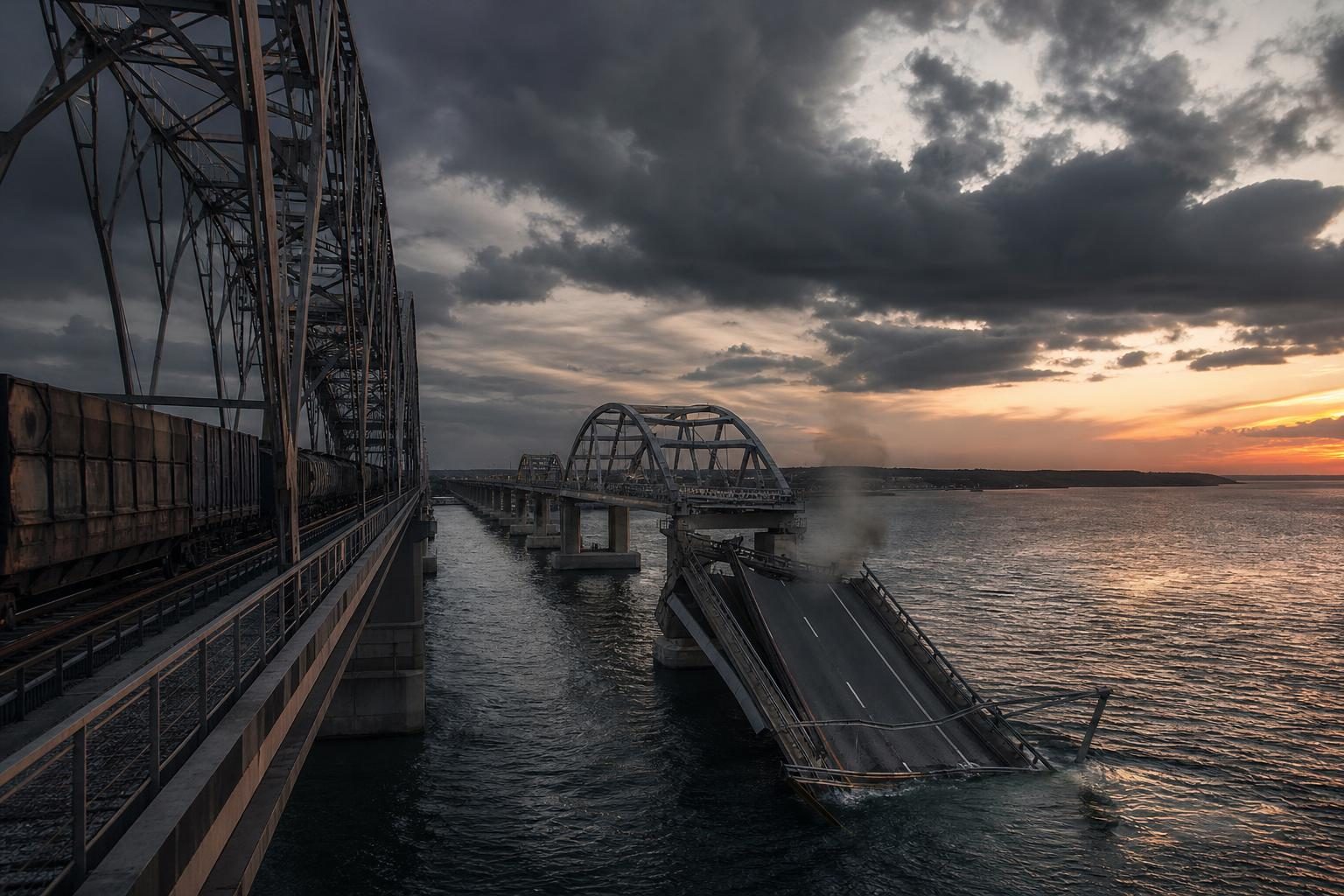
Illustration · Liberty Bell Report
Russian President Vladimir Putin said Thursday that Moscow will not negotiate even limited cease-fires with Ukraine after Kyiv's repeated strikes on the Kerch Bridge to Crimea, and he warned that Russia's answer will be "far more painful" than the damage Ukraine has done, according to the Associated Press report carried by Fox News.
Putin made the remarks at a news conference in Shenzhen, China, where he had just met with President Donald Trump and Chinese President Xi Jinping on the sidelines of the Asia-Pacific Economic Cooperation summit. His comments came hours after what the AP described as the third Ukrainian strike on the bridge in four days, an attack that halted train traffic across the crossing.
A Reversal on Partial Truces
Putin told reporters he had recently discussed with members of Russia's Security Council whether Moscow could reach arrangements to stop attacks on maritime traffic and energy infrastructure, and that he had asked them to weigh whether a deal was possible, the Kyiv Independent reported. The strikes on the bridge, he said, changed that position. The outlet's headline summed up his message in four words: "We will not negotiate".
CBS News reported that the options Putin had been weighing included a pause in attacks on Black Sea shipping and a halt to strikes on energy facilities, and that he now says those ideas are off the table. He said Russia would respond to the attacks.
Putin also claimed he had personally ordered that the bridge not be used to carry military equipment or ammunition, and said Russia does not even send oil or fuel products across it, according to the Kyiv Independent. He acknowledged that the road section suffered serious damage and said it will be rebuilt.
Kyiv tells a very different story. Ukraine's General Staff has described the bridge as the main artery for moving fuel, ammunition, military equipment and personnel into Crimea and on into southern Ukraine, and argued that every hour it stays out of service leaves Russian forces in the south with less of what they need to fight, Ukrinform reported.
Three Strikes in Four Days
The latest attack came overnight into Thursday and hit the railway portion of the crossing. Russian officials described it as a drone attack, and the AP reported that Ukrainian officials did not immediately comment. Sergei Aksyonov, the Moscow-installed head of Crimea, said train service would be restored beginning around 4 p.m. local time Thursday.
That strike followed attacks on Nov. 16 and Nov. 17 that shut down the road section of the bridge. After the Nov. 17 attack, Ukraine's General Staff said an arch and a span of the roadway had collapsed, while the rail section, though damaged, was still standing, according to Ukrinform. Ukrainian military officials described the operation as the end of a step-by-step campaign that first wore down Russian air defenses, electronic warfare systems and radar protecting the crossing.
The bridge is the only one linking Russia's mainland to the peninsula Moscow seized in 2014, and it has long been prized by the Kremlin as a symbol of that claim. It has been a recurring Ukrainian target during the war.
What It Means for Trump's Peace Push
The timing is awkward for the White House. The Shenzhen meeting of the three leaders ended with a four-point "peace declaration" focused on United Nations reform, fuel supplies and reducing nuclear risks, but Euronews reported that the document made no mention of the war in Ukraine. Before the three-way session, Trump said the United States and China want to help bring that war to an end.
Putin's refusal to discuss narrow truces on energy and shipping, which he says he had been weighing only recently, removes the kind of smaller, confidence-building steps that could have opened a path toward wider talks. It also raises the prospect of a new round of Russian retaliation at a moment when American diplomats are trying to keep both sides talking.
For U.S. military planners, the strikes show that Ukraine can still reach well behind Russian lines and hit high-value logistics targets. Whether those strikes strengthen Kyiv's hand at the bargaining table or simply harden Moscow's position is the question now hanging over Washington's peace effort.
What comes next is unclear. Putin did not spell out what form his promised response might take, and rail service across the bridge was expected to resume Thursday afternoon even as repairs to the roadway continue. For Ukrainians and Russians weary of years of full-scale war, and for the many Americans praying for a just and lasting peace, the words of Jesus in Matthew 5:9 still hold: "Blessed are the peacemakers."
Sources
- Fox News: Russia's Putin vows a response 'far more painful' after Ukraine attacks prized bridge in Crimea (link)
- CBS News: Putin says Russia won't negotiate limited ceasefire with Ukraine after bridge strike (link)
- Kyiv Independent: 'We will not negotiate' — Putin addresses Ukraine's strikes on Crimean Bridge (link)
- U.S. News & World Report (AP): A Third Ukrainian Strike in 4 Days Halts Rail Traffic on Russia's Kerch Bridge to Crimea (link)
- Ukrinform: Arch and road span collapse: General Staff confirms results of strike on Kerch Bridge (link)
- Euronews: Trilateral summit ends with 'peace declaration' but no mention of Ukraine and Iran (link)
— 30 —