World News
Follow the Oil: Iraq Fires Nine Officials Over Smuggling in a Militia Stronghold, but Baghdad Still Won't Name Kataib Hezbollah
Prime Minister Ali al-Zaidi sent suspects to court after investigators found illegal refineries and a tapped state pipeline in Jurf al-Sakhar, the closed enclave run by an Iran-backed militia that has attacked American targets. The hard part starts now.
By KEVIN NAKAMURAStaff Correspondent · WASHINGTON · Nov 15, 2:03 AM · 5 min. read
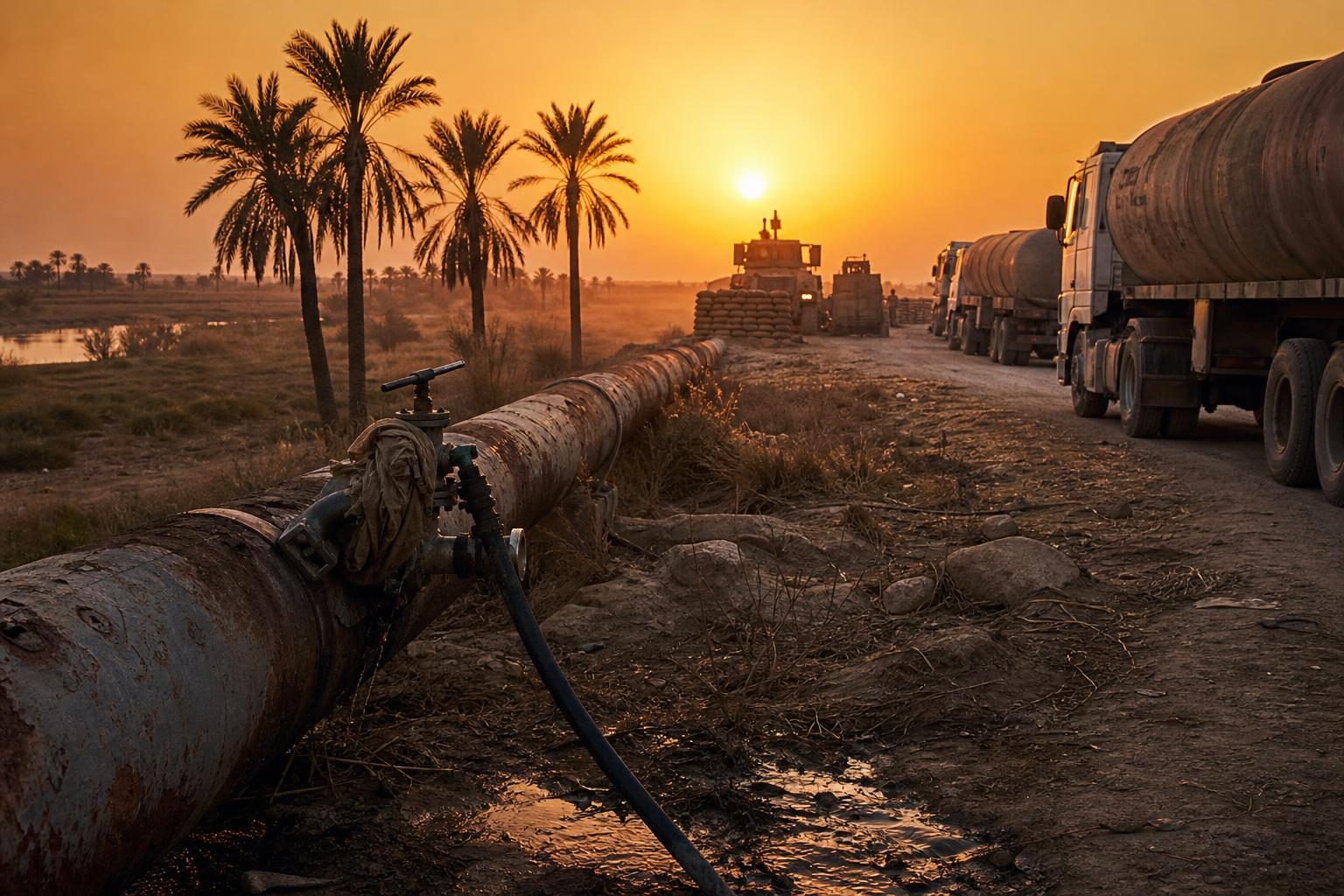
Illustration · Liberty Bell Report
Iraq's prime minister has fired nine officials and ordered suspects sent to court after an investigation into oil smuggling in Jurf al-Sakhar, a farming district south of Baghdad that serves as a stronghold of the Iran-backed militia Kataib Hezbollah. Al Jazeera reported that the dismissals followed a probe that uncovered illegal oil refineries and smuggling in the area.
For an enclave whose controllers turned away the government's first team of investigators, Saturday's announcement by Prime Minister Ali al-Zaidi was a striking step. But the official statement left the biggest question unanswered. It did not mention Kataib Hezbollah or say who ran the smuggling, Arab News reported. That silence says as much about the limits of the Iraqi state as the firings do, and it is where American taxpayers, who have poured blood and treasure into Iraq, should keep their eyes.
What the Investigators Found
The case began with an intelligence report from Iraq's Interior Ministry describing smuggling sites in the sprawling agricultural area, The National reported. That report said the sites were under the control and protection of "an armed faction" without naming it, and al-Zaidi ordered a committee to investigate.
On Saturday, military spokesman Sabah al-Numan said the inquiry had confirmed intelligence pointing to illegal oil smuggling, the presence of refineries and other irregularities in the area, according to Arab News. Investigators found that oil was being drawn from a pipeline in Jurf al-Sakhar through an unauthorized opening and carried away in tanker trucks, the report said.
Anyone who has followed public money for long knows what that description means. A tap on a state pipeline is not a clerical error, and a steady stream of tanker trucks does not go unnoticed for long. An operation like that needs roads, buyers, protection, and officials willing to look the other way.
According to Arab News, the nine dismissed officials include security and intelligence officers in Babil province, a commander at the Interior Ministry, and the director of the Oil Pipelines Company at the Oil Ministry. Al-Numan said everyone accused of taking part in the smuggling would be referred to the judiciary.
The makeup of that list is telling. A pipeline company director does not lose his job over a problem that is not happening on his pipes, and provincial security chiefs do not get fired over checkpoints that were doing their work. The firings are, in effect, an admission by Baghdad that the theft ran through the state's own chain of command, not just around it.
What the list does not include is just as important. No militia commander has been publicly named. No figure has been released for how much oil was taken or where the money went. And no one has explained how long the tap had been open.
How the Investigators Got In
Simply getting investigators through the gate was a negotiation. Kataib Hezbollah refused to let the first committee into Jurf al-Sakhar, 964media reported, and al-Zaidi then arranged the committee's entry under a new formula, with a security official from the Popular Mobilization Forces taking over the inquiry. When the committee finally entered on Friday, it was accompanied by members of Kataib Hezbollah, the outlet reported.
An investigation escorted by the people under suspicion is not the same as an independent one. Still, the committee did get in, and within a day officials were out of work. The Jerusalem Post reported that Iraq sent troops to the area over the weekend and described the probe as a potential turning point in Baghdad's struggle to assert its authority over Iran-backed militias.
Whether that turning point is real will depend on what those troops are allowed to do, and whether they stay.
A District Its Own People Cannot Go Home To
Jurf al-Sakhar's story is bound up with the war against the Islamic State. After the jihadists were driven out in 2014, tens of thousands of Sunni residents were displaced from the area, The Jerusalem Post noted. Today, as the fight over the committee's access showed, it is the militia rather than the government that decides who comes and goes.
There is a human cost behind the oil numbers. Tens of thousands of residents were displaced from this district, and the land they left behind is where, by the account of Iraq's own investigators, illegal refineries were operating. Any serious reform in Jurf al-Sakhar has to measure success not only in barrels recovered but in families allowed to go home.
Why It Matters to Americans
Kataib Hezbollah is not a local gang. It sits inside the network of militias Iran has built across the region, and it has been in the line of fire during this year's war. The Long War Journal reported in March that airstrikes, likely carried out by the United States as part of the U.S.-Israeli campaign against Iran and its proxies, were continuing to hit Iran-backed militias in Iraq. The group announced that its spokesman and senior commander, Abu Ali al-Askari, had been killed, and its new spokesman then declared a conditional pause in attacks on the U.S. Embassy in Baghdad, the outlet reported.
A militia that has aimed its weapons at Americans and can tap a state pipeline at will is not just stealing from Iraqi taxpayers. Stolen oil is money, and money buys drones, rockets and loyalty. Cutting off that revenue is one of the most practical things Baghdad can do to protect its own sovereignty and the Americans who still serve in the region.
It also tests a principle conservatives have long argued: a state that cannot control its own territory cannot be a reliable partner. Iraq's leaders have now said, in effect, that crimes were committed inside a militia enclave by people working with or around state officials. The next question is whether the state can act on that finding without asking the militia's permission.
The Questions Baghdad Still Has to Answer
Who ran the operation? Neither the Interior Ministry's intelligence report nor Saturday's statement named the faction responsible.
Where did the oil go, and who bought it? None of the public accounts so far say where the tanker trucks delivered their loads or who paid for them.
Will the courts follow through? A referral to the judiciary is a beginning, not a verdict. Iraqis will be watching whether any case reaches a courtroom and whether any defendant is more senior than a provincial officer.
Will investigators get independent access? A committee that enters with militia escorts can only see what it is shown.
Will the displaced be allowed home? Troops in the district are a test of state authority; the return of its residents would be the proof.
What Comes Next
The coming weeks will show whether al-Zaidi's move was the start of a real crackdown or a carefully limited housecleaning that punished officials while leaving the militia untouched. Watch the courts, watch where the troops are posted, and watch how Kataib Hezbollah responds. A militia that has spent years treating Jurf al-Sakhar as its own will not give up a lucrative business quietly, and any sign that the troops have pulled back or the cases have stalled would tell Iraqis exactly who still holds the keys to the district.
For Americans, the measure is simple. Every barrel kept in a state pipeline and every dollar kept out of a militia's hands makes the region a little safer for the troops and diplomats who still serve there. Baghdad has followed the oil this far. The country, and its friends, need it to keep following it all the way to the people at the top.
Sources
- Al Jazeera: Iraq PM sacks nine officials over oil smuggling in pro-Iran stronghold (link)
- Arab News: Iraq PM sacks officials over oil smuggling in pro-Iran group bastion (link)
- The National: Iraqi PM orders inquiry into oil product smuggling in area controlled by Iran-backed militia (link)
- 964media: Iraqi PM let PMF official lead Jurf al-Sakhar probe after deal, sources say (link)
- The Jerusalem Post: Iraqi troops deploy to Jurf Al-Sakhar amid oil smuggling probe (link)
- FDD's Long War Journal: Strikes continue hitting Iran-backed Iraqi militias, Kataib Hezbollah declares temporary US embassy ceasefire (link)
— 30 —