Technology
No Link to the Ground Stop, Officials Say, but the FAA's New SMART Tool Still Faces Hard Questions Before Thanksgiving
The FAA rolled out its AI traffic-planning tool nationwide three days before Friday's shutdown. The administration and the builder say it played no role. Here is what the tool does, what lawmakers want to know and what it means for holiday flyers.
By RYAN MERCERStaff Correspondent · WASHINGTON · Nov 16, 11:31 AM · 3 min. read
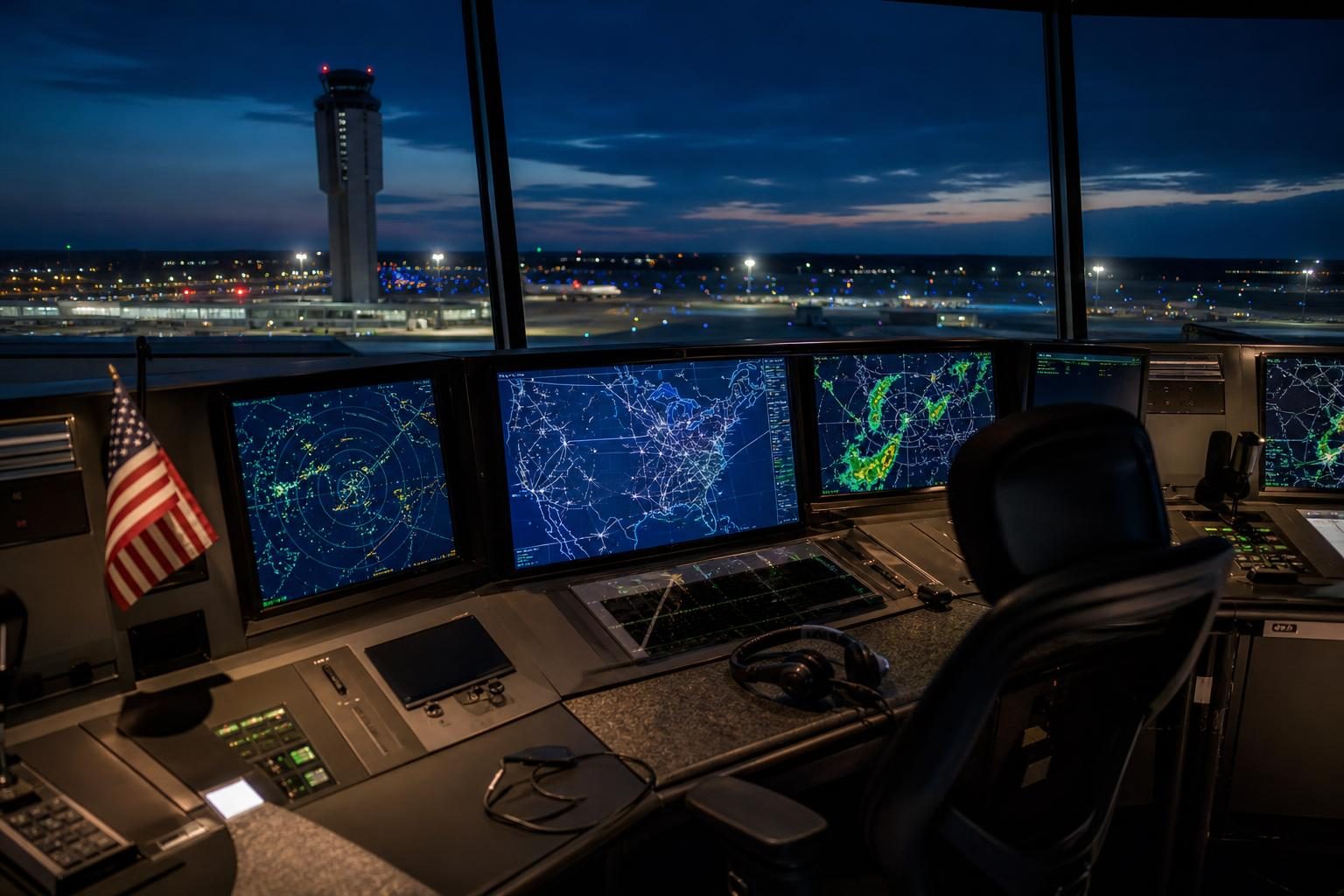
Illustration · Liberty Bell Report
Three days before Friday's nationwide ground stop, the Federal Aviation Administration switched on a new artificial intelligence planning tool across every one of its 22 en route air traffic control centers. The timing set off a wave of questions about whether the two were connected. The answer from the Trump administration, the FAA and the company that built the tool has been consistent: they were not.
Homeland Security Secretary Markwayne Mullin, asked at the White House on Friday whether SMART could have played a role, said officials were looking at it, but he also said there was no indication the communications problems behind the stoppage were tied to the new system. Transportation and FAA leaders repeated that the next day. Transportation Secretary Sean Duffy has said the tool is not connected to the agency's core radar and flight-tracking systems and could not have caused the outage.
What SMART is, and what it is not
The tool is called SMART, short for Strategic Management of Airspace, Routes and Trajectories. It was built by Air Space Intelligence under a 12-year contract worth about $875 million. SMART pulls together roughly 200 streams of data, including weather, flight paths, traffic flow and controller staffing, to spot congestion before it happens and plan hours, days or even weeks ahead.
Its job is to recommend, not to fly airplanes. SMART does not direct aircraft or feed information into the operational air traffic control system. It is not connected to STARS or ERAM, the systems controllers use to track and separate flights, and FAA specialists review every recommendation before local facility leaders decide whether to accept or decline it. The agency says the tool cannot replace air traffic controllers or take control of an aircraft.
SMART first went into use in the Washington area in September before the Nov. 10 nationwide expansion. The FAA says it has already helped reroute 180 flights, saving an average of about 10 minutes and almost 80 gallons of fuel per flight, though those figures come from the agency itself and the data so far are limited.
Air Space Intelligence has flatly denied any role in Friday's disruption, saying the ground stop was not caused by SMART, any of its products or its integration with the FAA.
What officials say did happen
Duffy has pinned the outage on old hardware. He said the agency's switches and routers were overloaded with data and began producing inconsistent information, which led the FAA to halt departures. According to TechRepublic, the FAA said its aging telecommunications network became unstable after receiving roughly 1,000 connection attempts every four to five seconds. The precise cause is still under investigation.
That account fits a pattern that has been visible for years: much of the equipment that keeps America's skies moving is decades old, and Duffy has asked Congress for $50 billion to modernize it.
What critics and lawmakers want answered
The questions about SMART did not begin on Friday. Lawmakers raised concerns before the outage, and some urged the FAA to pause the rollout for further evaluation. Last month, House Democrats asked the Government Accountability Office to audit the software, citing concerns about safety and guardrails and warning that front-line aviation safety workers appeared to have had little to no input into its development.
Those are fair questions, and they deserve straight answers. When the government hands a private company a contract this large to help manage the busiest airspace in the world, taxpayers and travelers are entitled to know how the tool was tested, how controllers were trained on it and who is accountable if a recommendation goes wrong. The FAA's Nov. 10 announcement did not address the lawmakers' questions about testing and training.
But fair questions are not the same as evidence. So far, every official who has spoken on the record, along with the company itself, says SMART had nothing to do with Friday's breakdown, and no one has produced facts showing otherwise. Blaming the newest piece of technology is tempting. The better lesson from Friday is that the oldest pieces of the system are the ones failing.
What it means for Thanksgiving travelers
For families flying next week, the practical news is reassuring. AAA expects nearly 6 million people to fly over the holiday, and the auto club said it does not expect Friday's unusually long ground stop to have a major effect on Thanksgiving travel unless it happens again. Duffy and FAA Administrator Bryan Bedford have said they expect air traffic to be back to normal well before the holiday rush begins.
If SMART works as promised, it should help planners route flights around storms and bottlenecks on the busiest travel days of the year. If it does not, Congress has every reason to keep asking, and the FAA has every reason to answer in public.
Travelers should still check their flight status before heading to the airport, sign up for airline alerts and leave extra time.
Sources
- ABC7 San Francisco: Questions swirl around FAA's new SMART AI system, though officials say no link to ground stop (link)
- The Washington Times: Duffy says FAA's new AI air traffic tool played no role in nationwide ground stop (link)
- The Hill: AI company behind FAA's SMART tool denies link to ground stop, Duffy confirms (link)
- TechRepublic: FAA Says Its New AI Didn't Ground US Flights, So What Does SMART Actually Control? (link)
- AVweb: FAA Expands AI-Assisted Traffic Management Nationwide (link)
- ABC7 San Francisco: AAA forecasts another busy, but not quite as busy, Thanksgiving travel week (link)
— 30 —